
Common Black Hawk vs Harris's Hawk
Buteogallus anthracinus versus Parabuteo unicinctus
Play a quiz with Common Black Hawk and Harris's Hawk
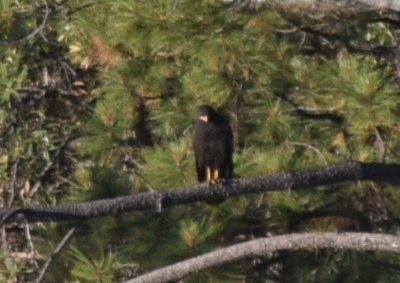 Common Black Hawk
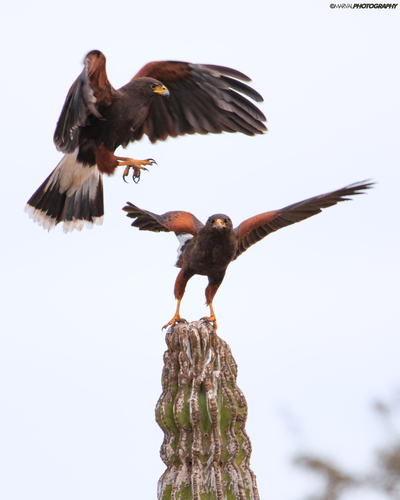 Harris's Hawk
In short
The most reliable field mark to separate Common Black Hawk from Harris's Hawk, especially in flight, is the tail pattern: Common Black Hawk shows a single broad white band and a white tip on a short black tail, while Harris's Hawk has both a white base and a broad white tip to the tail. Juvenile plumages are also distinct—juvenile Common Black Hawks are blotchy and streaked below with multiple tail bands, while juvenile Harris's Hawks are much paler below and show a pale panel on the outer wing. Structurally, Common Black Hawk is bulkier with broader wings and a shorter tail. Both species are mostly dark, but Harris's Hawk has chestnut shoulders and thighs, which are absent in Common Black Hawk. Use tail pattern and wing shape as your first checks, especially for immatures or birds in flight.
Identification tips
- Tail pattern in flight (all ages): Common Black Hawk has a single broad white band and a white tip on a short black tail. Harris's Hawk always shows both a white base and a broad white tip to the tail, with the dark area sandwiched between—this is the most consistent separation at any age.
- Juvenile underwing and body (in flight): Juvenile Harris's Hawk shows a pale, buffy underwing with a distinct pale panel on the outer wing (whitish primaries with dark tips), and is much paler below with heavy streaking. Juvenile Common Black Hawk is darker overall, with buff to whitish underparts blotched with dark, and lacks the pale wing panel.
- Chestnut/rufous tones: Harris's Hawk (all ages, but especially adults) has rich chestnut on the shoulders and thighs, visible both perched and in flight. Common Black Hawk never shows rufous or chestnut.
- Wing shape and flight style: Common Black Hawk has broader, paddle-shaped wings and a shorter tail, giving a heavy, almost eagle-like look in flight. Harris's Hawk has longer, narrower wings and a longer tail, appearing more agile and buoyant.
- Perched jizz: Perched Common Black Hawk looks bulkier and more hunched, with a short tail and broad body. Harris's Hawk is slimmer, longer-tailed, and often perches upright.
- Adult plumage: Adult Common Black Hawk is uniformly blackish or dark gray with yellow legs and cere, and a single white tail band. Adult Harris's Hawk is dark brown to blackish with chestnut shoulders/thighs and a white-based, white-tipped tail.
- Immature tail pattern: Juvenile Common Black Hawk has multiple black and white tail bands; juvenile Harris's Hawk has a paler tail band but always with both white base and tip.
- Leg color: Both species have yellow legs, so this is not diagnostic.
- Habitat context: If the bird is near water or in riparian forest, lean toward Common Black Hawk. In dry, open, or desert habitats, Harris's Hawk is far more likely.
- Group behavior: Multiple large hawks perched or hunting together strongly suggests Harris's Hawk, as Common Black Hawk is rarely social.
- Range overlap: Be aware that both species can occur in the southwestern US and northern South America, so use field marks rather than range alone.
- Bill and cere: Both have black bills and yellow ceres; not a useful separation.
- Vocalization: No diagnostic differences provided in the notes; do not rely on voice for separation.
- Sex differences: Both species are sexually similar in plumage; size difference is not reliably field-separable.
- Pitfall—dark morph confusion: Zone-tailed Hawk is similar to Common Black Hawk, but Harris's Hawk is not likely to be confused with Zone-tailed due to its chestnut and tail pattern.
Size
Common Black Hawk is the heavier and bulkier of the two, averaging about 996 g compared to Harris's Hawk at 844 g. In the field, Common Black Hawk appears more robust with broader wings and a noticeably shorter tail, contributing to a stockier impression. Harris's Hawk, while still a large raptor, is slimmer, with a longer tail and proportionately longer wings. These differences are most apparent when the birds are soaring or perched in good light, but can be subtle at a distance.
Plumage
Juvenile and immature birds are often confused, but show key differences:
- Juvenile Common Black Hawks are dark brown above with spotting and streaks, buff to whitish below with dark blotches, and have a tail with several black and white bars. In flight, the upperparts are generally dark, and the tail pattern is banded but not as striking as the adult's single white band.
- Juvenile Harris's Hawks are much paler below, heavily streaked with white or buff, and in flight show a distinctive pale panel on the outer wing formed by whitish primary feathers with dark tips. Their tail band is paler than adults, but always shows both a white base and a white tip.
- Adult Common Black Hawks are uniformly blackish or dark gray with a single broad white tail band and white tip, yellow legs and cere, and lack any rufous or chestnut tones.
- Adult Harris's Hawks are dark brown to blackish with rich chestnut shoulders and thighs, and a tail with both a white base and a broad white tip. The underwing of adult Harris's Hawk is dark (in North American birds) or patterned and lighter (in South American birds), but never as plain as Common Black Hawk.
- Both species have yellow legs, but only Harris's Hawk has obvious rufous on the body.
Behaviour
Harris's Hawk is famous for its social behavior, often hunting and nesting in groups of up to three adults, sometimes seen perched together or flying in loose formation. Common Black Hawk is more solitary or seen in pairs, rarely in groups. In flight, Common Black Hawk soars with very broad, paddle-shaped wings and a short tail, giving a heavy, almost eagle-like impression. Harris's Hawk is more agile, with a longer tail and more buoyant, active flight. Perched, Harris's Hawk often sits upright and alert, while Common Black Hawk appears bulkier and more hunched.
Habitat
Common Black Hawk is strongly associated with riparian habitats—rivers, streams, mangroves, or wetlands—often seen perched near water. Harris's Hawk prefers arid or semi-arid open country, including desert scrub, savanna, and sometimes agricultural land, and is rarely found near water. If you see a dark hawk in a wet, forested area, Common Black Hawk is more likely; in dry, open country, especially with cacti or scattered trees, Harris's Hawk is the default.