Birdr

Common Crossbill vs Two-barred Crossbill

Loxia curvirostra versus Loxia leucoptera

Play a quiz with Common Crossbill and Two-barred Crossbill
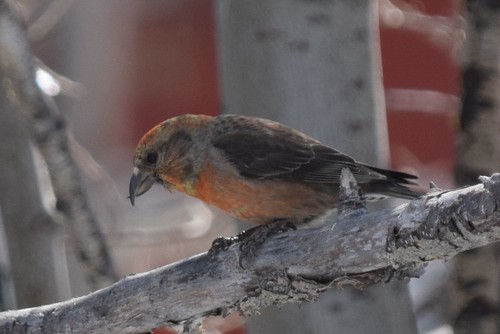
Common Crossbill (Loxia curvirostra) Common Crossbill
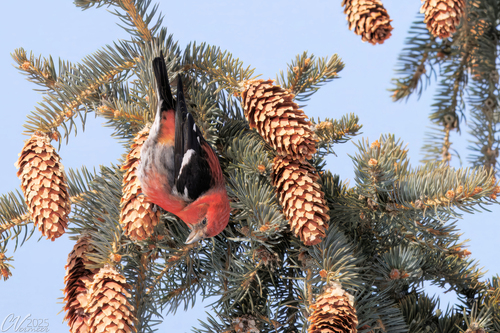
Two-barred Crossbill (Loxia leucoptera) Two-barred Crossbill

Media

Loading…

In short

The Two-barred Crossbill (Loxia leucoptera) is best distinguished from the Common Crossbill (Loxia curvirostra) by its prominent white wing bars, which are absent in the Common Crossbill. Both species have similar body shapes and are specialized for extracting seeds from conifer cones, but their vocalizations and preferred habitats can differ.

Identification tips

  1. Look for white wing bars on the Two-barred Crossbill. 2. Listen for the metallic, higher-pitched call of the Two-barred Crossbill. 3. Consider habitat: the Two-barred Crossbill is more associated with boreal forests. 4. Note that both species can appear similar in size and shape, so focus on wing bars and calls for reliable identification.

Size

Both species are similar in size, with robust bodies and strong bills adapted for conifer seed extraction.

Plumage

The Two-barred Crossbill has distinctive white wing bars that are absent in the Common Crossbill. Otherwise, both species exhibit similar plumage coloration, with males typically showing red or orange tones and females being more olive or yellowish.

Behaviour

Both species are nomadic and form flocks, often moving in response to conifer seed availability. They are adept at using their crossed bills to open cone scales.

Habitat

Both species inhabit coniferous forests, but the Two-barred Crossbill is more likely to be found in boreal forests, while the Common Crossbill has a broader range, including temperate forests.

Voice

Vocalizations differ, with the Two-barred Crossbill having a more metallic and higher-pitched call compared to the Common Crossbill. However, vocal differences can be subtle and require careful listening.

Submit a better description

Use the same sections as the comparison. Your text is published immediately.

The Two-barred Crossbill (Loxia leucoptera) is best distinguished from the Common Crossbill (Loxia curvirostra) by its prominent white wing bars, which are absent in the Common Crossbill. Both species have similar body shapes and are specialized for extracting seeds from conifer cones, but their vocalizations and preferred habitats can differ.

  1. Look for white wing bars on the Two-barred Crossbill. 2. Listen for the metallic, higher-pitched call of the Two-barred Crossbill. 3. Consider habitat: the Two-barred Crossbill is more associated with boreal forests. 4. Note that both species can appear similar in size and shape, so focus on wing bars and calls for reliable identification.

Both species are similar in size, with robust bodies and strong bills adapted for conifer seed extraction.

The Two-barred Crossbill has distinctive white wing bars that are absent in the Common Crossbill. Otherwise, both species exhibit similar plumage coloration, with males typically showing red or orange tones and females being more olive or yellowish.

Both species are nomadic and form flocks, often moving in response to conifer seed availability. They are adept at using their crossed bills to open cone scales.

Both species inhabit coniferous forests, but the Two-barred Crossbill is more likely to be found in boreal forests, while the Common Crossbill has a broader range, including temperate forests.

Vocalizations differ, with the Two-barred Crossbill having a more metallic and higher-pitched call compared to the Common Crossbill. However, vocal differences can be subtle and require careful listening.

Discard your changes?

You have unsaved edits. If you leave now, those changes will be lost.

Common Crossbill · Two-barred Crossbill · My Tricky Birds