
Common Eider vs Goosander
Somateria mollissima versus Mergus merganser
Play a quiz with Common Eider and Goosander
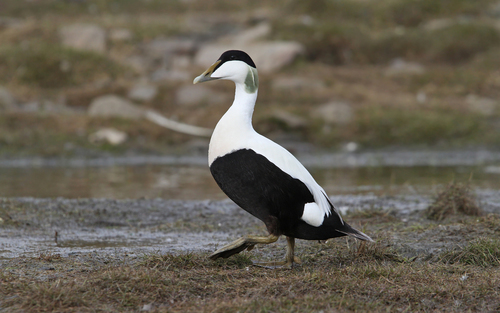 Common Eider
 Goosander
In short
The most reliable field mark to separate Common Eider from Goosander is overall structure and head/bill shape: eiders are extremely bulky sea-ducks with a massive, wedge-shaped bill, while goosanders are slimmer, long-bodied ducks with a narrow, serrated bill and a smoothly crested head. In flight or at rest, female and immature eiders can be confused with female goosanders, but eiders always look heavier and have a much thicker neck and head. Adult males are easily separated by plumage, but females and immatures require careful attention to size, head shape, and bill structure. Wing pattern is not described as a primary field mark for either species in the sources, so focus on structure and overall jizz.
Identification tips
- Head and Bill Shape: Eiders have a massive, wedge-shaped bill that merges smoothly into the forehead, giving a heavy, sloping profile. Goosanders have a long, narrow, serrated bill with a distinct step between forehead and bill, and a smoothly rounded crest at the rear of the head. This is the single most reliable mark at all ages.
- Overall Structure: Eiders are extremely bulky, deep-chested, and thick-necked, appearing heavy and broad both on water and in flight. Goosanders are more elongated, with a slimmer body, longer neck, and a sleeker profile.
- Female/Immature Plumage: Female and immature eiders are brown and heavily barred, with a pale, massive bill; goosander females/immatures are grey-bodied with a rich chestnut head, white chin, and a thin red bill. Juvenile goosanders also show a short white stripe edged in black between eye and bill—never present on eider.
- Male Plumage: Adult male eiders are boldly black-and-white with a green nape; male goosanders are white with a salmon-pink tinge, black/greenish head, and grey rump/tail. Confusion is unlikely in this plumage.
- Wing Pattern in Flight: Both show white in the wing, but eiders have broader wings without sharp black/white contrast; goosanders have white inner wings and black outer wings, creating a strong contrast in flight. However, this is not as diagnostic as head/bill shape.
- Habitat: Eiders are almost always on the sea, especially in large flocks; goosanders are on rivers and lakes, rarely in large groups. Inland sightings are almost always goosander.
- Behavior: Goosanders often perch on rocks or logs, swim low in the water, and may run upright on land; eiders are more buoyant, rarely leave the water except to nest, and are more gregarious.
- Vocalizations: Eider's 'ah-ooo' call is unique but rarely heard except in display; goosander's croak or whistle is less distinctive.
- Size: Eiders are heavier and bulkier, but length can overlap; use mass and jizz rather than length alone.
- Bill Color: Eiders have a pale (often yellowish or greenish) bill; goosanders have a red to brownish-red bill, brightest in adult males.
- Crest: Goosander shows a smoothly rounded crest (not usually erect); eider's head is smoothly rounded without a crest.
- White Chin Patch: Female/immature goosanders have a sharp white chin patch; eiders never do.
- Juvenile Face Stripe: Juvenile goosanders have a short black-edged white stripe between eye and bill; eiders lack this mark.
- Group Size: Eiders often in large, dense flocks; goosanders usually in small groups or alone.
- Feeding Behavior: Eiders dive for molluscs, often in synchrony; goosanders dive for fish, sometimes herding prey in groups.
Size
Common Eider is significantly heavier and bulkier than Goosander. Eiders average about 2066.5 g, with males often exceeding 2 kg, while Goosanders average 1470.5 g. Eiders are also slightly shorter in maximum length (50–71 cm) compared to Goosander (58–72 cm), but this is misleading: eiders are much more massive and broad-bodied, with a noticeably deeper chest and thicker neck. Goosanders are long-bodied but more slender overall, with a narrower, more elongated profile both on water and in flight.
Plumage
Juvenile and female plumages are the main confusion point. Female and immature Common Eiders are brown overall, with a uniform, barred appearance and a large, pale wedge-shaped bill. Female and immature Goosanders are mostly grey-bodied with a distinct reddish-brown head, a sharply defined white chin patch, and a thinner, red serrated bill. Juvenile Goosanders show a short black-edged white stripe between the eye and bill, which is never present on eiders. Adult male eiders are strikingly black-and-white with a green nape, while adult male goosanders are white-bodied with a salmon-pink tinge, black/greenish head, and grey rump/tail. In flight, both species show largely white inner wings, but eiders are broader-winged and lack the sharp contrast of the goosander's black outer wing. No distinctive juvenile upperwing pattern is described for either species in the sources.
Behaviour
Common Eiders are almost always seen in large flocks on coastal waters, diving for molluscs and crustaceans. They rarely come ashore except to breed. Goosanders are more often found singly or in small groups on rivers and lakes, sometimes seen perching on rocks or logs. Goosanders often swim low in the water, sometimes with their bodies submerged like cormorants, and are clumsy on land, running upright if flushed. Eiders are more buoyant and rarely leave the water except at nesting sites.
Habitat
Common Eider is strictly coastal, breeding and wintering along northern seashores, estuaries, and offshore islands. They are rarely found inland except in exceptional cases (e.g., introduced populations on Swiss lakes). Goosander is a bird of freshwater rivers and lakes in forested regions, but may also winter on estuaries and sheltered coasts. If you see a large duck inland on a river or lake, it is far more likely to be a Goosander; eiders are almost never found away from the sea.
Voice
Common Eider males have a strange, almost human-like 'ah-ooo' display call, while females give hoarse quacks. Goosander's normal call is a low, harsh croak; males and juveniles may give a soft, plaintive whistle in breeding season. Calls are not usually diagnostic at a distance, but the eider's display call is unique if heard.