Birdr

Common Eider vs Long-tailed Duck

Somateria mollissima versus Clangula hyemalis

Play a quiz with Common Eider and Long-tailed Duck
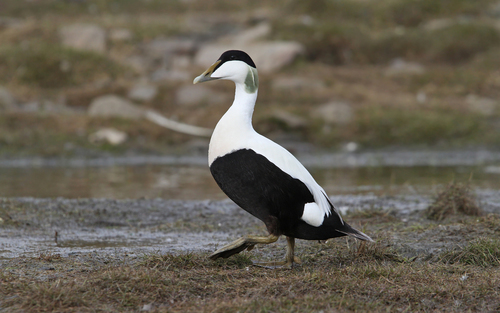
Common Eider (Somateria mollissima) Common Eider
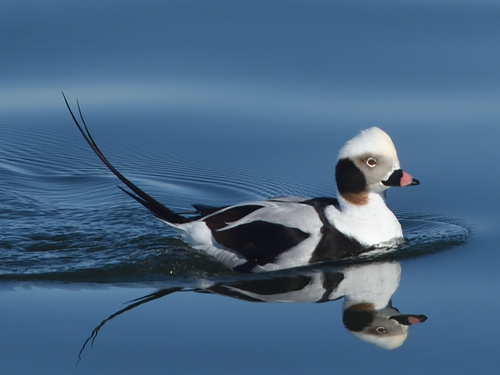
Long-tailed Duck (Clangula hyemalis) Long-tailed Duck

Media

Loading…

In short

The most reliable field mark to distinguish a Common Eider from a Long-tailed Duck is the tail: the Long-tailed Duck has two slim, elongated central tail feathers, while the Common Eider has a more typical duck tail. Additionally, the male Long-tailed Duck has a distinctive pink band around its bill during the breeding season, which the Common Eider lacks.

Identification tips

  1. Look for the elongated central tail feathers of the Long-tailed Duck, especially in males. 2. Check for the pink band around the bill of male Long-tailed Ducks in breeding condition. 3. Listen for the nasal-sounding call of the Long-tailed Duck, especially in coastal or tundra areas.

Plumage

The Long-tailed Duck male has a distinctive pink band around its bill in breeding condition and changes from white to black on the head in summer. The Common Eider does not have these features.

Voice

The Long-tailed Duck has a nasal-sounding call that is audible from a distance, which is a distinctive feature.

Submit a better description

Use the same sections as the comparison. Your text is published immediately.

The most reliable field mark to distinguish a Common Eider from a Long-tailed Duck is the tail: the Long-tailed Duck has two slim, elongated central tail feathers, while the Common Eider has a more typical duck tail. Additionally, the male Long-tailed Duck has a distinctive pink band around its bill during the breeding season, which the Common Eider lacks.

  1. Look for the elongated central tail feathers of the Long-tailed Duck, especially in males. 2. Check for the pink band around the bill of male Long-tailed Ducks in breeding condition. 3. Listen for the nasal-sounding call of the Long-tailed Duck, especially in coastal or tundra areas.

The Long-tailed Duck male has a distinctive pink band around its bill in breeding condition and changes from white to black on the head in summer. The Common Eider does not have these features.

The Long-tailed Duck has a nasal-sounding call that is audible from a distance, which is a distinctive feature.

Discard your changes?

You have unsaved edits. If you leave now, those changes will be lost.

Common Eider · Long-tailed Duck · My Tricky Birds