
Common Firecrest vs Eurasian Nuthatch
Regulus ignicapilla versus Sitta europaea
Play a quiz with Common Firecrest and Eurasian Nuthatch
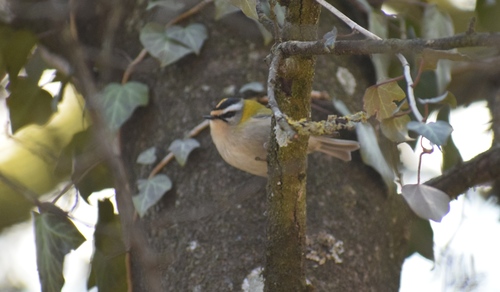 Common Firecrest
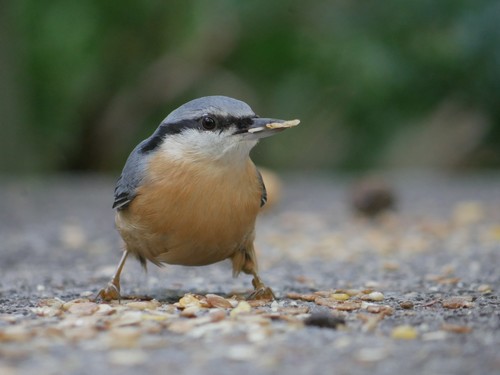 Eurasian Nuthatch
In short
The most reliable way to separate Common Firecrest from Eurasian Nuthatch in the field is by overall structure and head pattern: Firecrest is a tiny, plump, olive-green bird with a bold face and crest, while Nuthatch is much larger, blue-grey above, with a long pointed bill and strong black eye-stripe. Juvenile Firecrests may lack the full crown color but still show a distinct face pattern, unlike any nuthatch. In flight or perched, the nuthatch’s long bill, short tail, and tree-creeping behavior are instantly different from the firecrest’s tiny, active, horizontal posture. If you’re unsure, check for the firecrest’s two white wingbars and supercilium versus the nuthatch’s blue-grey, unmarked upperparts and orange flanks.
Identification tips
- Size: Nuthatch is more than twice the weight of Firecrest and much bulkier; if the bird looks wren- or goldcrest-sized, it is not a nuthatch.
- Bill shape: Firecrest has a tiny, fine, pointed bill; nuthatch has a long, strong, dagger-like bill, obvious even at a distance.
- Head pattern (all ages): Firecrest always shows a strong black eye-stripe, long white supercilium, and (in adults) a colored crest; even juveniles have a pale half-circle below the eye and a duller but still patterned face. Nuthatch has a black eye-stripe but lacks the white supercilium and crown stripe, and never shows a crest.
- Crest: Only Firecrest has a colored crest (orange in males, yellow in females); nuthatch never shows any crest.
- Wingbars: Firecrest has two clear white wingbars on each wing; nuthatch has plain blue-grey wings with no wingbars or pale panels.
- Upperparts color: Firecrest is bright olive-green with a bronze shoulder patch; nuthatch is blue-grey above with no olive tones.
- Underparts: Firecrest is whitish below with a brownish-grey wash on flanks; nuthatch has white throat and cheeks but rich orange-red flanks and belly, often mottled with white under the tail.
- Leg color: Firecrest has brownish-black legs; nuthatch’s legs are pale brown or greyish.
- Tail: Firecrest has a short, square tail, but nuthatch’s tail is even shorter and squarer, and is never used for support (unlike creepers or woodpeckers).
- Posture and movement: Firecrest is horizontal, active, and flicking through foliage; nuthatch is often vertical or upside down, creeping on bark, and rarely in the outer canopy.
- Flight style: Firecrest’s flight is weak and whirring, with quick turns; nuthatch’s flight is fast, direct, and typically short, with wings closed between beats.
- Habitat use: If seen on a tree trunk or large branch, especially moving headfirst downwards, it is a nuthatch. Firecrest almost never does this.
- Juvenile confusion: Even juvenile Firecrests show enough face pattern to separate from nuthatch; nuthatch juveniles are duller but still have the strong eye-stripe and blue-grey upperparts.
- Voice: Nuthatch’s calls are loud and repeated; firecrest’s are thin and high, but voice is only useful if you know both species well.
- Sex/season: Firecrest sexes are similar except for crest color, but both sexes show the same face pattern and wingbars; nuthatch sexes are similar, with females slightly paler, but this is rarely useful for separation from firecrest.
Size
Eurasian Nuthatch is dramatically larger and heavier than Common Firecrest. Nuthatch measures about 14 cm in length with a wingspan of 22.5–27 cm and weighs 17–28 g (average 23 g) [wikidata]. Firecrest is only 9 cm long, with a wingspan of 13–16 cm and weighs just 4–7 g. This size difference is obvious in the field: nuthatch is starling-sized, firecrest is barely larger than a goldcrest or wren.
Plumage
- Juvenile/immature birds: Juvenile Firecrests lack the colored crown but still show a dull version of the bold face pattern (black eye-stripe, white supercilium, pale half-circle below the eye). Nuthatch juveniles resemble adult females but are duller, with paler legs and less contrast.
- Adults: Firecrest adults have bright olive-green upperparts, a bronze shoulder patch, two white wingbars, and a striking head with black eye-stripe, long white supercilium, and a yellow/orange crest (orange in males, yellow in females). Nuthatch adults are blue-grey above, with a strong black eye-stripe, white throat and cheeks, orange-red flanks and belly, and no wingbars or crest. The nuthatch’s underparts are much more extensively orange and lack the firecrest’s clean white belly.
- In flight: Firecrest shows a compact, whirring flight with two white wingbars visible; nuthatch has round wings, a pointed head, and a short square tail, with no wingbars or contrasting panels.
Behaviour
Firecrest is hyperactive, often hopping or flitting through foliage with its body held horizontally, rarely pausing for long. It forages in conifers and mixed woodland, often high in the canopy. Nuthatch moves with short leaps up, down, and around tree trunks and branches, often headfirst, and never uses its tail for support. Its movement is more deliberate and it frequently pauses to hammer at bark or probe crevices. In flight, nuthatch is fast and direct, with wings closed between beats; firecrest’s flight is weaker and more fluttery.
Habitat
Firecrest prefers mature coniferous or mixed woodland, especially with dense foliage, and is usually found in the canopy. Nuthatch is found in a wider range of woodlands, including deciduous forests, parks, and gardens, and is often seen on trunks and large branches at all levels. While both can occur in the same broad habitats, nuthatch is more likely at lower levels and on trunks, firecrest in the outer foliage.
Voice
Nuthatch is very vocal, with a repeated loud 'dwip' call. Firecrest’s song and calls are higher-pitched, thin, and less forceful, but this is not a primary separation feature in the field unless you know both species well.