
Common Greenshank vs Greater Yellowlegs
Tringa nebularia versus Tringa melanoleuca
Play a quiz with Common Greenshank and Greater Yellowlegs
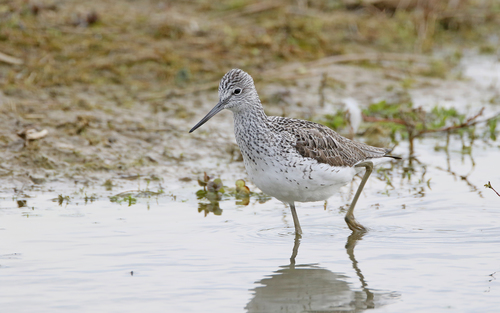 Common Greenshank
 Greater Yellowlegs
In short
The most reliable field mark to separate Common Greenshank from Greater Yellowlegs is leg color: greenshank has greenish legs, while yellowlegs has bright yellow legs. Bill shape also helps—greenshank’s bill is slightly upturned with a grey base, whereas yellowlegs has a straight, dark bill longer than its head. Both are large, long-legged waders with similar size and structure, and both show a white rump in flight, but subtle differences in bill and leg coloration are key. Breeding adults of both species share a coarse, dark breast pattern, so focus on structural and bare-part differences, especially in non-breeding or immature birds.
Identification tips
- Leg color is the most consistent field mark: Greenshank has greenish legs, while Greater Yellowlegs has bright yellow legs. This is visible in all plumages and ages, but mud or water can obscure the color.
- Bill shape and color: Greenshank’s bill is slightly upturned with a grey base, while yellowlegs’ bill is straight, all dark, and noticeably longer than the head. Look for the upturn and base color in good light.
- Breast pattern in breeding plumage: Both species show coarse, dark, crisp streaking on the breast and black on the shoulders/back, so this is not a reliable separator in spring/summer adults.
- Flight pattern: Both show a white rump in flight, so do not rely on this mark to separate them.
- Foraging behavior: Yellowlegs may be seen stirring water with its bill more often, but this is not exclusive.
- Voice: If calling, greenshank gives a rapid, fluty three-note call, while yellowlegs has a louder, harsher three-syllable whistle with a lower final note. This is most useful when birds are flushed or flying.
- Bill length: Yellowlegs’ bill is longer than its head, while greenshank’s is long but not as exaggeratedly so. Compare with head length if possible.
- Bill upturn: The upturned tip of the greenshank’s bill is subtle but diagnostic if seen well; yellowlegs’ bill is straight or only slightly upturned.
- Leg length: Both have long legs, but the color is more useful than length for separation.
- Plumage tone in winter: Both are grey-brown above and white below in non-breeding plumage; do not rely on back color alone.
- Habitat: Both use similar wetland habitats, so context is not helpful unless you are outside the normal range of one species.
- Size: Both are similar in size and mass; do not use size as a primary separator.
- Group association: Both can be solitary or in mixed flocks with other waders; flock composition is not a separator.
- Juvenile/immature plumage: No distinctive juvenile upperwing or flight marks are described between these two; focus on bare-part color and bill shape.
- Potential pitfalls: Muddy legs or poor light can obscure leg color; always check multiple features when possible, especially in dull light or at distance.
Size
Both species are nearly identical in size and mass, with Common Greenshank averaging 173 g and Greater Yellowlegs 170 g [wikidata]. Both are among the largest shanks, only exceeded by the Willet. Length and wingspan overlap considerably, so size alone is not a reliable separator in the field.
Plumage
No age-specific upperwing or flight pattern differences are described between these two species; both show a white rump in flight, which is not diagnostic. In breeding plumage, both have a coarse, dark, and crisp breast pattern with much black on the shoulders and back. In non-breeding (winter) plumage, greenshank is grey-brown above, while yellowlegs is grey-brown as well, but the difference is subtle. The main plumage distinction is in the legs (greenish vs yellow) and the bill (greenshank: upturned with grey base; yellowlegs: straight, dark, and longer than head).
Behaviour
Both species forage in shallow water and may be seen wading actively. Greater Yellowlegs often stirs up water with its bill while foraging, which can be a behavioral clue. Both may be found singly or in loose groups, and both are active, alert birds. No clear behavioral distinction is noted in the sources beyond foraging technique.
Habitat
Both species are found in similar wetland habitats—shallow freshwater or brackish marshes, mudflats, and the edges of lakes or rivers. Greenshank is more Eurasian in distribution, while Greater Yellowlegs is a Nearctic breeder, but their wintering habitats can overlap in some regions. Habitat alone is not a reliable separator where both occur.
Voice
Common Greenshank gives a rapid, fluty three-note call ('teu-teu-teu'), while Greater Yellowlegs has a harsher, louder, and clearer three-syllable whistle, with the third syllable lower in pitch. In flight, yellowlegs' call is distinctly sharper and more ringing than greenshank's. Voice can be helpful if the birds are calling, but both species can be silent when feeding.