
Birdr

Common Kestrel vs Peregrine Falcon

Falco tinnunculus versus Falco peregrinus

Play a quiz with Common Kestrel and Peregrine Falcon
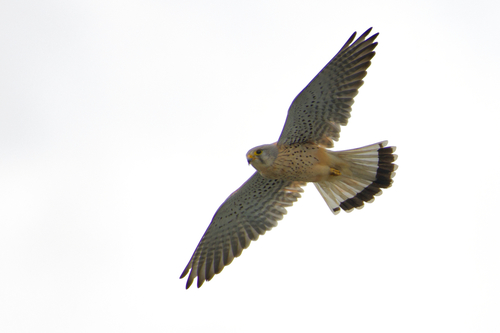
Common Kestrel (Falco tinnunculus) Common Kestrel
Peregrine Falcon (Falco peregrinus) Peregrine Falcon

Media

Loading…

In short

The Common Kestrel (Falco tinnunculus) and the Peregrine Falcon (Falco peregrinus) are both small to medium-sized falcons, but they can be distinguished by their plumage, size, and behaviors. The Common Kestrel is smaller, with a more varied plumage that includes distinctive spots and barring, while the Peregrine Falcon is larger, with a powerful build and a characteristic dark cap and mustache pattern.

Identification tips

  1. Birds of the World Similar-Species Diagnostics:
  2. The Common Kestrel is distinguishable from the Peregrine Falcon by its smaller size and contrasting plumage. The adult male Kestrel shows gray head and tail with a rufous mantle, while the Peregrine has a dark cap and mustache with gray-blue upperparts. The Kestrel's tail has a black subterminal band, whereas the Peregrine's tail is less patterned and more uniform.
  3. In flight, Kestrels have a different wing shape and often hover, while Peregrines are characterized by their swift, stooping flight.

  4. AI Field Diagnostics:

  5. Size and Shape: Look for the larger size and bulkier build of the Peregrine Falcon compared to the more slender Common Kestrel. The Kestrel's hovering behavior is a key identifier; if you see a bird hovering in place, it's likely a Kestrel.
  6. Wing Shape: The Kestrel has shorter, broader wings than the Peregrine, which has long, pointed wings. If you can observe the wingbeats, Kestrels flap more frequently, whereas Peregrines glide more often.
  7. Plumage Patterns: Pay attention to the color and pattern differences: the Kestrel has a more colorful and spotted appearance, especially in females, while the Peregrine's plumage is more subdued and streaked.
  8. Habitat and Behavior: Consider where the birds are located; if in a city or urban area, it’s likely a Peregrine, while open fields may host Kestrels. Observe their hunting techniques; Kestrels often perch and hover, while Peregrines dive rapidly from heights.

By utilizing these identification tips, birdwatchers can effectively distinguish between the Common Kestrel and the Peregrine Falcon in the field.

Size

Plumage

Behaviour

Habitat

Voice

Submit a better description

Use the same sections as the comparison. Your text is published immediately.

The Common Kestrel (Falco tinnunculus) and the Peregrine Falcon (Falco peregrinus) are both small to medium-sized falcons, but they can be distinguished by their plumage, size, and behaviors. The Common Kestrel is smaller, with a more varied plumage that includes distinctive spots and barring, while the Peregrine Falcon is larger, with a powerful build and a characteristic dark cap and mustache pattern.

  1. Birds of the World Similar-Species Diagnostics:
  2. The Common Kestrel is distinguishable from the Peregrine Falcon by its smaller size and contrasting plumage. The adult male Kestrel shows gray head and tail with a rufous mantle, while the Peregrine has a dark cap and mustache with gray-blue upperparts. The Kestrel's tail has a black subterminal band, whereas the Peregrine's tail is less patterned and more uniform.
  3. In flight, Kestrels have a different wing shape and often hover, while Peregrines are characterized by their swift, stooping flight.

  4. AI Field Diagnostics:

  5. Size and Shape: Look for the larger size and bulkier build of the Peregrine Falcon compared to the more slender Common Kestrel. The Kestrel's hovering behavior is a key identifier; if you see a bird hovering in place, it's likely a Kestrel.
  6. Wing Shape: The Kestrel has shorter, broader wings than the Peregrine, which has long, pointed wings. If you can observe the wingbeats, Kestrels flap more frequently, whereas Peregrines glide more often.
  7. Plumage Patterns: Pay attention to the color and pattern differences: the Kestrel has a more colorful and spotted appearance, especially in females, while the Peregrine's plumage is more subdued and streaked.
  8. Habitat and Behavior: Consider where the birds are located; if in a city or urban area, it’s likely a Peregrine, while open fields may host Kestrels. Observe their hunting techniques; Kestrels often perch and hover, while Peregrines dive rapidly from heights.

By utilizing these identification tips, birdwatchers can effectively distinguish between the Common Kestrel and the Peregrine Falcon in the field.

  • Common Kestrel: Average length ranges from 32-36 cm (12.6-14.2 inches) with a wingspan of 65-75 cm (25.6-29.5 inches). Weighs approximately 150-250 grams (5.3-8.8 ounces).
  • Peregrine Falcon: Larger, measuring about 34-58 cm (13.4-22.8 inches) in length with a wingspan of 80-120 cm (31.5-47.2 inches). Weight ranges from 500-1,500 grams (17.6-52.9 ounces), depending on the sex and subspecies.
  • Common Kestrel: Males have gray heads and tails, with a rufous mantle and spotted underparts. Adult females are more uniformly rufous and heavily spotted. Juveniles resemble females but have broader streaks on their underparts. The tail has a black subterminal band and a white tip.
  • Peregrine Falcon: Characterized by a dark cap, mustache, and a lighter, streaked breast. Their upperparts are slate-gray with a pale belly and distinctive dark "sideburns." The wings are long and pointed, contributing to their aerodynamic shape.
  • Common Kestrel: Known for its hovering flight while hunting, often seen in open fields, where it will perch and watch for small mammals and insects. It exhibits a more sedentary behavior compared to the Peregrine.
  • Peregrine Falcon: Renowned for its speed and hunting prowess, often performing high-speed dives (stoops) to catch prey, primarily birds. It is adaptable and can hunt in urban areas as well as more natural habitats.
  • Common Kestrel: Prefers open habitats such as grasslands, farmland, and urban areas. It nests in cavities or on ledges and is commonly found across Europe, Asia, and parts of Africa.
  • Peregrine Falcon: Historically favored cliffs for nesting but has adapted to urban environments, nesting on skyscrapers and bridges. It is found worldwide, with a preference for areas with ample flying bird populations, such as wetlands and coastal regions.
  • Common Kestrel: Produces a series of sharp "kek-kek-kek" calls, especially during the breeding season.
  • Peregrine Falcon: Known for its distinctive "kak-kak-kak" vocalizations, which are often heard during courtship and in territorial disputes.

Discard your changes?

You have unsaved edits. If you leave now, those changes will be lost.

Common Kestrel · Peregrine Falcon · My Tricky Birds