Birdr

Common Moorhen vs Baillon's Crake

Gallinula chloropus versus Zapornia pusilla

Play a quiz with Common Moorhen and Baillon's Crake
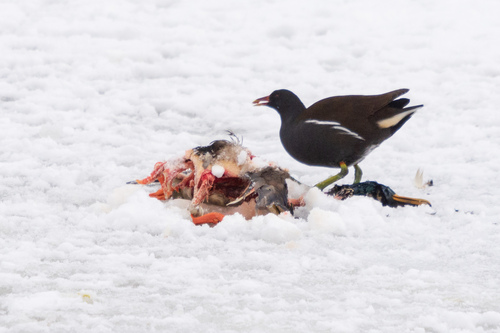
Common Moorhen (Gallinula chloropus) Common Moorhen
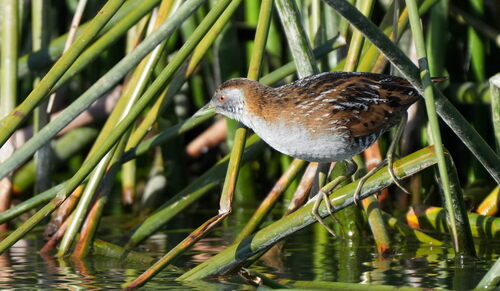
Baillon's Crake (Zapornia pusilla) Baillon's Crake

Media

Loading…

In short

The Common Moorhen and Baillon's Crake can be distinguished primarily by size and plumage. The Moorhen is larger with a distinctive red bill and frontal shield, while Baillon's Crake is smaller and more cryptic with a less conspicuous coloration. Both species inhabit wetlands, but their vocalizations and behaviors provide additional clues.

Identification tips

  1. Size: The Common Moorhen is larger than Baillon's Crake. 2. Bill and Shield: Look for the Moorhen's red bill and frontal shield. 3. Plumage: Note the Moorhen's white flank stripe and undertail coverts. 4. Behavior: Observe the Moorhen's tail-flicking habit. 5. Vocalization: Listen for the Moorhen's varied calls; Baillon's Crake is quieter.

Size

The Common Moorhen is significantly larger than Baillon's Crake.

Plumage

The Common Moorhen has sooty black plumage with browner upperparts, a prominent white flank stripe, and a red bill with a yellow tip. In contrast, Baillon's Crake is more cryptically colored, lacking the bright red bill and shield.

Behaviour

The Common Moorhen is known for its habit of flicking its tail while foraging, which is a useful identification feature. Baillon's Crake is more secretive and less likely to be seen in open areas.

Habitat

Both species inhabit wetlands, but the Common Moorhen is more adaptable to a variety of wetland habitats.

Voice

The Common Moorhen produces a wide range of vocalizations including shrieks, clucks, and chattering notes. Baillon's Crake's vocalizations are less documented but are generally softer and less varied.

Submit a better description

Use the same sections as the comparison. Your text is published immediately.

The Common Moorhen and Baillon's Crake can be distinguished primarily by size and plumage. The Moorhen is larger with a distinctive red bill and frontal shield, while Baillon's Crake is smaller and more cryptic with a less conspicuous coloration. Both species inhabit wetlands, but their vocalizations and behaviors provide additional clues.

  1. Size: The Common Moorhen is larger than Baillon's Crake. 2. Bill and Shield: Look for the Moorhen's red bill and frontal shield. 3. Plumage: Note the Moorhen's white flank stripe and undertail coverts. 4. Behavior: Observe the Moorhen's tail-flicking habit. 5. Vocalization: Listen for the Moorhen's varied calls; Baillon's Crake is quieter.

The Common Moorhen is significantly larger than Baillon's Crake.

The Common Moorhen has sooty black plumage with browner upperparts, a prominent white flank stripe, and a red bill with a yellow tip. In contrast, Baillon's Crake is more cryptically colored, lacking the bright red bill and shield.

The Common Moorhen is known for its habit of flicking its tail while foraging, which is a useful identification feature. Baillon's Crake is more secretive and less likely to be seen in open areas.

Both species inhabit wetlands, but the Common Moorhen is more adaptable to a variety of wetland habitats.

The Common Moorhen produces a wide range of vocalizations including shrieks, clucks, and chattering notes. Baillon's Crake's vocalizations are less documented but are generally softer and less varied.

Discard your changes?

You have unsaved edits. If you leave now, those changes will be lost.

Common Moorhen · Baillon's Crake · My Tricky Birds