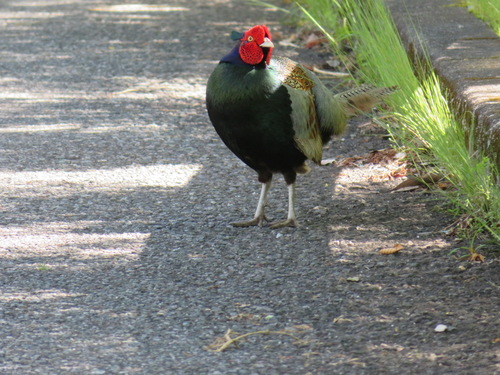
Common Pheasant vs Green Pheasant
Phasianus colchicus versus Phasianus versicolor
Play a quiz with Common Pheasant and Green Pheasant
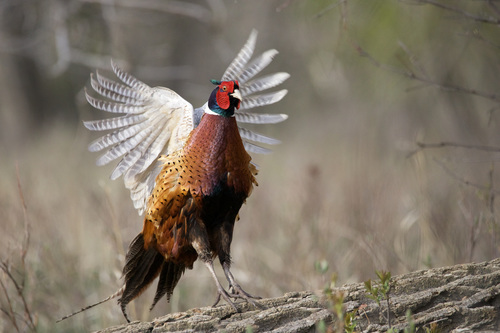
Common Pheasant
Green Pheasant
In short
The Common Pheasant (Phasianus colchicus) and the Green Pheasant (Phasianus versicolor) are closely related, with the most reliable field mark being their plumage coloration. The Common Pheasant typically has more varied and brighter plumage, while the Green Pheasant exhibits a more uniform greenish hue. Both species are similar in structure, but their habitats and vocalizations can also aid in differentiation.
Identification tips
- Look for the white neck ring in male Common Pheasants, absent in Green Pheasants.
- Note the greenish overall hue of the Green Pheasant, especially in males.
- Consider the location: Green Pheasants are endemic to Japan, while Common Pheasants are widespread due to introductions.
- Listen for differences in calls if both species are present.
Size
Both species are similar in size, with no significant differences in overall body structure.
Plumage
The Common Pheasant often displays a mix of bright colors including gold, copper, and a distinctive white neck ring in males, while the Green Pheasant has a more uniform greenish plumage with less contrast and no neck ring. Females of both species are more cryptically colored, but the Green Pheasant female tends to be slightly darker.
Behaviour
Both species exhibit similar behaviors, being ground-dwelling and often seen foraging in open fields. They are both known for their explosive flight when flushed.
Habitat
The Common Pheasant is highly adaptable, found in a variety of habitats including agricultural areas and woodlands. In contrast, the Green Pheasant is endemic to Japan, favoring lightly wooded areas and open-country habitats with tall grass.
Voice
Vocalizations are not a primary distinguishing feature, but the Green Pheasant's calls are generally described as harsher and more abrupt compared to the Common Pheasant.