
Birdr

Common Redpoll vs Arctic Redpoll

Acanthis flammea versus Acanthis hornemanni

Play a quiz with Common Redpoll and Arctic Redpoll
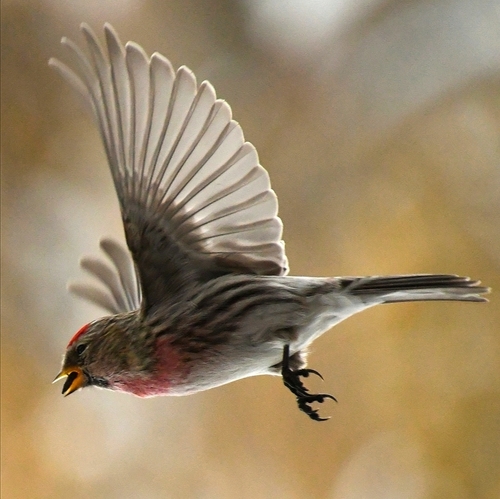
Common Redpoll (Acanthis flammea) Common Redpoll
Arctic Redpoll (Acanthis hornemanni) Arctic Redpoll

Media

Loading…

In short

Common Redpoll and Arctic Redpoll are closely related finches often found in similar habitats, making them challenging to distinguish. The most reliable field mark is the whiteness of the plumage, with Arctic Redpoll generally appearing paler and frostier than the Common Redpoll. Bill size and shape can also help, as Arctic Redpolls tend to have a smaller, more conical bill.

Identification tips

  1. Look for the frosty, pale appearance of the Arctic Redpoll, especially on the rump and underparts. 2. Check the bill size and shape; Arctic Redpolls have a smaller, more conical bill. 3. Observe the streaking; Common Redpolls are more heavily streaked on the flanks. 4. Consider the overall bulkiness; Arctic Redpolls may appear fluffier. 5. Be cautious of individual variation and overlapping characteristics.

Size

Both species are similar in size, but Arctic Redpolls may appear slightly bulkier due to their fluffier plumage.

Plumage

Arctic Redpolls are generally paler with a frosty appearance, especially on the rump and underparts, while Common Redpolls have a more streaked and brownish look. Arctic Redpolls often show a whiter rump and less streaking on the flanks.

Behaviour

Both species exhibit similar behaviors, often seen in flocks and feeding on seeds, especially birch and alder.

Habitat

Both species inhabit northern and Arctic regions, often found in open woodlands and scrubby areas. They may overlap in range during winter.

Voice

Vocalizations are similar, with both species producing a variety of calls and trills. Distinguishing them by sound alone is challenging.

Submit a better description

Use the same sections as the comparison. Your text is published immediately.

Common Redpoll and Arctic Redpoll are closely related finches often found in similar habitats, making them challenging to distinguish. The most reliable field mark is the whiteness of the plumage, with Arctic Redpoll generally appearing paler and frostier than the Common Redpoll. Bill size and shape can also help, as Arctic Redpolls tend to have a smaller, more conical bill.

  1. Look for the frosty, pale appearance of the Arctic Redpoll, especially on the rump and underparts. 2. Check the bill size and shape; Arctic Redpolls have a smaller, more conical bill. 3. Observe the streaking; Common Redpolls are more heavily streaked on the flanks. 4. Consider the overall bulkiness; Arctic Redpolls may appear fluffier. 5. Be cautious of individual variation and overlapping characteristics.

Both species are similar in size, but Arctic Redpolls may appear slightly bulkier due to their fluffier plumage.

Arctic Redpolls are generally paler with a frosty appearance, especially on the rump and underparts, while Common Redpolls have a more streaked and brownish look. Arctic Redpolls often show a whiter rump and less streaking on the flanks.

Both species exhibit similar behaviors, often seen in flocks and feeding on seeds, especially birch and alder.

Both species inhabit northern and Arctic regions, often found in open woodlands and scrubby areas. They may overlap in range during winter.

Vocalizations are similar, with both species producing a variety of calls and trills. Distinguishing them by sound alone is challenging.

Discard your changes?

You have unsaved edits. If you leave now, those changes will be lost.

Common Redpoll · Arctic Redpoll · My Tricky Birds