Common Redstart vs European Stonechat
Phoenicurus phoenicurus versus Saxicola rubicola
Play a quiz with Common Redstart and European Stonechat
Common Redstart
European Stonechat
In short
The Common Redstart and European Stonechat can be distinguished primarily by their tail and plumage patterns. The Common Redstart has a distinctive orange-red tail, while the European Stonechat has a darker, less conspicuous tail. Both species are small, but their behavior and habitat preferences can also aid in identification.
Identification tips
- Tail Color: Look for the orange-red tail of the Common Redstart, especially in males. 2. Plumage: Note the black face and white forehead of the male Common Redstart versus the black head and throat of the male European Stonechat. 3. Behavior: Observe tail-flicking in Common Redstarts and the perching habits of European Stonechats. 4. Habitat: Consider the habitat; woodlands for redstarts, open fields for stonechats. 5. Vocalization: Listen for the melodious song of the Common Redstart versus the 'chak' call of the European Stonechat.
Size
Both species are similar in size, but the Common Redstart may appear slightly more slender.
Plumage
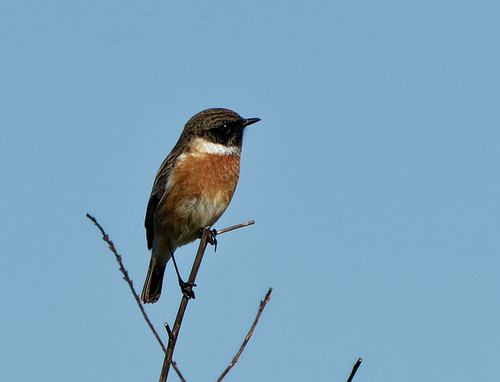
The Common Redstart male has a striking orange-red tail and a black face with a white forehead, whereas the European Stonechat male has a darker, more uniform appearance with a black head and throat, and a less vibrant tail. Females of both species are more subdued, but the Common Redstart female has a paler, more orange-tinged tail compared to the stonechat's darker tail.
Behaviour
Common Redstarts are often seen flicking their tails and wings, while European Stonechats frequently perch conspicuously on top of shrubs or posts.
Habitat
Common Redstarts prefer open woodlands and forest edges, while European Stonechats are more commonly found in open fields, heathlands, and scrubby areas.
Voice
The Common Redstart's song is a series of melodious phrases, while the European Stonechat's call is a sharp 'chak' sound. The songs are different, but may require experience to distinguish.