Birdr

Common Ringed Plover vs Semipalmated Plover

Charadrius hiaticula versus Charadrius semipalmatus

Play a quiz with Common Ringed Plover and Semipalmated Plover
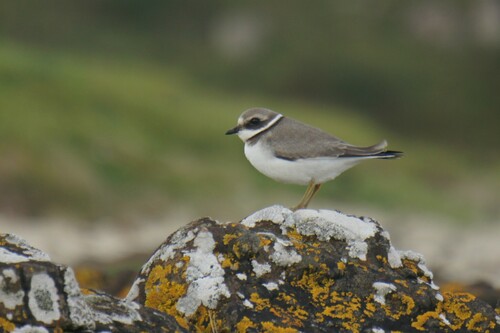
Common Ringed Plover (Charadrius hiaticula) Common Ringed Plover
Semipalmated Plover (Charadrius semipalmatus) Semipalmated Plover

Media

Loading…

In short

The Common Ringed Plover and Semipalmated Plover are similar small shorebirds, but they can be distinguished by the presence of partial webbing between the toes in the Semipalmated Plover. Both species have similar plumage patterns, but subtle differences in bill structure and leg color can aid identification.

Identification tips

  1. Toe Webbing: Look for partial webbing between the toes in the Semipalmated Plover. 2. Bill: Check the bill color; the Common Ringed Plover often has an orange base, while the Semipalmated Plover's bill is more uniformly dark. 3. Leg Color: The Common Ringed Plover typically has orange legs, whereas the Semipalmated Plover's legs are more yellowish. 4. Call: Listen for the high-pitched 'chu-wee' of the Semipalmated Plover compared to the softer 'too-lee' of the Common Ringed Plover.

Size

Both species are similar in size, with no significant differences that are easily observed in the field.

Plumage

Both plovers have a brown back, white underparts, and a distinctive black breast band. The Common Ringed Plover typically has a slightly broader and more distinct breast band. The Semipalmated Plover's bill is usually shorter and more uniformly dark compared to the Common Ringed Plover, which often has a more distinct orange base to the bill.

Behaviour

Both species exhibit similar behaviors, such as running and stopping frequently while foraging on mudflats or sandy shores.

Habitat

The Common Ringed Plover is more commonly found in Eurasia, while the Semipalmated Plover is primarily found in North America. Both species favor open habitats near water, such as beaches, mudflats, and riverbanks.

Voice

The Semipalmated Plover has a distinctive, high-pitched 'chu-wee' call, whereas the Common Ringed Plover's call is a softer, rolling 'too-lee'.

Submit a better description

Use the same sections as the comparison. Your text is published immediately.

The Common Ringed Plover and Semipalmated Plover are similar small shorebirds, but they can be distinguished by the presence of partial webbing between the toes in the Semipalmated Plover. Both species have similar plumage patterns, but subtle differences in bill structure and leg color can aid identification.

  1. Toe Webbing: Look for partial webbing between the toes in the Semipalmated Plover. 2. Bill: Check the bill color; the Common Ringed Plover often has an orange base, while the Semipalmated Plover's bill is more uniformly dark. 3. Leg Color: The Common Ringed Plover typically has orange legs, whereas the Semipalmated Plover's legs are more yellowish. 4. Call: Listen for the high-pitched 'chu-wee' of the Semipalmated Plover compared to the softer 'too-lee' of the Common Ringed Plover.

Both species are similar in size, with no significant differences that are easily observed in the field.

Both plovers have a brown back, white underparts, and a distinctive black breast band. The Common Ringed Plover typically has a slightly broader and more distinct breast band. The Semipalmated Plover's bill is usually shorter and more uniformly dark compared to the Common Ringed Plover, which often has a more distinct orange base to the bill.

Both species exhibit similar behaviors, such as running and stopping frequently while foraging on mudflats or sandy shores.

The Common Ringed Plover is more commonly found in Eurasia, while the Semipalmated Plover is primarily found in North America. Both species favor open habitats near water, such as beaches, mudflats, and riverbanks.

The Semipalmated Plover has a distinctive, high-pitched 'chu-wee' call, whereas the Common Ringed Plover's call is a softer, rolling 'too-lee'.

Discard your changes?

You have unsaved edits. If you leave now, those changes will be lost.

Common Ringed Plover · Semipalmated Plover · My Tricky Birds