Birdr

Common Rock Thrush vs Blue Rock Thrush

Monticola saxatilis versus Monticola solitarius

Play a quiz with Common Rock Thrush and Blue Rock Thrush

Common Rock Thrush (Monticola saxatilis) Common Rock Thrush
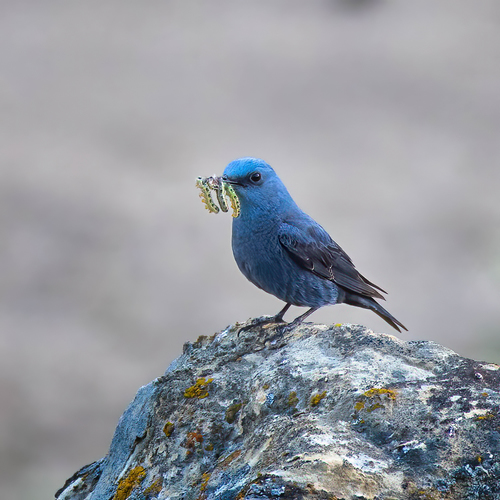
Blue Rock Thrush (Monticola solitarius) Blue Rock Thrush

Media

Loading…

In short

The Common Rock Thrush and Blue Rock Thrush are both rock-dwelling birds with distinct male plumage. The Common Rock Thrush male is vivid blue with rust-colored tail and bright orange underparts, while the Blue Rock Thrush male is uniformly blue. Females of both species are more similar, with subdued colors and scaling, but the Common Rock Thrush female has a whitish chin and more orange-buff underparts.

Identification tips

  1. Male Plumage: Look for vivid blue head and rust-colored tail in Common Rock Thrush males; Blue Rock Thrush males are uniformly blue. 2. Female Plumage: Note the whitish chin and orange-buff underparts in female Common Rock Thrush. 3. Habitat: Consider the habitat; Common Rock Thrushes prefer open, stony areas, while Blue Rock Thrushes can be found in urban settings. 4. Behavior: Both species perch on rocks or trees to scan for prey, which is a common behavior.

Size

Both species are similar in size, typical of medium-sized thrushes.

Plumage

Male Common Rock Thrushes have a vivid blue head, rust-colored tail, and bright orange underparts. In contrast, male Blue Rock Thrushes are uniformly blue. Females of both species are grayish-brown with scaling, but the Common Rock Thrush female has a whitish chin and orange-buff underparts.

Behaviour

Both species feed on insects and other invertebrates, often scanning from a perch before dropping to the ground to catch prey. They share similar nesting habits, often using rock crevices or overhangs.

Habitat

Both species inhabit rocky, mountainous regions. The Common Rock Thrush prefers open, stony areas and cliffs, while the Blue Rock Thrush can also be found in urban areas with suitable rocky habitats.

Voice

Vocalizations are not well-documented in the sources provided, but both species have typical thrush-like songs.

Submit a better description

Use the same sections as the comparison. Your text is published immediately.

The Common Rock Thrush and Blue Rock Thrush are both rock-dwelling birds with distinct male plumage. The Common Rock Thrush male is vivid blue with rust-colored tail and bright orange underparts, while the Blue Rock Thrush male is uniformly blue. Females of both species are more similar, with subdued colors and scaling, but the Common Rock Thrush female has a whitish chin and more orange-buff underparts.

  1. Male Plumage: Look for vivid blue head and rust-colored tail in Common Rock Thrush males; Blue Rock Thrush males are uniformly blue. 2. Female Plumage: Note the whitish chin and orange-buff underparts in female Common Rock Thrush. 3. Habitat: Consider the habitat; Common Rock Thrushes prefer open, stony areas, while Blue Rock Thrushes can be found in urban settings. 4. Behavior: Both species perch on rocks or trees to scan for prey, which is a common behavior.

Both species are similar in size, typical of medium-sized thrushes.

Male Common Rock Thrushes have a vivid blue head, rust-colored tail, and bright orange underparts. In contrast, male Blue Rock Thrushes are uniformly blue. Females of both species are grayish-brown with scaling, but the Common Rock Thrush female has a whitish chin and orange-buff underparts.

Both species feed on insects and other invertebrates, often scanning from a perch before dropping to the ground to catch prey. They share similar nesting habits, often using rock crevices or overhangs.

Both species inhabit rocky, mountainous regions. The Common Rock Thrush prefers open, stony areas and cliffs, while the Blue Rock Thrush can also be found in urban areas with suitable rocky habitats.

Vocalizations are not well-documented in the sources provided, but both species have typical thrush-like songs.

Discard your changes?

You have unsaved edits. If you leave now, those changes will be lost.

Common Rock Thrush · Blue Rock Thrush · My Tricky Birds