
Common Sandpiper vs Green Sandpiper
Actitis hypoleucos versus Tringa ochropus
Play a quiz with Common Sandpiper and Green Sandpiper
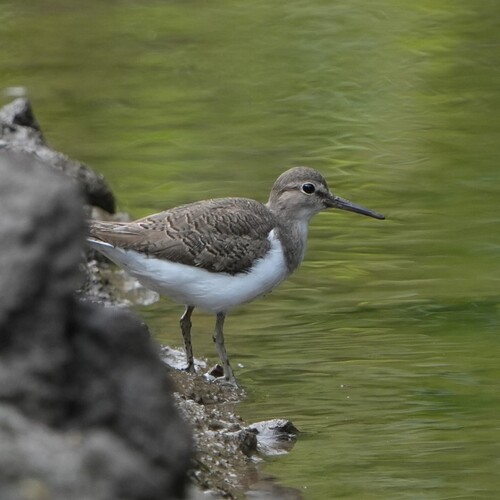 Common Sandpiper
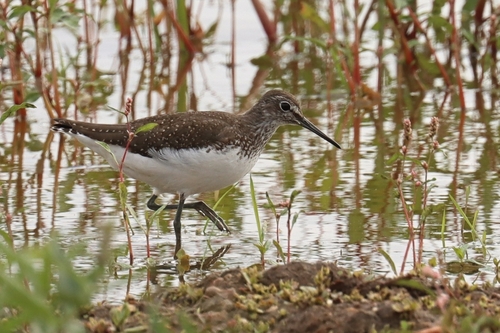 Green Sandpiper
In short
The most reliable way to separate Common Sandpiper from Green Sandpiper is by their flight pattern and rump: Green Sandpiper shows a strikingly white rump and dark wings above and below, while Common Sandpiper lacks this white rump and has a more uniform brown upperwing. Juvenile Common Sandpipers show heavy barring and buff edges on the upperwing, while Green Sandpiper juveniles have less extensive spotting than adults but always retain the white rump. On the ground, leg color and overall structure help: Common Sandpiper has dark yellowish legs and a shorter, finer bill, while Green Sandpiper's legs and bill are dark green. Size and shape differences are subtle but present, with Green Sandpiper being noticeably heavier and plumper. Both species can be solitary, but their preferred habitats and flight jizz differ.
Identification tips
- White rump in flight (all ages): Green Sandpiper always shows a brilliant white rump and uppertail in flight, contrasting with dark wings above and below. Common Sandpiper never shows a white rump—its back and uppertail are brown and uniform.
- Upperwing pattern (juveniles): Juvenile Common Sandpiper has heavy barring and buff edges on the upperwing coverts, giving a crisp, barred look. Green Sandpiper juveniles lack this barring but may have some white spotting on the back; the white rump is always present.
- Flight jizz: Common Sandpiper flies low over water with stiff, shallow wingbeats; Green Sandpiper is more direct, often flushed from cover, and shows a flash of white rump as it departs.
- Leg color: Common Sandpiper has dark yellowish legs, best seen when perched or walking. Green Sandpiper's legs are dark green, which can look almost black in poor light but have a greenish cast in good light.
- Bill color: Common Sandpiper's bill is mostly dark with a pale base; Green Sandpiper's bill is uniformly dark green.
- Body shape: Green Sandpiper is noticeably plumper and heavier, with a more robust body and slightly longer legs. Common Sandpiper is slimmer and more delicate.
- Back and wing color: Common Sandpiper is greyish-brown above, with little or no white spotting. Green Sandpiper is darker, with greenish-brown tones and white spotting (most extensive in breeding adults).
- Underparts: Both species have white underparts, but Green Sandpiper's breast is more greyish and can look smudged, while Common Sandpiper's is cleaner white with a sharper demarcation from the brown upperparts.
- Tail-bobbing: Both species bob their tails, but Common Sandpiper does so more frequently and with a more pronounced motion, especially while feeding.
- Habitat preference: Common Sandpiper is more likely on open, stony or muddy shores; Green Sandpiper prefers vegetated or wooded wetlands and is less often seen on open mud.
- Vocalization: If you hear a three-note whistle as the bird takes flight, it's Green Sandpiper. Common Sandpiper's call is not described here, so use this only for Green Sandpiper.
- Group size: Both are often solitary, but Common Sandpiper can form small groups, especially on migration; Green Sandpiper is almost always alone.
- Seasonal changes: In winter, Common Sandpiper becomes duller and more barred above, but never gains a white rump. Green Sandpiper loses some spotting but always retains the white rump.
- Confusion risk: In poor light or at a distance, leg and bill color can be hard to judge—rely on rump and flight pattern first.
- Geographic overlap: Both are Old World species and can occur together on migration, so careful attention to the above marks is essential.
Size
Green Sandpiper is distinctly heavier (around 80g) and somewhat bulkier than Common Sandpiper, which is smaller and lighter (exact mass not given but clearly less). Green Sandpiper appears plumper and more robust, while Common Sandpiper is more slender and delicate. In the field, this size difference is subtle but can be appreciated with direct comparison or experience.
Plumage
-
Juvenile/immature birds: Juvenile Common Sandpiper has heavy barring above and buff edges to wing feathers, giving a crisp, barred look on the upperparts and upperwing. Green Sandpiper juveniles have less white spotting on the back than adults but always show a bright white rump in flight, which is never present in Common Sandpiper of any age.
-
Adults (breeding): Common Sandpiper adults have greyish-brown upperparts and white underparts, with a subtle, crisp wing pattern only visible at close range. Green Sandpiper adults have a dark greenish-brown back and wings, with white spotting (most extensive in breeding plumage), a greyish head and breast, and pure white underparts. In flight, Green Sandpiper's dark wings contrast with the brilliant white rump and uppertail.
-
Non-breeding/winter: Common Sandpiper becomes duller, with more visible barring on the wings. Green Sandpiper loses some spotting but always retains the white rump and contrasting dark wings in flight.
-
Legs and bill: Common Sandpiper has short, dark yellowish legs and a bill with a pale base and dark tip. Green Sandpiper has both legs and bill dark green.
Behaviour
Common Sandpiper is often seen alone or in small groups, rarely joining mixed flocks, and is famous for its low, stiff-winged flight over water, often with a distinctive tail-bobbing walk. Green Sandpiper is also typically solitary, but its flight is more direct and less stiff, and it is conspicuous when flushed, showing the white rump. Both species exhibit tail-bobbing, but Common Sandpiper's is more pronounced and frequent during foraging.
Habitat
Both species are Old World waders, but Common Sandpiper is more likely to be seen along the edges of rivers, lakes, and streams, often on exposed mud or stones. Green Sandpiper prefers more vegetated or wooded wetlands, including ponds, ditches, and flooded areas, and is less tied to open shorelines. Overlap can occur, especially on migration, but habitat choice can be a clue.
Voice
Green Sandpiper gives a distinctive three-note whistle in flight, which is a reliable field mark when heard. Common Sandpiper's call is not described in the provided notes, so vocalization is only diagnostic for Green Sandpiper in this context.