
Birdr

Common Sandpiper vs Grey-tailed Tattler

Actitis hypoleucos versus Tringa brevipes

Play a quiz with Common Sandpiper and Grey-tailed Tattler
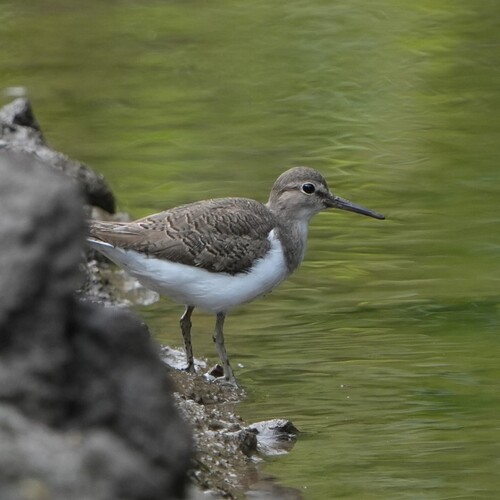
Common Sandpiper (Actitis hypoleucos) Common Sandpiper
Grey-tailed Tattler (Tringa brevipes) Grey-tailed Tattler

Media

Loading…

In short

The Common Sandpiper and Grey-tailed Tattler are both small waders, but the Common Sandpiper is distinguished by its more pronounced white wingbar in flight and a longer tail that extends beyond the wings when at rest. The Grey-tailed Tattler has a more uniform grey appearance and lacks the distinct wingbar of the Common Sandpiper.

Identification tips

Size

Both species are similar in size, but the Common Sandpiper is slightly smaller with a wingspan of 38–41 cm compared to the Grey-tailed Tattler.

Plumage

The Common Sandpiper has greenish-brown upperparts with dark lateral breast patches and a white wingbar in flight. The Grey-tailed Tattler is more uniformly grey with less contrast between the upperparts and underparts.

Behaviour

Both species exhibit similar foraging behavior, often seen probing in mud or shallow water. The Common Sandpiper is known for its distinctive bobbing motion.

Habitat

Both species frequent similar habitats such as mudflats, riverbanks, and coastal areas. The Common Sandpiper is more often seen inland near freshwater bodies.

Voice

The Common Sandpiper's call is a quick, shrill 'swee-wee-wee' series, while the Grey-tailed Tattler's call is less frequently described but generally quieter and less distinctive.

Submit a better description

Use the same sections as the comparison. Your text is published immediately.

The Common Sandpiper and Grey-tailed Tattler are both small waders, but the Common Sandpiper is distinguished by its more pronounced white wingbar in flight and a longer tail that extends beyond the wings when at rest. The Grey-tailed Tattler has a more uniform grey appearance and lacks the distinct wingbar of the Common Sandpiper.

  • Wingbar: Look for the distinct white wingbar in the Common Sandpiper during flight.
  • Tail Length: At rest, the Common Sandpiper's tail extends beyond the wingtips, unlike the Grey-tailed Tattler.
  • Plumage Color: The Common Sandpiper has more contrast with its greenish-brown upperparts and white underparts, whereas the Grey-tailed Tattler is more uniformly grey.
  • Behavior: Note the Common Sandpiper's characteristic bobbing motion.
  • Vocalization: Listen for the Common Sandpiper's 'swee-wee-wee' call, which is more distinctive than the Grey-tailed Tattler's.

Both species are similar in size, but the Common Sandpiper is slightly smaller with a wingspan of 38–41 cm compared to the Grey-tailed Tattler.

The Common Sandpiper has greenish-brown upperparts with dark lateral breast patches and a white wingbar in flight. The Grey-tailed Tattler is more uniformly grey with less contrast between the upperparts and underparts.

Both species exhibit similar foraging behavior, often seen probing in mud or shallow water. The Common Sandpiper is known for its distinctive bobbing motion.

Both species frequent similar habitats such as mudflats, riverbanks, and coastal areas. The Common Sandpiper is more often seen inland near freshwater bodies.

The Common Sandpiper's call is a quick, shrill 'swee-wee-wee' series, while the Grey-tailed Tattler's call is less frequently described but generally quieter and less distinctive.

Discard your changes?

You have unsaved edits. If you leave now, those changes will be lost.

Common Sandpiper · Grey-tailed Tattler · My Tricky Birds