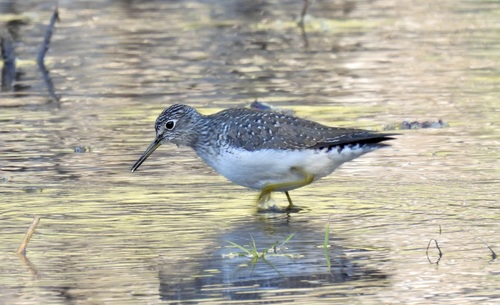
Common Sandpiper vs Solitary Sandpiper
Actitis hypoleucos versus Tringa solitaria
Play a quiz with Common Sandpiper and Solitary Sandpiper

Common Sandpiper
Solitary Sandpiper
In short
The Common Sandpiper and Solitary Sandpiper can be distinguished by their flight patterns and wing markings. The Common Sandpiper shows a distinct white wingbar in flight, while the Solitary Sandpiper lacks this feature. Additionally, the Solitary Sandpiper is more likely to be seen alone or in small groups.
Identification tips
- Flight pattern: Look for the white wingbar in the Common Sandpiper.
- Group size: Solitary Sandpipers are often alone or in small groups.
- Tail behavior: Common Sandpipers frequently bob their tails.
- Habitat: Check for wooded areas for Solitary Sandpipers, especially during breeding season.
Size
Both species are similar in size, but the Common Sandpiper is slightly smaller with a wingspan of 38–41 cm compared to the Solitary Sandpiper.
Plumage
The Common Sandpiper has greenish-brown upperparts with a pale eye-ring and dark lateral breast patches, while the Solitary Sandpiper has a more uniform dark brown plumage with a white eye-ring and lacks the distinct wingbar.
Behaviour
The Common Sandpiper often bobs its tail and is more likely to be found in flocks, whereas the Solitary Sandpiper is aptly named for its tendency to be alone or in small groups. The Solitary Sandpiper also holds its wings straight up when alighting.
Habitat
The Common Sandpiper is often found near freshwater habitats, while the Solitary Sandpiper prefers more wooded areas and can be found nesting in abandoned tree nests.
Voice
The Common Sandpiper's call is a quick, shrill 'swee-wee-wee' series, while the Solitary Sandpiper's vocalizations are less documented but are known to be different from the Common Sandpiper.