Birdr

Common Scoter vs Long-tailed Duck

Melanitta nigra versus Clangula hyemalis

Play a quiz with Common Scoter and Long-tailed Duck
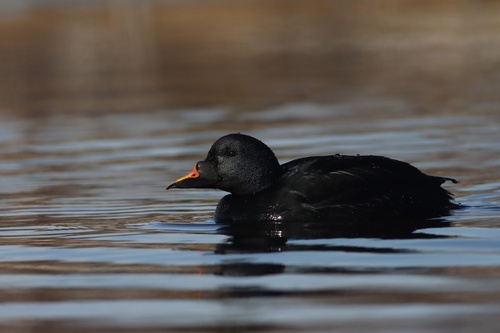
Common Scoter (Melanitta nigra) Common Scoter
Long-tailed Duck (Clangula hyemalis) Long-tailed Duck

Media

Loading…

In short

The Common Scoter (Melanitta nigra) and Long-tailed Duck (Clangula hyemalis) can be distinguished primarily by their tail and bill features. The Long-tailed Duck has distinctive long tail feathers in males and a pink band on the bill, while the Common Scoter is more uniformly dark with a yellow patch on the male's bill.

Identification tips

  1. Tail: Look for the long tail feathers in male Long-tailed Ducks. 2. Bill: Check for the yellow patch on the Common Scoter's bill and the pink band on the Long-tailed Duck's bill. 3. Plumage: Note the uniform dark color of the Common Scoter versus the seasonal plumage changes in the Long-tailed Duck. 4. Habitat: Consider the likelihood of seeing Common Scoters at sea compared to Long-tailed Ducks in coastal or tundra areas. 5. Vocalization: Listen for the distinctive nasal calls of the Long-tailed Duck.

Size

Common Scoter is larger, with a wingspan of 79–90 cm, while the Long-tailed Duck is smaller with a more compact appearance.

Plumage

Common Scoter males are sooty black with a yellow patch on the bill, while females are dark brown. Long-tailed Duck males have striking long tail feathers and a pink band on the bill, with seasonal plumage changes; females are more muted but share the long tail feature.

Behaviour

Common Scoter has a light, fast, and direct flight with a long-necked appearance on water. Long-tailed Duck often dives and is more active, with a distinctive flight pattern due to its long tail.

Habitat

Common Scoter is often found at sea, while Long-tailed Duck frequents coastal waters and tundra breeding grounds.

Voice

Common Scoter is usually silent, but males may produce thin, piping whistles. Long-tailed Duck is known for its nasal-sounding calls, audible over long distances.

Submit a better description

Use the same sections as the comparison. Your text is published immediately.

The Common Scoter (Melanitta nigra) and Long-tailed Duck (Clangula hyemalis) can be distinguished primarily by their tail and bill features. The Long-tailed Duck has distinctive long tail feathers in males and a pink band on the bill, while the Common Scoter is more uniformly dark with a yellow patch on the male's bill.

  1. Tail: Look for the long tail feathers in male Long-tailed Ducks. 2. Bill: Check for the yellow patch on the Common Scoter's bill and the pink band on the Long-tailed Duck's bill. 3. Plumage: Note the uniform dark color of the Common Scoter versus the seasonal plumage changes in the Long-tailed Duck. 4. Habitat: Consider the likelihood of seeing Common Scoters at sea compared to Long-tailed Ducks in coastal or tundra areas. 5. Vocalization: Listen for the distinctive nasal calls of the Long-tailed Duck.

Common Scoter is larger, with a wingspan of 79–90 cm, while the Long-tailed Duck is smaller with a more compact appearance.

Common Scoter males are sooty black with a yellow patch on the bill, while females are dark brown. Long-tailed Duck males have striking long tail feathers and a pink band on the bill, with seasonal plumage changes; females are more muted but share the long tail feature.

Common Scoter has a light, fast, and direct flight with a long-necked appearance on water. Long-tailed Duck often dives and is more active, with a distinctive flight pattern due to its long tail.

Common Scoter is often found at sea, while Long-tailed Duck frequents coastal waters and tundra breeding grounds.

Common Scoter is usually silent, but males may produce thin, piping whistles. Long-tailed Duck is known for its nasal-sounding calls, audible over long distances.

Discard your changes?

You have unsaved edits. If you leave now, those changes will be lost.

Common Scoter · Long-tailed Duck · My Tricky Birds