
Common Snipe vs Wilson's Snipe
Gallinago gallinago versus Gallinago delicata
Play a quiz with Common Snipe and Wilson's Snipe
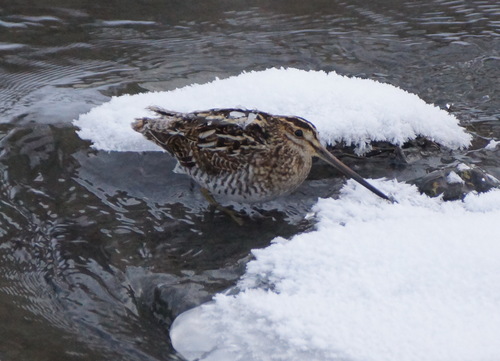 Common Snipe
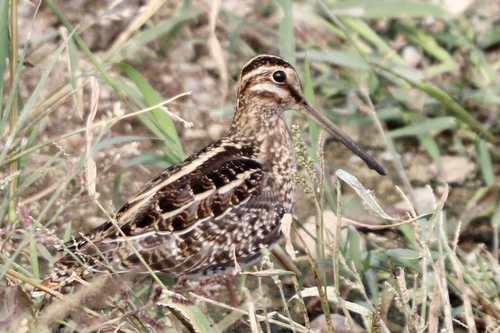 Wilson's Snipe
In short
The most reliable field mark between Common Snipe and Wilson's Snipe is the number of tail feather pairs: Common Snipe has seven, while Wilson's Snipe has eight. In the field, this is rarely visible, but the width of the white trailing edge to the wing in flight is a practical clue—Common Snipe shows a broader white trailing edge, while Wilson's Snipe's is distinctly narrower. Both species are extremely similar in size, structure, and general plumage, with subtle differences in upperpart tone and pattern. Separation is challenging, especially outside their core ranges, and most field marks are best judged on birds in flight or with excellent views.
Identification tips
- White trailing edge to wing (all ages, in flight): Look for the width of the white trailing edge on the secondaries. Common Snipe shows a broader white band, while Wilson's Snipe's is narrower and more restricted to the tips. This is best seen in good light as the bird flies away or banks.
- Tail feather count (all ages): If you have a clear photo or the bird fans its tail, count the pairs of tail feathers—seven in Common, eight in Wilson's. This is rarely practical in the field.
- Upperpart tone (adults, perched): Common Snipe may appear slightly richer or warmer-toned above, especially in the faeroeensis subspecies, but this is subtle and overlaps with Wilson's Snipe.
- Bill length and shape: Both species have very long, straight, dark bills; do not use this for separation.
- Head pattern: Both have a dark eye-stripe with pale lines above and below; not useful for ID.
- Leg color: Both have short greenish-grey legs; not a separator.
- Underparts: Both are pale below; no consistent difference.
- Behavior (flushing, feeding): Both are shy, flush at close range, and zig-zag in flight; behavior does not separate them.
- Courtship display: Both perform aerial 'winnowing' displays with similar sounds; display behavior is not diagnostic.
- Vocalizations: Both give a sharp scape call when flushed and a similar 'drumming' sound in display; not reliably different.
- Habitat: Both use marshes, bogs, and wet meadows; context is only helpful if you are in a region where one species is the default.
- Geographic context: In Eurasia, Common Snipe is expected; in North America, Wilson's Snipe is the default. Use this as a starting point but confirm with plumage if possible, especially in overlap zones or for vagrants.
- Age/season: No age-specific plumage differences are reliably diagnostic between these two; the wing trailing edge is consistent across ages.
- Pitfalls: Do not rely on general color, bill length, or behavior. Focus on the wing trailing edge in flight and, if possible, tail feather count.
- When in doubt: If the white trailing edge is not clearly visible and tail feather count is unavailable, identification may not be possible in the field. Document with photos for expert review.
Size
Both species are compact, stocky waders with similar proportions. Common Snipe averages 119.5 g in mass [wikidata], while Wilson's Snipe falls within a nearly identical range (79–147 g). Length and wingspan overlap: Common Snipe is 25–27 cm long with a 44–47 cm wingspan; Wilson's Snipe is 23–28 cm long with a 39–45 cm wingspan [wikipedia]. In the field, size is not a reliable separator.
Plumage
- Juvenile/immature and adult flight views: The most diagnostic mark is the white trailing edge to the wing. Common Snipe (all ages) shows a broader white trailing edge, especially on the secondaries, while Wilson's Snipe's is narrower and more confined to the tips of the secondaries. This difference is subtle but visible in good light and close flight views.
- Tail feathers: If seen well (e.g., in photos or at close range), Common Snipe has seven pairs of tail feathers, Wilson's Snipe has eight. This is rarely visible in the field.
- Upperparts: Common Snipe tends to be more richly toned above, especially in the faeroeensis subspecies, but this is variable and unreliable for most observers. Both species have similar straw-yellow stripes on a brown background.
- Head pattern: Both species have a dark eye-stripe with pale supercilium and subocular lines; this is not a useful separator.
- Underparts: Both are pale below, with no consistent differences.
- Leg color: Both have short greenish-grey legs.
- Bill: Both have a very long, straight, dark bill; bill length and shape are not diagnostic.
Behaviour
Both species are shy, well-camouflaged, and flush only when approached closely, zig-zagging away in flight. Both probe in soft mud for food and perform aerial 'winnowing' displays during courtship, producing a distinctive sound with their tail feathers. Their general behavior and 'jizz' are virtually identical in the field.
Habitat
Habitat preferences are extremely similar: both breed and forage in marshes, bogs, wet meadows, and tundra. In the Old World, Common Snipe is the default; in North America, Wilson's Snipe predominates. Overlap occurs in western Alaska (Aleutians) and as vagrants elsewhere, but habitat alone is not a separator.
Voice
Both species give a sharp scape-like call when flushed and perform a 'winnowing' or 'drumming' display in flight by vibrating their tail feathers. The sound is similar in both, described as a bleating or breathy noise, and is not reliably different in the field.