Birdr

Common Starling vs Grey Catbird

Sturnus vulgaris versus Dumetella carolinensis

Play a quiz with Common Starling and Grey Catbird

Common Starling (Sturnus vulgaris) Common Starling
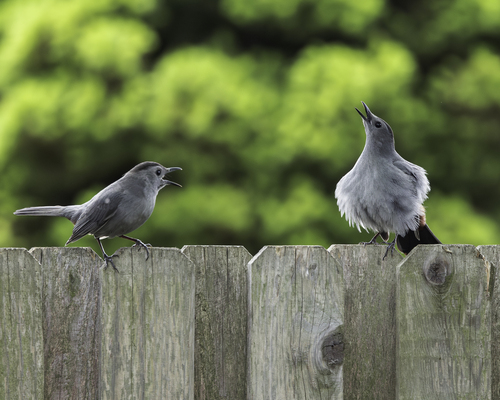
Grey Catbird (Dumetella carolinensis) Grey Catbird

Media

Loading…

In short

The Common Starling and Grey Catbird can be distinguished by their plumage and behavior. Starlings have a glossy, iridescent appearance with speckled underparts, while Catbirds are uniformly grey with a distinctive black cap. In terms of behavior, Starlings are often seen in large flocks, whereas Catbirds are more solitary and secretive.

Identification tips

1. Plumage: Look for the Starling's iridescent sheen and speckled underparts versus the Catbird's uniform grey and black cap. 2. Behavior: Note the Starling's flocking behavior compared to the Catbird's solitary nature. 3. Habitat: Consider the environment; Starlings are more urban, while Catbirds prefer dense shrubs. 4. Vocalization: Listen for the Starling's complex song and mimicry versus the Catbird's cat-like calls.

Size

Both species are similar in size, but the Common Starling is slightly more robust.

Plumage

Common Starlings have a glossy black plumage with iridescent greens and purples, especially in sunlight, and speckled underparts. Grey Catbirds are uniformly slate grey with a black cap and a small chestnut patch under the tail.

Behaviour

Starlings are highly social, often seen in large flocks, especially during migration and winter. Grey Catbirds are more solitary, skulking in dense vegetation and rarely seen in groups.

Habitat

Starlings are adaptable and found in urban areas, farmlands, and open woodlands. Grey Catbirds prefer dense, shrubby vegetation and are more often found in thickets and forest edges.

Voice

Common Starlings are known for their varied and complex songs, often mimicking other species. Grey Catbirds have a distinctive cat-like mew and a varied song that includes mimicry but is less complex than the Starling's.

Submit a better description

Use the same sections as the comparison. Your text is published immediately.

The Common Starling and Grey Catbird can be distinguished by their plumage and behavior. Starlings have a glossy, iridescent appearance with speckled underparts, while Catbirds are uniformly grey with a distinctive black cap. In terms of behavior, Starlings are often seen in large flocks, whereas Catbirds are more solitary and secretive.

1. Plumage: Look for the Starling's iridescent sheen and speckled underparts versus the Catbird's uniform grey and black cap. 2. Behavior: Note the Starling's flocking behavior compared to the Catbird's solitary nature. 3. Habitat: Consider the environment; Starlings are more urban, while Catbirds prefer dense shrubs. 4. Vocalization: Listen for the Starling's complex song and mimicry versus the Catbird's cat-like calls.

Both species are similar in size, but the Common Starling is slightly more robust.

Common Starlings have a glossy black plumage with iridescent greens and purples, especially in sunlight, and speckled underparts. Grey Catbirds are uniformly slate grey with a black cap and a small chestnut patch under the tail.

Starlings are highly social, often seen in large flocks, especially during migration and winter. Grey Catbirds are more solitary, skulking in dense vegetation and rarely seen in groups.

Starlings are adaptable and found in urban areas, farmlands, and open woodlands. Grey Catbirds prefer dense, shrubby vegetation and are more often found in thickets and forest edges.

Common Starlings are known for their varied and complex songs, often mimicking other species. Grey Catbirds have a distinctive cat-like mew and a varied song that includes mimicry but is less complex than the Starling's.

Discard your changes?

You have unsaved edits. If you leave now, those changes will be lost.

Common Starling · Grey Catbird · My Tricky Birds