
Common Starling vs Song Thrush
Sturnus vulgaris versus Turdus philomelos
Play a quiz with Common Starling and Song Thrush
 Common Starling
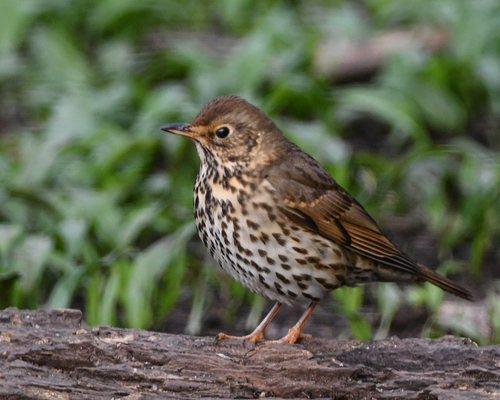 Song Thrush
In short
The most reliable field mark to separate Common Starling from Song Thrush is the overall plumage: starlings are iridescent black with a metallic sheen and seasonal white speckling, while song thrushes are warm brown above and heavily spotted below. Immature starlings are grey-brown and can be confused with thrushes, but even then, the starling’s short tail, sharply pointed wings, and blade-like bill stand out, especially in flight. Song thrushes show a warm yellow underwing in flight, never present in starlings. Both species are similar in length, but starlings appear more compact and stocky, with a waddling gait, while thrushes are more upright and slender. Use bill color, leg color, and flight style as additional checks, especially in mixed flocks or poor light.
Identification tips
- Underparts spotting: Song Thrushes of all ages have bold, dark spots on a cream or buff breast and flanks; starlings never show this pattern. Even in juvenile starlings, the underparts are plain.
- Overall color: Adult starlings are iridescent black with a metallic sheen and white speckling in winter; song thrushes are always brown above and pale below.
- Bill shape and color: Starlings have a long, narrow, sharply pointed bill (black in winter, yellow in summer); thrushes have a stouter, yellowish bill year-round.
- Leg color: Both species have pinkish legs, but starlings’ are stouter and can appear more reddish, especially in breeding season.
- Tail shape: Starlings have a short, square tail; song thrushes have a longer, more rounded tail.
- Wing shape in flight: Starlings have strongly pointed, triangular wings; song thrushes’ wings are broader and more rounded.
- Underwing color in flight: Song Thrushes show a warm yellow underwing, never present in starlings (whose wings are uniformly dark).
- Juvenile confusion: Young starlings are plain grey-brown and can look superficially like thrushes, but lack any spotting below and have a more uniform appearance.
- Flock structure: Starlings are often in tight, synchronized flocks, especially in flight; thrushes are usually solitary or in loose groups.
- Movement on the ground: Starlings walk or run with a waddling gait; thrushes hop and are more upright.
- Song: Song Thrushes sing loud, repeated musical phrases; starlings have a more chaotic, mimicking song.
- Iris color (close views): Adult male starlings have rich brown irises; females’ are mouse-brown or grey. Not useful for thrushes.
- Seasonal bill color: Starling bills turn yellow in summer (with a blue-grey base in males, pink in females); thrush bills do not change seasonally.
- Habitat context: Large, dense flocks in open fields are more likely to be starlings; single birds or pairs in shrubby or wooded areas are more likely thrushes.
- Flight style: Starlings fly fast and direct with rapid wingbeats and short glides; thrushes have a more bounding, less direct flight.
Size
Both species are similar in length (about 20–23 cm), but the Song Thrush is slightly heavier on average (72 g vs a variable 58–101 g for starlings). In the field, starlings look more compact and round-bellied, with a shorter tail and a chunkier, more powerful build. Song thrushes are more upright, longer-bodied, and have a proportionally longer tail. Starlings have a sharper, conical bill, while the thrush’s bill is stouter and more typical of a true thrush. These differences are subtle at a distance but become clear with good views.
Plumage
- Juvenile and immature birds: Juvenile Common Starlings are grey-brown overall, lacking the adult’s iridescence and spots, and can be confused with Song Thrushes at a glance. However, even young starlings have a uniform, plain appearance without the bold, dark spotting on the underparts that is diagnostic for all ages of Song Thrush. Juvenile Song Thrushes resemble adults but show buff or orange streaks on the back and wing coverts, and always have spotted underparts.
- Adults: Adult starlings are glossy black with a metallic purple or green sheen and are spangled with white in winter (from pale feather tips), becoming less spotted as the tips wear off by spring. Song thrushes are always brown above and cream or buff below, with neat black spots on the chest and flanks. Starlings never show the thrush’s warm yellow underwing in flight; their wings are uniformly dark and strongly pointed. The starling’s bill changes from black in winter to yellow in summer, while the thrush’s bill is always yellowish. Starlings’ legs are pinkish or greyish-red, while thrushes’ are pink.
Behaviour
Common Starlings move with a waddling walk or run on the ground, rarely hopping, and often feed in tight, coordinated flocks. Their flight is fast, direct, and marked by rapid wingbeats with short glides; flocks wheel and turn in tight synchrony. Song Thrushes are more solitary or in loose groups, move with a more upright stance, and hop rather than walk. Their flight is less direct, more bounding, and they often perch upright on exposed branches or rooftops to sing.
Habitat
Both species can be found in a wide range of open or semi-open habitats, including parks, gardens, and farmland. Starlings are more likely to be seen in large, dense flocks, especially in winter, and are often associated with urban areas and open fields. Song Thrushes are more often found singly or in pairs, preferring areas with more cover such as hedgerows, woodland edges, and dense gardens. In migration or winter, both may overlap in more open habitats.
Voice
Song Thrushes are famous for their loud, musical song made up of repeated phrases, often delivered from a high perch. Their calls include a sharp 'tsip' and a strident 'chook-chook' alarm. Starlings are highly vocal and mimic a wide range of sounds, but their song is a jumble of whistles, clicks, and rattles, lacking the thrush’s repeated musical phrases. In flight, starlings give a harsh, dry call, while thrushes’ flight calls are thinner and more high-pitched.