Birdr

Common Swift vs African Swift

Apus apus versus Apus barbatus

Play a quiz with Common Swift and African Swift
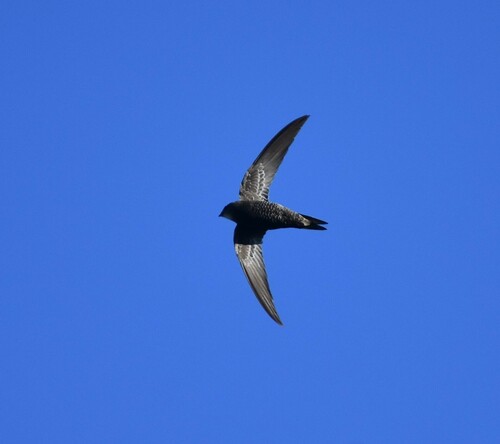
Common Swift (Apus apus) Common Swift
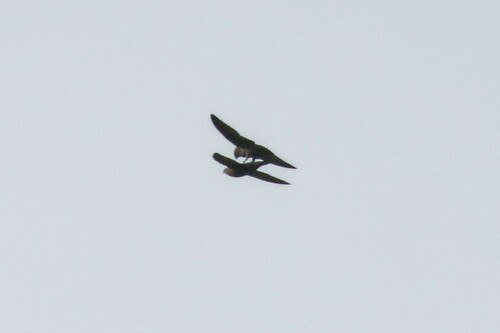
African Swift (Apus barbatus) African Swift

Media

Loading…

In short

The Common Swift (Apus apus) and African Swift (Apus barbatus) are both dark, fast-flying swifts with long, pointed wings and forked tails. The most reliable field mark is the presence of a small off-white throat patch in the Common Swift, which is absent or much less distinct in the African Swift. Both species are often seen in flight, making structural differences more useful than plumage details.

Identification tips

  1. Look for the off-white throat patch in the Common Swift, absent in the African Swift. 2. Note the habitat: Common Swifts are more widespread across various climates, while African Swifts prefer highland areas. 3. Observe behavior: both species are highly aerial, but the Common Swift is known for extended periods of flight without landing.

Size

Both species are similar in size, with the Common Swift having a wingspan of 42–48 cm. The African Swift's measurements are not detailed here, but they are generally comparable.

Plumage

The Common Swift has a small off-white throat patch, which can be a key distinguishing feature. The African Swift lacks this distinct throat patch, appearing more uniformly dark.

Behaviour

Both species are highly aerial and spend most of their time in flight. The Common Swift is known for being airborne for extended periods, even during migration.

Habitat

Common Swifts inhabit a wide range of habitats from temperate to boreal zones, while African Swifts are often found in moist highlands at elevations of 1,600–2,400 m. The African Swift is more common in the southeast of its range.

Submit a better description

Use the same sections as the comparison. Your text is published immediately.

The Common Swift (Apus apus) and African Swift (Apus barbatus) are both dark, fast-flying swifts with long, pointed wings and forked tails. The most reliable field mark is the presence of a small off-white throat patch in the Common Swift, which is absent or much less distinct in the African Swift. Both species are often seen in flight, making structural differences more useful than plumage details.

  1. Look for the off-white throat patch in the Common Swift, absent in the African Swift. 2. Note the habitat: Common Swifts are more widespread across various climates, while African Swifts prefer highland areas. 3. Observe behavior: both species are highly aerial, but the Common Swift is known for extended periods of flight without landing.

Both species are similar in size, with the Common Swift having a wingspan of 42–48 cm. The African Swift's measurements are not detailed here, but they are generally comparable.

The Common Swift has a small off-white throat patch, which can be a key distinguishing feature. The African Swift lacks this distinct throat patch, appearing more uniformly dark.

Both species are highly aerial and spend most of their time in flight. The Common Swift is known for being airborne for extended periods, even during migration.

Common Swifts inhabit a wide range of habitats from temperate to boreal zones, while African Swifts are often found in moist highlands at elevations of 1,600–2,400 m. The African Swift is more common in the southeast of its range.

Discard your changes?

You have unsaved edits. If you leave now, those changes will be lost.

Common Swift · African Swift · My Tricky Birds