Birdr

Common Swift vs Asian Palm Swift

Apus apus versus Cypsiurus balasiensis

Play a quiz with Common Swift and Asian Palm Swift
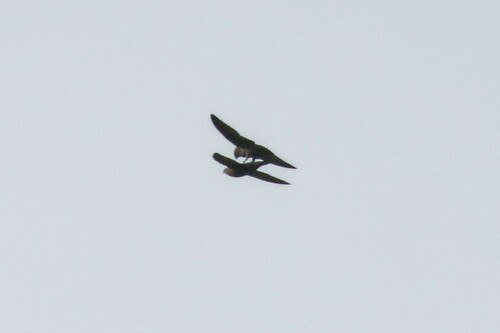
Common Swift (Apus apus) Common Swift
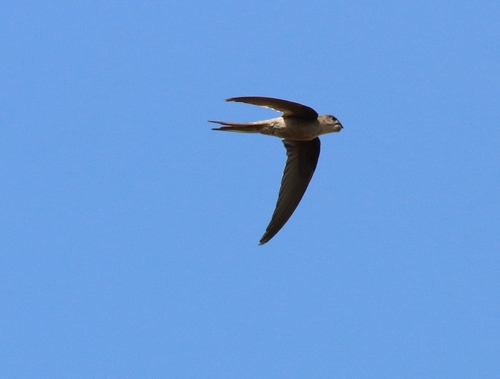
Asian Palm Swift (Cypsiurus balasiensis) Asian Palm Swift

Media

Loading…

In short

The Common Swift and Asian Palm Swift are both members of the swift family but differ notably in structure and habitat preferences. The Common Swift is larger with a more robust build and deeply forked tail, while the Asian Palm Swift is smaller, more slender, and has a less pronounced fork in its tail.

Identification tips

  1. Size and Shape: Look for the larger size and more robust build of the Common Swift compared to the slender Asian Palm Swift. 2. Tail Shape: The Common Swift has a deeply forked tail, while the Asian Palm Swift's tail is less forked. 3. Throat Patch: A small off-white throat patch is visible on the Common Swift but not on the Asian Palm Swift. 4. Habitat: Consider the habitat; Common Swifts are more likely in temperate zones, while Asian Palm Swifts are found in tropical areas near palms.

Size

The Common Swift is larger, measuring 16–18 cm in length with a wingspan of 42–48 cm, while the Asian Palm Swift is smaller and more slender.

Plumage

Common Swifts are uniformly dark brown with a small off-white throat patch, whereas Asian Palm Swifts have a paler, more uniform brown plumage without a distinct throat patch.

Behaviour

Common Swifts are known for their almost entirely aerial lifestyle, spending most of their time in flight. Asian Palm Swifts also spend much time in the air but are often seen near palm trees where they nest.

Habitat

Common Swifts inhabit a wide range of habitats from temperate to boreal zones, often seen over urban areas. In contrast, Asian Palm Swifts are typically found in tropical and subtropical regions, frequently near palm trees.

Submit a better description

Use the same sections as the comparison. Your text is published immediately.

The Common Swift and Asian Palm Swift are both members of the swift family but differ notably in structure and habitat preferences. The Common Swift is larger with a more robust build and deeply forked tail, while the Asian Palm Swift is smaller, more slender, and has a less pronounced fork in its tail.

  1. Size and Shape: Look for the larger size and more robust build of the Common Swift compared to the slender Asian Palm Swift. 2. Tail Shape: The Common Swift has a deeply forked tail, while the Asian Palm Swift's tail is less forked. 3. Throat Patch: A small off-white throat patch is visible on the Common Swift but not on the Asian Palm Swift. 4. Habitat: Consider the habitat; Common Swifts are more likely in temperate zones, while Asian Palm Swifts are found in tropical areas near palms.

The Common Swift is larger, measuring 16–18 cm in length with a wingspan of 42–48 cm, while the Asian Palm Swift is smaller and more slender.

Common Swifts are uniformly dark brown with a small off-white throat patch, whereas Asian Palm Swifts have a paler, more uniform brown plumage without a distinct throat patch.

Common Swifts are known for their almost entirely aerial lifestyle, spending most of their time in flight. Asian Palm Swifts also spend much time in the air but are often seen near palm trees where they nest.

Common Swifts inhabit a wide range of habitats from temperate to boreal zones, often seen over urban areas. In contrast, Asian Palm Swifts are typically found in tropical and subtropical regions, frequently near palm trees.

Discard your changes?

You have unsaved edits. If you leave now, those changes will be lost.

Common Swift · Asian Palm Swift · My Tricky Birds