Birdr

Common Swift vs Little Swift

Apus apus versus Apus affinis

Play a quiz with Common Swift and Little Swift
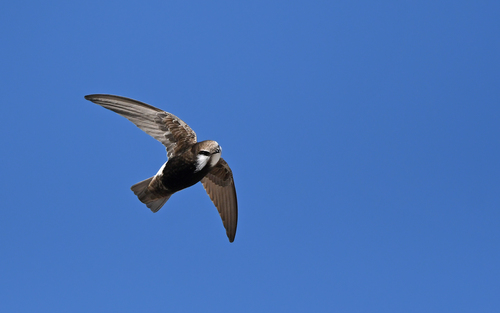
Common Swift (Apus apus) Common Swift
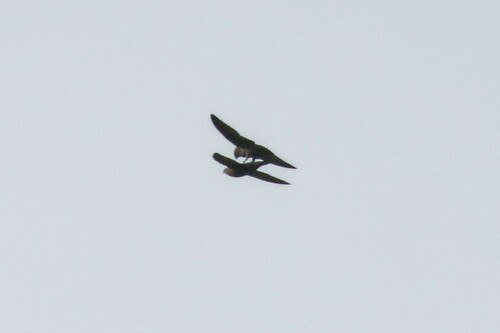
Little Swift (Apus affinis) Little Swift

Media

Loading…

In short

The Common Swift and Little Swift are both dark, fast-flying birds with long wings, but they can be distinguished by size and tail shape. The Common Swift is larger with a more pronounced forked tail, while the Little Swift is smaller with a shorter, more square tail.

Identification tips

  1. Size and Tail Shape: Look for the larger size and deeply forked tail of the Common Swift compared to the smaller, square-tailed Little Swift. 2. Throat Patch: The Common Swift has a small off-white throat patch that can help in identification. 3. Flight Behavior: Observe flight patterns; Common Swifts are almost constantly airborne.

Size

The Common Swift is larger, measuring 16–18 cm in length with a wingspan of 42–48 cm, whereas the Little Swift is noticeably smaller.

Plumage

Both species have dark plumage, but the Common Swift has a small off-white throat patch, which is less prominent in the Little Swift. The Common Swift's plumage can appear slightly paler on the inner wing and rump.

Behaviour

Common Swifts are known for spending most of their life airborne, even during migration. Little Swifts also spend much time in the air but are more likely to be seen nesting on buildings and cliffs.

Habitat

Common Swifts are found in a wide range of habitats, from temperate to boreal zones, and are common in urban areas. Little Swifts are more often associated with urban environments and are found in parts of Africa and Asia.

Submit a better description

Use the same sections as the comparison. Your text is published immediately.

The Common Swift and Little Swift are both dark, fast-flying birds with long wings, but they can be distinguished by size and tail shape. The Common Swift is larger with a more pronounced forked tail, while the Little Swift is smaller with a shorter, more square tail.

  1. Size and Tail Shape: Look for the larger size and deeply forked tail of the Common Swift compared to the smaller, square-tailed Little Swift. 2. Throat Patch: The Common Swift has a small off-white throat patch that can help in identification. 3. Flight Behavior: Observe flight patterns; Common Swifts are almost constantly airborne.

The Common Swift is larger, measuring 16–18 cm in length with a wingspan of 42–48 cm, whereas the Little Swift is noticeably smaller.

Both species have dark plumage, but the Common Swift has a small off-white throat patch, which is less prominent in the Little Swift. The Common Swift's plumage can appear slightly paler on the inner wing and rump.

Common Swifts are known for spending most of their life airborne, even during migration. Little Swifts also spend much time in the air but are more likely to be seen nesting on buildings and cliffs.

Common Swifts are found in a wide range of habitats, from temperate to boreal zones, and are common in urban areas. Little Swifts are more often associated with urban environments and are found in parts of Africa and Asia.

Discard your changes?

You have unsaved edits. If you leave now, those changes will be lost.

Common Swift · Little Swift · My Tricky Birds