
Common Tern vs White-cheeked Tern
Sterna hirundo versus Sterna repressa
Play a quiz with Common Tern and White-cheeked Tern
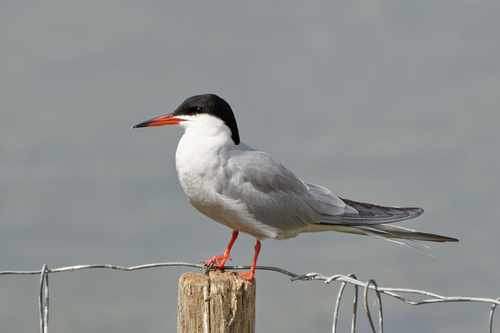 Common Tern
 White-cheeked Tern
In short
The most reliable field mark to separate Common Tern from White-cheeked Tern is plumage: adult White-cheeked Terns in breeding plumage show uniform grey upperparts and distinctly whiter cheeks, while Common Terns have paler grey upperparts and less contrast in the face. Juvenile and immature plumages are not fully described for White-cheeked Tern, but Common Tern juveniles are easily separated from similar-aged birds of other species. Structurally, Common Tern is slightly larger and more robust, with longer legs and a more triangular wing shape, while White-cheeked Tern is smaller and more delicate. Both species are coastal, but their ranges do not overlap: Common Tern is widespread in temperate and subarctic regions, while White-cheeked Tern is restricted to the Red Sea, western Indian Ocean, and adjacent coasts. Use a combination of plumage, structure, and location for confident identification.
Identification tips
- Location is key: If you are outside the Red Sea, Persian Gulf, or western Indian Ocean, you are almost certainly looking at a Common Tern, not a White-cheeked Tern. Conversely, within the White-cheeked Tern's range, both species could occur as vagrants, but Common Tern is rare.
- Adult breeding plumage: Look for uniform grey upperparts and sharply white cheeks on White-cheeked Tern; Common Tern is paler above with less facial contrast.
- Facial pattern: White-cheeked Tern in breeding plumage has whiter cheeks, making the face stand out more; Common Tern's cheeks are less distinct from the rest of the head.
- Wing shape and flight: Common Tern has longer, more triangular, and stiffer wings, giving a more powerful, direct flight. White-cheeked Tern is smaller and likely more agile, but this is subtle and best used with other marks.
- Bill and leg color: Common Tern's bill is orange-red with a black tip (except in some subspecies), and legs are bright red. White-cheeked Tern's bill and legs are darker, but this is not always reliable at distance.
- Size and structure: Common Tern is slightly larger, with a bigger head, thicker neck, and longer legs. White-cheeked Tern is more delicate overall.
- Upperwing pattern: Common Tern develops a dark wedge on the wings in breeding season; White-cheeked Tern's wings remain more uniform.
- Juvenile/immature birds: Common Tern juveniles are said to be easily separated from other species, but detailed marks are not provided for White-cheeked Tern, so caution is needed with young birds.
- Non-breeding plumage: Common Tern can show a greyish rump and less facial contrast; White-cheeked Tern's non-breeding plumage is not described in detail, so use caution.
- Habitat context: Common Tern can be seen inland during migration; White-cheeked Tern is strictly coastal.
- Tail length: Not detailed for White-cheeked Tern, but Common Tern has moderately long tail streamers; if tail streamers are very long, consider other species.
- Mixed flocks: In areas of overlap, scan for facial contrast and upperpart color to pick out White-cheeked Tern among Common Terns.
- Voice: No diagnostic information provided; do not rely on calls for separation.
- Pitfalls: Beware of lighting conditions that can alter the appearance of upperpart color and facial contrast, especially at distance or in harsh light.
- When in doubt: Use a combination of range, structure, and facial pattern for the most reliable separation, and document with photos if possible.
Size
Direct mass data is only available for White-cheeked Tern (123.5 g [wikidata]); Common Tern is similar or slightly larger by reputation, with a more robust build, larger head, and longer legs. In the field, Common Tern may appear bulkier and more powerful in flight, while White-cheeked Tern is smaller and more delicate overall. However, size alone is subtle and best used in conjunction with other marks.
Plumage
- Juvenile/immature plumage: Detailed juvenile plumage for White-cheeked Tern is not described in the sources, but Common Tern juveniles are noted as being easily separated from similar-aged birds of other species (details not provided). Without specifics, age-based separation is limited.
- Adult breeding plumage: White-cheeked Tern adults in breeding plumage have uniform grey upperparts and distinctly whiter cheeks, creating a strong facial contrast. Common Tern adults have paler grey upperparts and less sharply defined white cheeks. The Common Tern may develop a dark wedge on the wings as the breeding season progresses, while White-cheeked Tern's wings remain more uniformly colored.
- Non-breeding plumage: Not fully described for White-cheeked Tern, but Common Tern can show a greyish rump and less contrast in the face.
- Bill and leg color: Common Tern has an orange-red bill with a black tip (except in some subspecies) and bright red legs; White-cheeked Tern's bill and legs are not described in detail, but are generally darker.
- Wing pattern in flight: Common Tern's wings are more triangular and stiffer, with only the four innermost primaries translucent against the sky, while White-cheeked Tern's flight style and wing translucency are not detailed.
Behaviour
Common Tern has a more powerful, direct flight with stiffer, triangular wings, reflecting its robust structure. White-cheeked Tern is smaller and likely more agile and delicate in flight, though specific flight style is not described. Both species are coastal and forage over water, but Common Tern is strongly migratory and can be seen inland during migration, while White-cheeked Tern is more localized to tropical coastal areas.
Habitat
Common Tern breeds in temperate and subarctic regions of Europe, Asia, and North America, and winters in tropical and subtropical coastal areas worldwide. White-cheeked Tern is restricted to the Red Sea, Horn of Africa, Persian Gulf, and adjacent coasts of Pakistan and western India. There is no range overlap: seeing a tern in Europe or North America rules out White-cheeked Tern, while a tern on the Red Sea or Persian Gulf is more likely to be White-cheeked. Both species use coastal habitats, but Common Tern may be found further inland during migration.