Birdr

Coppersmith Barbet vs Lineated Barbet

Psilopogon haemacephalus versus Psilopogon lineatus

Play a quiz with Coppersmith Barbet and Lineated Barbet
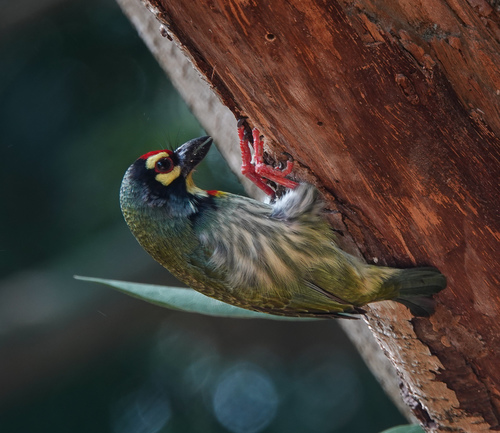
Coppersmith Barbet (Psilopogon haemacephalus) Coppersmith Barbet
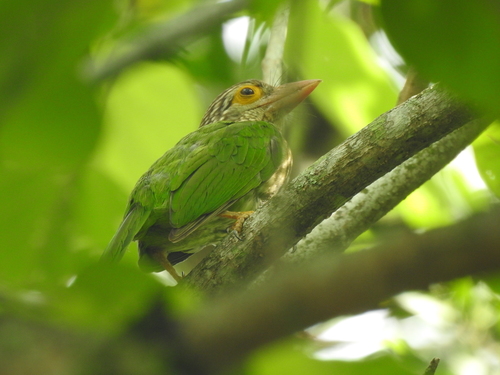
Lineated Barbet (Psilopogon lineatus) Lineated Barbet

Media

Loading…

In short

The Coppersmith Barbet and Lineated Barbet are both green-plumaged Asian barbets, but they can be distinguished by their head markings and vocalizations. The Coppersmith Barbet has a distinctive red forehead and throat, while the Lineated Barbet lacks these red patches and has a more uniformly streaked head. Their calls are also different, with the Coppersmith Barbet's call resembling a repetitive metallic hammering sound.

Identification tips

  1. Look for the red forehead and throat on the Coppersmith Barbet. 2. Note the uniformly streaked head of the Lineated Barbet. 3. Listen for the metallic 'tuk-tuk-tuk' call of the Coppersmith Barbet. 4. Consider the habitat; while both are adaptable, the Lineated Barbet is less common in dense forests.

Size

Both species are similar in size, but the Lineated Barbet is slightly larger and bulkier than the Coppersmith Barbet.

Plumage

The Coppersmith Barbet has bright-green upperparts with a red forehead and throat, and dark-streaked, pale-yellowish underparts. The Lineated Barbet lacks the red patches and has a more uniformly streaked head and underparts, with a generally duller appearance.

Behaviour

Both species are frugivorous and can be seen foraging in fruiting trees. They are cavity nesters, often using dead trees or anthropogenic structures.

Habitat

Both species are adaptable to human-modified environments. The Coppersmith Barbet is widespread across the Indian subcontinent and Southeast Asia, while the Lineated Barbet is found in similar regions but tends to avoid dense evergreen forests.

Voice

The Coppersmith Barbet's call is a repetitive, metallic 'tuk-tuk-tuk', reminiscent of a coppersmith hammering metal. The Lineated Barbet's call is less metallic and more of a series of hoots.

Submit a better description

Use the same sections as the comparison. Your text is published immediately.

The Coppersmith Barbet and Lineated Barbet are both green-plumaged Asian barbets, but they can be distinguished by their head markings and vocalizations. The Coppersmith Barbet has a distinctive red forehead and throat, while the Lineated Barbet lacks these red patches and has a more uniformly streaked head. Their calls are also different, with the Coppersmith Barbet's call resembling a repetitive metallic hammering sound.

  1. Look for the red forehead and throat on the Coppersmith Barbet. 2. Note the uniformly streaked head of the Lineated Barbet. 3. Listen for the metallic 'tuk-tuk-tuk' call of the Coppersmith Barbet. 4. Consider the habitat; while both are adaptable, the Lineated Barbet is less common in dense forests.

Both species are similar in size, but the Lineated Barbet is slightly larger and bulkier than the Coppersmith Barbet.

The Coppersmith Barbet has bright-green upperparts with a red forehead and throat, and dark-streaked, pale-yellowish underparts. The Lineated Barbet lacks the red patches and has a more uniformly streaked head and underparts, with a generally duller appearance.

Both species are frugivorous and can be seen foraging in fruiting trees. They are cavity nesters, often using dead trees or anthropogenic structures.

Both species are adaptable to human-modified environments. The Coppersmith Barbet is widespread across the Indian subcontinent and Southeast Asia, while the Lineated Barbet is found in similar regions but tends to avoid dense evergreen forests.

The Coppersmith Barbet's call is a repetitive, metallic 'tuk-tuk-tuk', reminiscent of a coppersmith hammering metal. The Lineated Barbet's call is less metallic and more of a series of hoots.

Discard your changes?

You have unsaved edits. If you leave now, those changes will be lost.

Coppersmith Barbet · Lineated Barbet · My Tricky Birds