
Corn Bunting vs Cirl Bunting
Emberiza calandra versus Emberiza cirlus
Play a quiz with Corn Bunting and Cirl Bunting
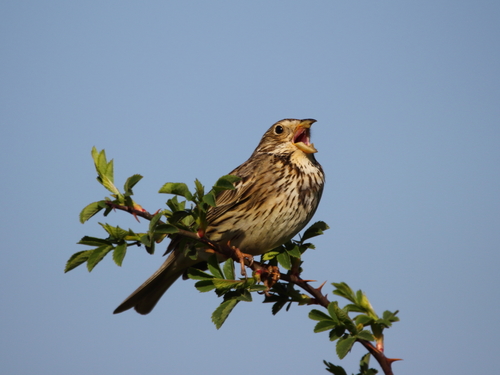 Corn Bunting
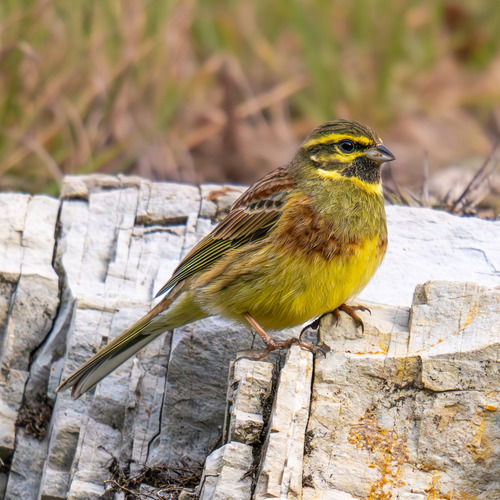 Cirl Bunting
In short
Corn Bunting and Cirl Bunting can be confused at a distance, especially when females or immatures are involved, but the most reliable field mark is the Corn Bunting’s plain, streaky, lark-like appearance versus the Cirl Bunting’s brighter, more patterned plumage—especially the male’s bold yellow and black head. Corn Bunting is noticeably larger and bulkier, with a heavy, plain bill and no strong color contrasts. Cirl Bunting males are unmistakable in spring and summer, but females can look drab and streaky, so check for chestnut shoulders and a smaller, more delicate structure. In flight or perched, Corn Bunting always lacks the yellow and black facial pattern of male Cirl Bunting, and has less contrast overall. Voice, habitat, and jizz also help, but structure and plumage are usually decisive.
Identification tips
- Size and bulk: Corn Bunting is distinctly larger and bulkier than Cirl Bunting; look for a thick-necked, heavy-bodied bird, especially when perched on wires or posts.
- Bill shape: Corn Bunting has a larger, heavier, more conical bill, often with a yellowish tinge to the mandibles; Cirl Bunting’s bill is thick but smaller relative to head size.
- Head pattern (males): Male Cirl Bunting shows a bright yellow head with bold black crown, eyestripe, and throat—unique among buntings in its range. Corn Bunting males are plain-headed, lacking any yellow or black facial markings.
- Head pattern (females/immatures): Female Cirl Bunting is duller but usually shows a more patterned face than Corn Bunting, with a streaked grey-brown rump and chestnut shoulders. Corn Bunting females are plain and lack any chestnut or yellow.
- Underparts: Corn Bunting has whitish underparts with heavy streaking on the breast and flanks, forming a gorget around the throat. Cirl Bunting males have yellow underparts with a greenish breast band; females are paler but less heavily streaked than Corn Bunting.
- Upperparts: Both are streaky brown above, but Corn Bunting is more uniformly dull and lark-like. Cirl Bunting has a more contrasting back, especially in males.
- Tail: Corn Bunting’s tail is plain brown, with no white edges or strong pattern; Cirl Bunting’s tail is not described as strongly patterned, but the overall contrast is less than in Yellowhammer.
- Wing coverts: Corn Bunting’s lesser coverts are dark with white tips, but this is subtle and not usually diagnostic at a distance.
- Jizz: Corn Bunting appears heavy, slow, and often sits upright on exposed perches. Cirl Bunting is more delicate and active, with a lighter, more agile feel.
- Habitat: Corn Bunting prefers open, treeless farmland; Cirl Bunting is more likely in areas with hedgerows, rough grass, and traditional mixed farming.
- Song: Corn Bunting’s metallic jangle contrasts with Cirl Bunting’s rattling trill. Use this only if the bird is singing.
- Season: Male Cirl Buntings are easiest to identify in spring and summer when in full breeding plumage; females and immatures are trickier, so rely more on size, structure, and subtle plumage differences.
- Pitfalls: Female and immature Cirl Buntings can be confused with Corn Bunting due to their streaky, brownish appearance. Always check for size, bill shape, and any hint of chestnut in the shoulder or pattern in the face.
- No strong flight pattern difference: Neither species has a distinctive upperwing or tail pattern in flight that is diagnostic at a distance, so rely on perched views for positive ID.
- Range context: In southern Europe and the Mediterranean, both species can occur, but Cirl Bunting is more likely in hedgy, insect-rich fields; Corn Bunting is more widespread in open, arable land.
Size
Corn Bunting is the larger and heavier of the two: 16–19 cm in length, making it the bulkiest bunting in its range. Cirl Bunting is smaller at around 15.5 cm, with a noticeably shorter wingspan (22–25.5 cm). Corn Bunting’s size is especially obvious when perched on wires or posts, where it appears chunky and thick-necked, while Cirl Bunting is more slender and delicate. The Corn Bunting’s bill is also heavier and more conical, while Cirl Bunting’s is thick but proportionally smaller for its body size.
Plumage
No age-specific upperwing or flight pattern is described for either species that is diagnostic in the field. For adults, Corn Bunting is overall dull and streaky: both sexes are grey-brown above with heavy streaking, whitish underparts with streaks on the breast and flanks, and a plain brown tail. The head is plain, lacking any bright color or strong pattern, with a conspicuously dark eye and yellowish mandibles. Cirl Bunting males are striking: bright yellow head with black crown, eyestripe, and throat, plus a greenish breast band and yellow underparts. The back is heavily streaked brown. Female Cirl Buntings are more subdued, but still show a streaked grey-brown rump and chestnut shoulders, and usually a more patterned face than Corn Bunting. Corn Bunting’s lesser wing coverts are distinctively dark with white tips, but this is subtle and not as obvious as the Cirl Bunting’s facial pattern. In all ages and sexes, Corn Bunting lacks any yellow or black on the head.
Behaviour
Corn Bunting often perches conspicuously on wires, fence posts, or the tops of bushes, singing its metallic song. It appears heavy and somewhat sluggish in movement. Cirl Bunting is more likely to be seen foraging in low vegetation or on the ground, and males sing from exposed perches but with a lighter, more active jizz. Both species feed on seeds and insects, but Corn Bunting is more tied to open farmland, while Cirl Bunting prefers areas with hedgerows, rough grass, and field margins.
Habitat
Corn Bunting favors open country with scattered trees, especially farmland and weedy wasteland. It is more widespread in central and southern Europe, but has declined in northwest Europe. Cirl Bunting is more restricted to southern Europe, Mediterranean islands, and parts of North Africa, preferring warmer climates and not migrating in winter. It favors mixed farmland with hedgerows, rough grass, and field margins, and is closely tied to traditional farming practices. If you are in a hedgy, insect-rich field in southern Europe, Cirl Bunting is more likely; in open, treeless farmland, especially in central Europe, Corn Bunting is more expected.
Voice
Corn Bunting’s song is a repetitive, metallic jangle, often compared to jangling keys, delivered from a prominent perch. Cirl Bunting’s song is a monotonous rattling trill, similar to the terminal rattle of a Lesser Whitethroat or Arctic Warbler. While both are simple and repetitive, Corn Bunting’s is more metallic and less musical; Cirl Bunting’s is softer and more trilled. These differences are helpful if the bird is singing, but less so for silent birds.