Birdr

Corncrake vs Common Moorhen

Crex crex versus Gallinula chloropus

Play a quiz with Corncrake and Common Moorhen
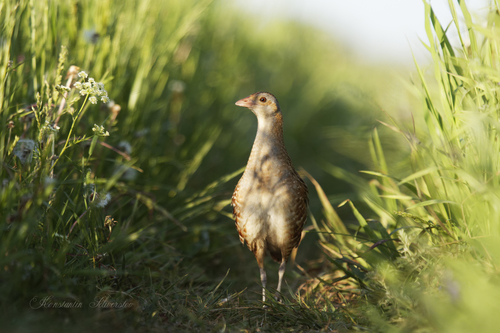
Corncrake (Crex crex) Corncrake
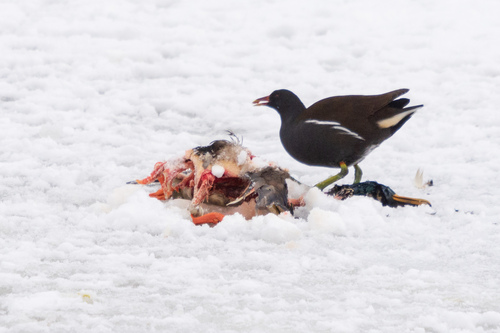
Common Moorhen (Gallinula chloropus) Common Moorhen

Media

Loading…

In short

The Corncrake and Common Moorhen are both rails, but they differ significantly in appearance and behavior. The Corncrake is more secretive and prefers to stay hidden in grasslands, while the Moorhen is more conspicuous in wetland habitats, often seen flicking its tail.

Identification tips

  1. Look for the Corncrake's chestnut wing patches in flight. 2. Note the Moorhen's red bill with a yellow tip and constant tail flicking. 3. Listen for the Corncrake's grating call in grasslands, contrasting with the Moorhen's varied vocalizations in wetlands.

Size

The Corncrake is slightly larger, measuring 27–30 cm, compared to the Moorhen's more compact size.

Plumage

Corncrakes have buff-and-gray-streaked brownish-black upperparts with distinctive chestnut wing patches and blue-gray underparts. Moorhens are sooty black with browner upperparts, a prominent white flank stripe, and a red bill with a yellow tip.

Behaviour

Corncrakes are elusive, often fleeing on foot with a high-stepping gait, while Moorhens are more visible, frequently flicking their tails as they forage.

Habitat

Corncrakes prefer grasslands and meadows, while Moorhens are commonly found in a wide range of wetland habitats.

Voice

Corncrakes have a loud, grating call during the breeding season, whereas Moorhens produce a variety of vocalizations including shrieks and clucks.

Submit a better description

Use the same sections as the comparison. Your text is published immediately.

The Corncrake and Common Moorhen are both rails, but they differ significantly in appearance and behavior. The Corncrake is more secretive and prefers to stay hidden in grasslands, while the Moorhen is more conspicuous in wetland habitats, often seen flicking its tail.

  1. Look for the Corncrake's chestnut wing patches in flight. 2. Note the Moorhen's red bill with a yellow tip and constant tail flicking. 3. Listen for the Corncrake's grating call in grasslands, contrasting with the Moorhen's varied vocalizations in wetlands.

The Corncrake is slightly larger, measuring 27–30 cm, compared to the Moorhen's more compact size.

Corncrakes have buff-and-gray-streaked brownish-black upperparts with distinctive chestnut wing patches and blue-gray underparts. Moorhens are sooty black with browner upperparts, a prominent white flank stripe, and a red bill with a yellow tip.

Corncrakes are elusive, often fleeing on foot with a high-stepping gait, while Moorhens are more visible, frequently flicking their tails as they forage.

Corncrakes prefer grasslands and meadows, while Moorhens are commonly found in a wide range of wetland habitats.

Corncrakes have a loud, grating call during the breeding season, whereas Moorhens produce a variety of vocalizations including shrieks and clucks.

Discard your changes?

You have unsaved edits. If you leave now, those changes will be lost.

Corncrake · Common Moorhen · My Tricky Birds