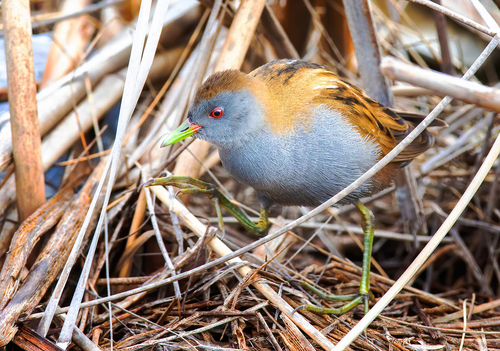
Corncrake vs Little Crake
Crex crex versus Zapornia parva
Play a quiz with Corncrake and Little Crake
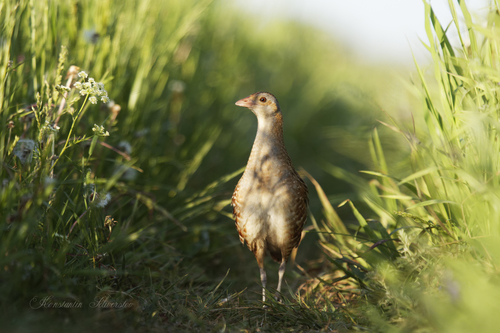
Corncrake
Little Crake
In short
The Corncrake and Little Crake can be distinguished by size and plumage details. Corncrakes are larger with buff-and-gray-streaked upperparts and chestnut wing patches, while Little Crakes are smaller with more uniform plumage. Both species are secretive, but their habitats and vocalizations differ.
Identification tips
- Size: Corncrakes are noticeably larger than Little Crakes.
- Plumage: Look for the chestnut wing patches of the Corncrake in flight.
- Habitat: Corncrakes are more likely in open grasslands, while Little Crakes are found in dense reed beds.
- Vocalization: Listen for the Corncrake's loud, repetitive call during the breeding season.
Size
Corncrakes are medium-sized rails, 27–30 cm in length, while Little Crakes are smaller, typically around 17–19 cm.
Plumage
Corncrakes have buff-and-gray-streaked brownish-black upperparts with distinctive chestnut wing patches and blue-gray underparts. Little Crakes are more uniformly colored with less contrast in their plumage.
Behaviour
Both species are elusive and prefer to flee on foot rather than fly. Corncrakes have a high-stepping gait and are known for their laterally compressed bodies.
Habitat
Corncrakes breed in managed floodplain meadows and migrate to African savannas. Little Crakes prefer reed beds and marshes in Europe and Asia.
Voice
Corncrakes have a loud, grating call repeated for hours during the breeding season, while Little Crakes have a softer, less distinctive call.