Birdr

Crested Becard vs Black-capped Piprites

Pachyramphus validus versus Piprites pileata

Play a quiz with Crested Becard and Black-capped Piprites
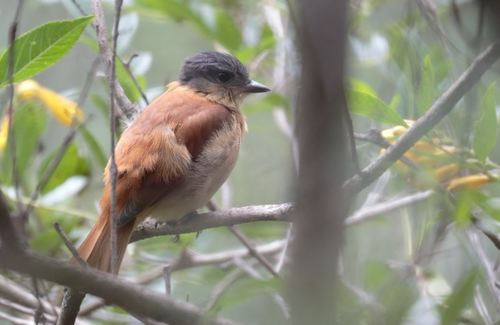
Crested Becard (Pachyramphus validus) Crested Becard
Black-capped Piprites (Piprites pileata) Black-capped Piprites

Media

Loading…

In short

To distinguish between the Crested Becard and the Black-capped Piprites, focus on the head markings: the Crested Becard has a distinctive crest, while the Black-capped Piprites features a prominent black cap. These species differ in habitat preferences, with the Crested Becard favoring more open areas compared to the forest-dwelling Black-capped Piprites.

Identification tips

Look for the crest on the Crested Becard and the black cap on the Black-capped Piprites. Consider habitat: open areas suggest Crested Becard; dense forests suggest Black-capped Piprites. Observe behavior: frequent perching and scanning is typical of Crested Becard, while secretive behavior and displays may indicate Black-capped Piprites.

Size

Both species are small passerines, but the Crested Becard is generally more robust in appearance compared to the more slender Black-capped Piprites.

Plumage

The Crested Becard has a noticeable crest and a generally uniform plumage, while the Black-capped Piprites is characterized by its black cap and contrasting grayish body.

Behaviour

Crested Becards often perch visibly and scan for prey, moving frequently between perches. The Black-capped Piprites is more secretive, often engaging in ritualized displays during the breeding season.

Habitat

Crested Becards are found in more open areas, often at forest edges, whereas Black-capped Piprites prefer dense forest environments.

Voice

Vocalizations are not well-documented for these species in the provided notes, but they likely differ given their taxonomic separation.

Submit a better description

Use the same sections as the comparison. Your text is published immediately.

To distinguish between the Crested Becard and the Black-capped Piprites, focus on the head markings: the Crested Becard has a distinctive crest, while the Black-capped Piprites features a prominent black cap. These species differ in habitat preferences, with the Crested Becard favoring more open areas compared to the forest-dwelling Black-capped Piprites.

Look for the crest on the Crested Becard and the black cap on the Black-capped Piprites. Consider habitat: open areas suggest Crested Becard; dense forests suggest Black-capped Piprites. Observe behavior: frequent perching and scanning is typical of Crested Becard, while secretive behavior and displays may indicate Black-capped Piprites.

Both species are small passerines, but the Crested Becard is generally more robust in appearance compared to the more slender Black-capped Piprites.

The Crested Becard has a noticeable crest and a generally uniform plumage, while the Black-capped Piprites is characterized by its black cap and contrasting grayish body.

Crested Becards often perch visibly and scan for prey, moving frequently between perches. The Black-capped Piprites is more secretive, often engaging in ritualized displays during the breeding season.

Crested Becards are found in more open areas, often at forest edges, whereas Black-capped Piprites prefer dense forest environments.

Vocalizations are not well-documented for these species in the provided notes, but they likely differ given their taxonomic separation.

Discard your changes?

You have unsaved edits. If you leave now, those changes will be lost.

Crested Becard · Black-capped Piprites · My Tricky Birds