Birdr

Crested Serpent-Eagle vs Wallace's Hawk-Eagle

Spilornis cheela versus Nisaetus nanus

Play a quiz with Crested Serpent-Eagle and Wallace's Hawk-Eagle
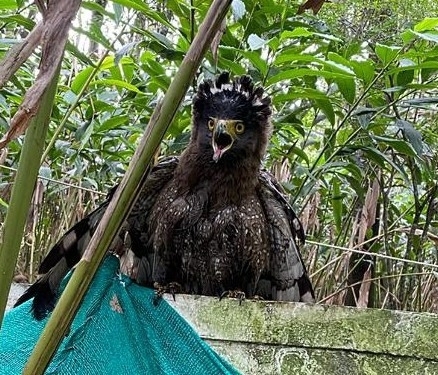
Crested Serpent-Eagle (Spilornis cheela) Crested Serpent-Eagle
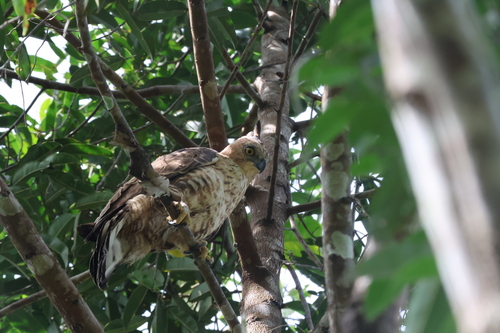
Wallace's Hawk-Eagle (Nisaetus nanus) Wallace's Hawk-Eagle

Media

Loading…

In short

The most reliable field mark to separate Crested Serpent-Eagle from Wallace's Hawk-Eagle is overall structure and flight silhouette: Crested Serpent-Eagle is stocky and broad-winged with a short, rounded tail and a thick neck topped by a short, fan-shaped crest, while Wallace's Hawk-Eagle is much slimmer, with narrower wings and a longer, more graduated tail. In flight, Crested Serpent-Eagle shows broad, paddle-shaped wings held in a shallow V and a bold black-and-white barred tail and flight feathers; Wallace's Hawk-Eagle is more agile and accipiter-like, with a longer tail and less contrasting underwing pattern. Juvenile Crested Serpent-Eagles are paler on the head and show more white below, but still retain the chunky silhouette. Size is also a strong clue: Crested Serpent-Eagle is much larger and bulkier than Wallace's Hawk-Eagle. Both species occur in Southeast Asian forests, but Wallace's Hawk-Eagle is more strictly tied to lowland forest.

Identification tips

  1. Structure is key: Crested Serpent-Eagle is stocky, with a thick neck, broad paddle-shaped wings, and a short, rounded tail. Wallace's Hawk-Eagle is much slimmer, with narrower, more pointed wings and a longer, more graduated tail. This difference is obvious both perched and in flight.
  2. Crest and head shape: Crested Serpent-Eagle has a short, black-and-white fan-shaped nuchal crest, giving it a thick-necked, big-headed look. Wallace's Hawk-Eagle lacks this thick neck and has a slimmer head profile.
  3. Flight silhouette: In soaring flight, Crested Serpent-Eagle holds its broad wings in a shallow V, with a short tail and heavy body. Wallace's Hawk-Eagle flies with more accipiter-like agility, with longer tail and narrower wings.
  4. Tail pattern: Crested Serpent-Eagle shows bold black-and-white bars on the tail, visible both perched and in flight. Wallace's Hawk-Eagle's tail is less boldly barred and longer in proportion to the body.
  5. Underwing and flight feather pattern: Crested Serpent-Eagle has broad white bars on the underside of the flight feathers and tail, creating a high-contrast look. Wallace's Hawk-Eagle's underwing is less contrasting and more uniformly marked.
  6. Juvenile plumage: Young Crested Serpent-Eagles have a lot of white on the head and underparts, but still show the species' broad white tail and wing bars. Juvenile Wallace's Hawk-Eagle does not show this much white on the head, nor the same bold barring.
  7. Perched jizz: When perched, Crested Serpent-Eagle's wing tips do not reach the tail tip, and the bird appears thickset. Wallace's Hawk-Eagle appears more slender and long-tailed.
  8. Bare parts: Crested Serpent-Eagle has yellow bare facial skin and feet, which may be visible at close range. Wallace's Hawk-Eagle's bare parts are not described here, so use with caution.
  9. Behavior: Crested Serpent-Eagle spends much of the day perched in dense foliage or soaring high, often calling. Wallace's Hawk-Eagle is more likely to be seen flying actively through the canopy or along forest edges.
  10. Habitat: If seen in open country, edge, or higher elevation forests, Crested Serpent-Eagle is more likely. Wallace's Hawk-Eagle is tied to lowland moist forest.
  11. Size impression: Even without direct comparison, Crested Serpent-Eagle is much larger and bulkier than Wallace's Hawk-Eagle. If the bird looks small and agile for a raptor, suspect Wallace's Hawk-Eagle.
  12. Vocalization: If you hear a loud, rising 'kluee-wip-wip,' it's diagnostic for Crested Serpent-Eagle.
  13. Pitfalls: Both species are dark brown above and can appear similar at a distance, but the combination of structure, tail and wing pattern, and habitat should separate them in most views.
  14. Sex and season: No strong sexual dimorphism or seasonal plumage differences are noted for either species, so all these marks apply year-round and to both sexes.
  15. If in doubt: Focus on the bird's overall shape, tail length, and wing pattern in flight, and look for the thick neck and short crest of Crested Serpent-Eagle versus the slim, long-tailed profile of Wallace's Hawk-Eagle.

Size

Crested Serpent-Eagle is significantly larger and bulkier than Wallace's Hawk-Eagle. Adult Crested Serpent-Eagles vary greatly in size across their range, but even the smallest subspecies are heavier and larger than Wallace's Hawk-Eagle, whose average body mass is about 555 g [wikidata]. Some Crested Serpent-Eagle races can exceed 1,500 g, with even small mainland birds around 900 g. In the field, Crested Serpent-Eagle appears broad and thickset, while Wallace's Hawk-Eagle is noticeably smaller, slimmer, and more lightly built.

Plumage

Juvenile and immature Crested Serpent-Eagles show a lot of white on the head and underparts, but retain the species' typical broad white bars on the tail and flight feathers, visible both perched and in flight. Adults are dark brown above with a thick neck, short fan-shaped crest, and bold black-and-white barring on the tail and flight feathers below. In flight, the underwing is dark with broad pale bands, and the wings are broad and paddle-shaped. Wallace's Hawk-Eagle, by contrast, lacks the thick neck and short crest, and is more uniformly marked below, with less contrast on the underwing and tail. Its tail is longer and more graduated, and the wings are narrower and more pointed. Juvenile Wallace's Hawk-Eagle does not show the extensive white on the head or the broad white bars of Crested Serpent-Eagle. Both species are dark brown above, but the eagle's structure and wing/tail pattern are key.

Behaviour

Crested Serpent-Eagle spends most of its day perched in dense foliage, often calling from an exposed perch and soaring on thermals with wings held in a shallow V. It is a sit-and-wait predator, often seen scanning for snakes and reptiles. Wallace's Hawk-Eagle is more active and agile, often seen flying through the forest canopy or along edges, and is less likely to be seen soaring high above the forest. The eagle's flight is more accipiter-like, with quick, agile movements and less time spent perched in the open.

Habitat

Both species inhabit Southeast Asian forests, but Crested Serpent-Eagle is more adaptable, found in a range of forested habitats from lowland to hills and even near wet grasslands. Wallace's Hawk-Eagle is more restricted to subtropical or tropical moist lowland forests, especially in the Malay Peninsula, Sumatra, and Borneo. Seeing a raptor in open or edge habitats, or at higher elevations, is more likely to indicate Crested Serpent-Eagle.

Voice

Crested Serpent-Eagle has a distinctive, far-carrying call described as 'kluee-wip-wip,' with the first note high and rising, often repeated from a perch or in flight. Wallace's Hawk-Eagle's vocalizations are not described in the provided notes, so voice is only diagnostic if the Crested Serpent-Eagle's call is heard.

Submit a better description

Use the same sections as the comparison. Your text is published immediately.

The most reliable field mark to separate Crested Serpent-Eagle from Wallace's Hawk-Eagle is overall structure and flight silhouette: Crested Serpent-Eagle is stocky and broad-winged with a short, rounded tail and a thick neck topped by a short, fan-shaped crest, while Wallace's Hawk-Eagle is much slimmer, with narrower wings and a longer, more graduated tail. In flight, Crested Serpent-Eagle shows broad, paddle-shaped wings held in a shallow V and a bold black-and-white barred tail and flight feathers; Wallace's Hawk-Eagle is more agile and accipiter-like, with a longer tail and less contrasting underwing pattern. Juvenile Crested Serpent-Eagles are paler on the head and show more white below, but still retain the chunky silhouette. Size is also a strong clue: Crested Serpent-Eagle is much larger and bulkier than Wallace's Hawk-Eagle. Both species occur in Southeast Asian forests, but Wallace's Hawk-Eagle is more strictly tied to lowland forest.

  1. Structure is key: Crested Serpent-Eagle is stocky, with a thick neck, broad paddle-shaped wings, and a short, rounded tail. Wallace's Hawk-Eagle is much slimmer, with narrower, more pointed wings and a longer, more graduated tail. This difference is obvious both perched and in flight.
  2. Crest and head shape: Crested Serpent-Eagle has a short, black-and-white fan-shaped nuchal crest, giving it a thick-necked, big-headed look. Wallace's Hawk-Eagle lacks this thick neck and has a slimmer head profile.
  3. Flight silhouette: In soaring flight, Crested Serpent-Eagle holds its broad wings in a shallow V, with a short tail and heavy body. Wallace's Hawk-Eagle flies with more accipiter-like agility, with longer tail and narrower wings.
  4. Tail pattern: Crested Serpent-Eagle shows bold black-and-white bars on the tail, visible both perched and in flight. Wallace's Hawk-Eagle's tail is less boldly barred and longer in proportion to the body.
  5. Underwing and flight feather pattern: Crested Serpent-Eagle has broad white bars on the underside of the flight feathers and tail, creating a high-contrast look. Wallace's Hawk-Eagle's underwing is less contrasting and more uniformly marked.
  6. Juvenile plumage: Young Crested Serpent-Eagles have a lot of white on the head and underparts, but still show the species' broad white tail and wing bars. Juvenile Wallace's Hawk-Eagle does not show this much white on the head, nor the same bold barring.
  7. Perched jizz: When perched, Crested Serpent-Eagle's wing tips do not reach the tail tip, and the bird appears thickset. Wallace's Hawk-Eagle appears more slender and long-tailed.
  8. Bare parts: Crested Serpent-Eagle has yellow bare facial skin and feet, which may be visible at close range. Wallace's Hawk-Eagle's bare parts are not described here, so use with caution.
  9. Behavior: Crested Serpent-Eagle spends much of the day perched in dense foliage or soaring high, often calling. Wallace's Hawk-Eagle is more likely to be seen flying actively through the canopy or along forest edges.
  10. Habitat: If seen in open country, edge, or higher elevation forests, Crested Serpent-Eagle is more likely. Wallace's Hawk-Eagle is tied to lowland moist forest.
  11. Size impression: Even without direct comparison, Crested Serpent-Eagle is much larger and bulkier than Wallace's Hawk-Eagle. If the bird looks small and agile for a raptor, suspect Wallace's Hawk-Eagle.
  12. Vocalization: If you hear a loud, rising 'kluee-wip-wip,' it's diagnostic for Crested Serpent-Eagle.
  13. Pitfalls: Both species are dark brown above and can appear similar at a distance, but the combination of structure, tail and wing pattern, and habitat should separate them in most views.
  14. Sex and season: No strong sexual dimorphism or seasonal plumage differences are noted for either species, so all these marks apply year-round and to both sexes.
  15. If in doubt: Focus on the bird's overall shape, tail length, and wing pattern in flight, and look for the thick neck and short crest of Crested Serpent-Eagle versus the slim, long-tailed profile of Wallace's Hawk-Eagle.

Crested Serpent-Eagle is significantly larger and bulkier than Wallace's Hawk-Eagle. Adult Crested Serpent-Eagles vary greatly in size across their range, but even the smallest subspecies are heavier and larger than Wallace's Hawk-Eagle, whose average body mass is about 555 g [wikidata]. Some Crested Serpent-Eagle races can exceed 1,500 g, with even small mainland birds around 900 g. In the field, Crested Serpent-Eagle appears broad and thickset, while Wallace's Hawk-Eagle is noticeably smaller, slimmer, and more lightly built.

Juvenile and immature Crested Serpent-Eagles show a lot of white on the head and underparts, but retain the species' typical broad white bars on the tail and flight feathers, visible both perched and in flight. Adults are dark brown above with a thick neck, short fan-shaped crest, and bold black-and-white barring on the tail and flight feathers below. In flight, the underwing is dark with broad pale bands, and the wings are broad and paddle-shaped. Wallace's Hawk-Eagle, by contrast, lacks the thick neck and short crest, and is more uniformly marked below, with less contrast on the underwing and tail. Its tail is longer and more graduated, and the wings are narrower and more pointed. Juvenile Wallace's Hawk-Eagle does not show the extensive white on the head or the broad white bars of Crested Serpent-Eagle. Both species are dark brown above, but the eagle's structure and wing/tail pattern are key.

Crested Serpent-Eagle spends most of its day perched in dense foliage, often calling from an exposed perch and soaring on thermals with wings held in a shallow V. It is a sit-and-wait predator, often seen scanning for snakes and reptiles. Wallace's Hawk-Eagle is more active and agile, often seen flying through the forest canopy or along edges, and is less likely to be seen soaring high above the forest. The eagle's flight is more accipiter-like, with quick, agile movements and less time spent perched in the open.

Both species inhabit Southeast Asian forests, but Crested Serpent-Eagle is more adaptable, found in a range of forested habitats from lowland to hills and even near wet grasslands. Wallace's Hawk-Eagle is more restricted to subtropical or tropical moist lowland forests, especially in the Malay Peninsula, Sumatra, and Borneo. Seeing a raptor in open or edge habitats, or at higher elevations, is more likely to indicate Crested Serpent-Eagle.

Crested Serpent-Eagle has a distinctive, far-carrying call described as 'kluee-wip-wip,' with the first note high and rising, often repeated from a perch or in flight. Wallace's Hawk-Eagle's vocalizations are not described in the provided notes, so voice is only diagnostic if the Crested Serpent-Eagle's call is heard.

Discard your changes?

You have unsaved edits. If you leave now, those changes will be lost.

Crested Serpent-Eagle · Wallace's Hawk-Eagle · My Tricky Birds