Birdr

Crested Treeswift vs Grey-rumped Treeswift

Hemiprocne coronata versus Hemiprocne longipennis

Play a quiz with Crested Treeswift and Grey-rumped Treeswift
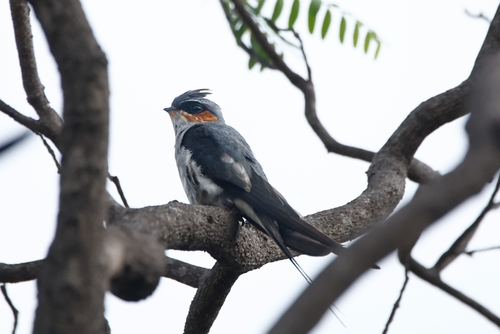
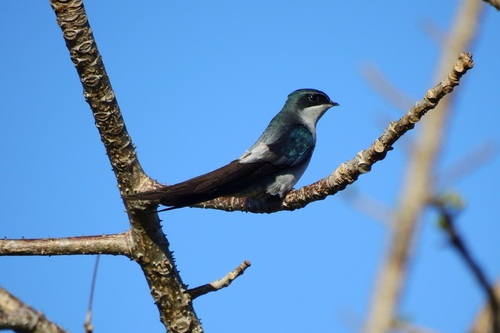
Crested Treeswift (Hemiprocne coronata) Crested Treeswift
Grey-rumped Treeswift (Hemiprocne longipennis) Grey-rumped Treeswift

Media

Loading…

In short

The Crested Treeswift and Grey-rumped Treeswift are similar in appearance but can be distinguished by their plumage and tail shape. The Crested Treeswift has a more pronounced crest and a longer tail with a forked shape, while the Grey-rumped Treeswift has a less distinct crest and a shorter, more squared tail. Both species share similar habitats and behaviors, making plumage and tail shape the most reliable field marks.

Identification tips

  1. Look for the pronounced crest and long, forked tail of the Crested Treeswift. 2. Note the greyish rump and less distinct crest of the Grey-rumped Treeswift. 3. Observe plumage details: the Crested Treeswift has a white face and throat. 4. Consider the tail shape: the Crested Treeswift's tail is longer and more forked compared to the Grey-rumped Treeswift's shorter, squared tail.

Size

Both species are similar in size, with no significant differences that are easily observable in the field.

Plumage

The Crested Treeswift has a more pronounced crest and a distinctive white face and throat, contrasting with its darker upperparts. The Grey-rumped Treeswift has a less distinct crest and a greyish rump, which is a key differentiator.

Behaviour

Both species exhibit similar behaviors, often seen gliding gracefully in open skies or perched on exposed branches.

Habitat

Both species inhabit open woodlands and forest edges, often near water bodies, making habitat a less reliable differentiator.

Voice

Vocalizations are not a primary distinguishing factor as both species have similar calls, which are not easily differentiated in the field.

Submit a better description

Use the same sections as the comparison. Your text is published immediately.

The Crested Treeswift and Grey-rumped Treeswift are similar in appearance but can be distinguished by their plumage and tail shape. The Crested Treeswift has a more pronounced crest and a longer tail with a forked shape, while the Grey-rumped Treeswift has a less distinct crest and a shorter, more squared tail. Both species share similar habitats and behaviors, making plumage and tail shape the most reliable field marks.

  1. Look for the pronounced crest and long, forked tail of the Crested Treeswift. 2. Note the greyish rump and less distinct crest of the Grey-rumped Treeswift. 3. Observe plumage details: the Crested Treeswift has a white face and throat. 4. Consider the tail shape: the Crested Treeswift's tail is longer and more forked compared to the Grey-rumped Treeswift's shorter, squared tail.

Both species are similar in size, with no significant differences that are easily observable in the field.

The Crested Treeswift has a more pronounced crest and a distinctive white face and throat, contrasting with its darker upperparts. The Grey-rumped Treeswift has a less distinct crest and a greyish rump, which is a key differentiator.

Both species exhibit similar behaviors, often seen gliding gracefully in open skies or perched on exposed branches.

Both species inhabit open woodlands and forest edges, often near water bodies, making habitat a less reliable differentiator.

Vocalizations are not a primary distinguishing factor as both species have similar calls, which are not easily differentiated in the field.

Discard your changes?

You have unsaved edits. If you leave now, those changes will be lost.

Crested Treeswift · Grey-rumped Treeswift · My Tricky Birds