Birdr

Crimson-collared Grosbeak vs Silver-beaked Tanager

Periporphyrus celaeno versus Ramphocelus carbo

Play a quiz with Crimson-collared Grosbeak and Silver-beaked Tanager
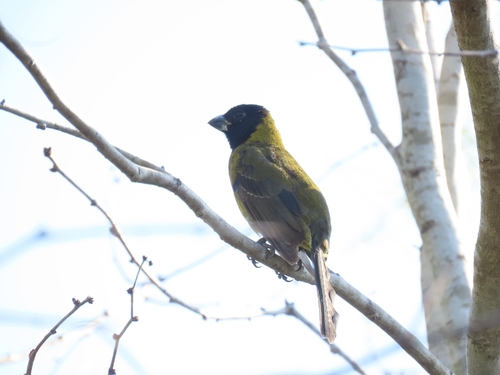
Crimson-collared Grosbeak (Periporphyrus celaeno) Crimson-collared Grosbeak
Silver-beaked Tanager (Ramphocelus carbo) Silver-beaked Tanager

Media

Loading…

In short

The Crimson-collared Grosbeak and Silver-beaked Tanager can be distinguished primarily by their plumage and bill shape. The grosbeak has a distinctive crimson collar and a large, predominantly black bill, while the tanager features a deep red body and a silver-hued bill. Both species are not closely related, belonging to different families.

Identification tips

  1. Bill Shape: Look for the grosbeak's large, predominantly black bill versus the tanager's silver-hued bill. 2. Plumage: Note the crimson collar of the grosbeak, absent in the tanager. 3. Size: The grosbeak is larger and bulkier. 4. Behavior: Observe social behavior; tanagers are often in groups.

Size

The Crimson-collared Grosbeak is generally larger and bulkier than the Silver-beaked Tanager.

Plumage

Male Crimson-collared Grosbeaks have a blackish face and throat with a striking crimson-red collar and underparts, whereas females are mainly olive-green with a black face and throat. Silver-beaked Tanagers have a deep red body with a contrasting silver bill and lack the distinct collar of the grosbeak.

Behaviour

Both species are often seen foraging in the mid to upper levels of forests, but the grosbeak may appear more solitary compared to the more social tanager.

Habitat

Crimson-collared Grosbeaks are typically found in subtropical and tropical moist lowland forests, while Silver-beaked Tanagers are more adaptable, inhabiting a variety of forested and semi-open areas.

Voice

The vocalizations of these species differ, but specific details are not well-documented for field identification.

Submit a better description

Use the same sections as the comparison. Your text is published immediately.

The Crimson-collared Grosbeak and Silver-beaked Tanager can be distinguished primarily by their plumage and bill shape. The grosbeak has a distinctive crimson collar and a large, predominantly black bill, while the tanager features a deep red body and a silver-hued bill. Both species are not closely related, belonging to different families.

  1. Bill Shape: Look for the grosbeak's large, predominantly black bill versus the tanager's silver-hued bill. 2. Plumage: Note the crimson collar of the grosbeak, absent in the tanager. 3. Size: The grosbeak is larger and bulkier. 4. Behavior: Observe social behavior; tanagers are often in groups.

The Crimson-collared Grosbeak is generally larger and bulkier than the Silver-beaked Tanager.

Male Crimson-collared Grosbeaks have a blackish face and throat with a striking crimson-red collar and underparts, whereas females are mainly olive-green with a black face and throat. Silver-beaked Tanagers have a deep red body with a contrasting silver bill and lack the distinct collar of the grosbeak.

Both species are often seen foraging in the mid to upper levels of forests, but the grosbeak may appear more solitary compared to the more social tanager.

Crimson-collared Grosbeaks are typically found in subtropical and tropical moist lowland forests, while Silver-beaked Tanagers are more adaptable, inhabiting a variety of forested and semi-open areas.

The vocalizations of these species differ, but specific details are not well-documented for field identification.

Discard your changes?

You have unsaved edits. If you leave now, those changes will be lost.

Crimson-collared Grosbeak · Silver-beaked Tanager · My Tricky Birds