
Birdr

Crimson-crested Woodpecker vs Lineated Woodpecker

Campephilus melanoleucos versus Dryocopus lineatus

Play a quiz with Crimson-crested Woodpecker and Lineated Woodpecker
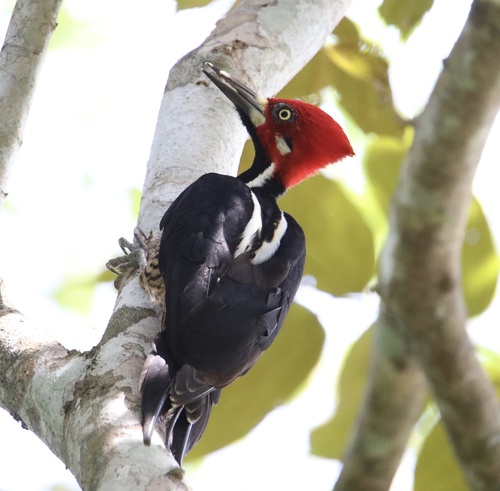
Crimson-crested Woodpecker (Campephilus melanoleucos) Crimson-crested Woodpecker
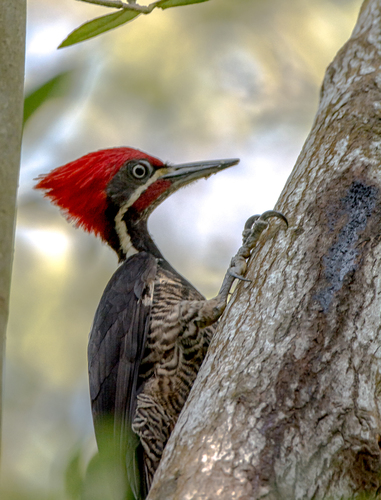
Lineated Woodpecker (Dryocopus lineatus) Lineated Woodpecker

Media

Loading…

In short

The Crimson-crested Woodpecker and Lineated Woodpecker can be distinguished by the pattern of their white stripes and the width of their malar stripes. The Crimson-crested has a 'V' pattern on its back and a wide white malar stripe, while the Lineated has a narrow white malar stripe and lacks the 'V' pattern.

Identification tips

  1. Look for the 'V' pattern on the back of the Crimson-crested Woodpecker. 2. Check the width of the white malar stripe: wide in Crimson-crested, narrow in Lineated. 3. Note the red crest and white neck stripe in males: the Lineated has a narrow white stripe from the bill. 4. Listen for the Lineated's distinctive laughing call and compare drumming patterns.

Size

The Crimson-crested Woodpecker is generally larger than the Lineated Woodpecker.

Plumage

The Crimson-crested Woodpecker features a wide white malar stripe and white streaks on the back that converge into a 'V' pattern. In contrast, the Lineated Woodpecker has a narrow white malar stripe and does not have a 'V' pattern on its back. Both species have a red crest, but the male Lineated has a narrow white stripe from the bill connecting to the neck stripe.

Behaviour

Both species often occur in pairs or family groups. The Crimson-crested can be quite noisy, while the Lineated is known for its distinctive vocalizations and drumming during territory defense.

Habitat

Both species inhabit forested areas, but the Crimson-crested is found in a variety of habitats from forest to forest edge and light woodland, whereas the Lineated is more commonly found in the Neotropics.

Voice

The Lineated Woodpecker has distinctive vocalizations, including a sustained, laughing call, which is a common sound in many areas. The Crimson-crested's drumming typically consists of 3-5 raps.

Submit a better description

Use the same sections as the comparison. Your text is published immediately.

The Crimson-crested Woodpecker and Lineated Woodpecker can be distinguished by the pattern of their white stripes and the width of their malar stripes. The Crimson-crested has a 'V' pattern on its back and a wide white malar stripe, while the Lineated has a narrow white malar stripe and lacks the 'V' pattern.

  1. Look for the 'V' pattern on the back of the Crimson-crested Woodpecker. 2. Check the width of the white malar stripe: wide in Crimson-crested, narrow in Lineated. 3. Note the red crest and white neck stripe in males: the Lineated has a narrow white stripe from the bill. 4. Listen for the Lineated's distinctive laughing call and compare drumming patterns.

The Crimson-crested Woodpecker is generally larger than the Lineated Woodpecker.

The Crimson-crested Woodpecker features a wide white malar stripe and white streaks on the back that converge into a 'V' pattern. In contrast, the Lineated Woodpecker has a narrow white malar stripe and does not have a 'V' pattern on its back. Both species have a red crest, but the male Lineated has a narrow white stripe from the bill connecting to the neck stripe.

Both species often occur in pairs or family groups. The Crimson-crested can be quite noisy, while the Lineated is known for its distinctive vocalizations and drumming during territory defense.

Both species inhabit forested areas, but the Crimson-crested is found in a variety of habitats from forest to forest edge and light woodland, whereas the Lineated is more commonly found in the Neotropics.

The Lineated Woodpecker has distinctive vocalizations, including a sustained, laughing call, which is a common sound in many areas. The Crimson-crested's drumming typically consists of 3-5 raps.

Discard your changes?

You have unsaved edits. If you leave now, those changes will be lost.

Crimson-crested Woodpecker · Lineated Woodpecker · My Tricky Birds