
Curlew Sandpiper vs Dunlin
Calidris ferruginea versus Calidris alpina
Play a quiz with Curlew Sandpiper and Dunlin
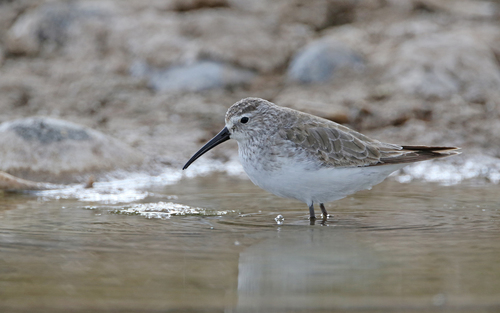 Curlew Sandpiper
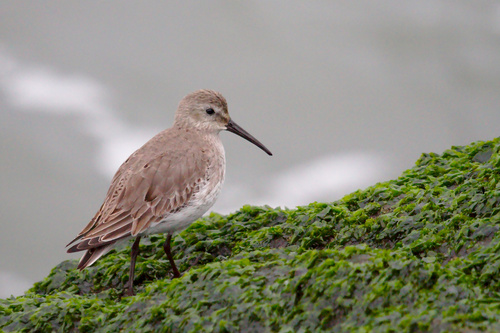 Dunlin
In short
The most reliable field mark between Curlew Sandpiper and Dunlin is the presence of a large white rump and a strong white wing stripe in flight on Curlew Sandpiper of all ages, versus Dunlin's plain back and only a narrow white wingbar. Juvenile and non-breeding birds are especially tricky, but Curlew Sandpiper is longer-legged and longer-billed, with a more elegant, slender profile and a distinct supercilium. Dunlin, by contrast, is stouter, with a shorter, thicker bill and a dumpier look. In breeding plumage, Dunlin's black belly patch is unique and diagnostic, but outside that season, careful attention to structure and flight pattern is essential.
Identification tips
- White rump in flight (all ages): Curlew Sandpiper shows a large white rump and uppertail, visible as a striking flash when the bird takes off or flies; Dunlin's rump is plain and matches the back. This is the single best separator in flight.
- White wing stripe (all ages): Curlew Sandpiper has a strong white stripe across the wing in flight, broader and more obvious than Dunlin's narrow white wingbar.
- Bill shape and length: Curlew Sandpiper's bill is longer, thinner, and more evenly decurved; Dunlin's is shorter, stouter, and only slightly downcurved (especially in males). Female Dunlin can have longer bills but still appear thicker and less elegant than Curlew Sandpiper.
- Leg length: Curlew Sandpiper has longer legs, often appearing to stand taller and wade deeper than Dunlin, which looks short-legged and squat.
- Supercilium (eyebrow): Curlew Sandpiper shows a distinct white supercilium in all plumages; Dunlin's is faint or absent, especially in non-breeding and juvenile plumage.
- Breeding plumage belly: Dunlin in breeding plumage has a unique black belly patch, never shown by Curlew Sandpiper. Curlew Sandpiper in breeding plumage is reddish below and on the face, with no black belly.
- Juvenile upperparts: Juvenile Curlew Sandpiper is scaly above with buff fringes and a pale supercilium; juvenile Dunlin is browner, with two faint whitish 'V's on the back and often some blackish marks on the belly or flanks.
- Non-breeding (winter) plumage: Curlew Sandpiper is paler grey above, white below, with a clean face and supercilium; Dunlin is greyer-brown above, white below, and lacks the strong supercilium. Dunlin often shows dark marks on flanks or belly even in winter.
- Size and jizz: Curlew Sandpiper is slightly larger and more elegant, with a longer neck, legs, and bill; Dunlin is dumpier and more compact.
- Feeding behavior: Dunlin feeds with a rapid, repetitive 'sewing machine' motion; Curlew Sandpiper is more methodical and graceful, often probing deeper water.
- Habitat context: In Europe and North America, Dunlin is much more common in winter; Curlew Sandpiper is scarcer and more likely in Africa, Oceania, or southern Eurasia.
- Flock composition: Dunlin often forms dense, synchronized flocks; Curlew Sandpiper is usually less numerous and may be found on the edges of Dunlin flocks or in slightly deeper water.
- Tail and uppertail pattern: Only Curlew Sandpiper shows broad, pale grey tail feathers and a white rump; Dunlin's tail is plain and matches the back.
- Sex differences: Female Dunlin can have longer bills, but still appear stouter than Curlew Sandpiper; male Dunlin has the shortest, thickest bill.
- Voice: Dunlin's 'chreep' call and trilling song are typical; Curlew Sandpiper's voice is not distinctive in the field for separation.
Size
Curlew Sandpiper is slightly larger overall: 18–23 cm in length and 44–117 g, with a wingspan of 38–46 cm [wikipedia][avonet]. Dunlin is shorter and lighter: 16–20 cm and 34–77 g, wingspan 38–43 cm [wikipedia][avonet]. The difference is subtle in the field, but Curlew Sandpiper often appears longer-legged and more elongated, while Dunlin looks compact and stocky.
Plumage
Juvenile and non-breeding birds are the main source of confusion. In flight, all ages of Curlew Sandpiper show a large white rump and uppertail, with a strong white wing stripe; Dunlin lacks the white rump and shows only a narrow white wingbar. Juvenile Curlew Sandpiper is scaly above with buff fringes and a distinct supercilium, while juvenile Dunlin is brown above with two faint whitish 'V's on the back and often blackish marks on the belly or flanks. In non-breeding (winter) plumage, Curlew Sandpiper is pale grey above and white below, with a clean white face and supercilium, and a longer, more slender bill; Dunlin is greyer-brown above, white below, and lacks the strong supercilium. In breeding plumage, Curlew Sandpiper is reddish below and on the face, while Dunlin has a unique black belly patch and rufous upperparts. Both have black legs and bills, but Curlew Sandpiper's bill is longer, thinner, and more downcurved, especially compared to male Dunlin.
Behaviour
Dunlin is highly gregarious in winter, often forming dense, swirling flocks on mudflats and beaches, and feeds with a rapid 'sewing machine' motion. Curlew Sandpiper is also social but tends to be less densely packed and often wades in slightly deeper water, using its longer bill to probe. In mixed flocks, Curlew Sandpiper often stands out by feeding in slightly deeper areas and moving with a more graceful, less hurried gait.
Habitat
Both species frequent tidal mudflats and saltpans outside the breeding season, but Curlew Sandpiper breeds in the Siberian Arctic bogs and coastal lowlands, while Dunlin breeds more widely across the northern Holarctic. In winter, both can be found together, but Dunlin is often more abundant and widespread, especially in Europe and North America. Curlew Sandpiper is more likely in Africa, Oceania, and southern Eurasia during the non-breeding season.
Voice
Dunlin gives a typical sandpiper 'chreep' and a harsh trilling song in display. Curlew Sandpiper's calls are not detailed in the notes, so voice is not a reliable separator here.