Dark-billed Cuckoo vs Mangrove Cuckoo
Coccyzus melacoryphus versus Coccyzus minor
Play a quiz with Dark-billed Cuckoo and Mangrove Cuckoo
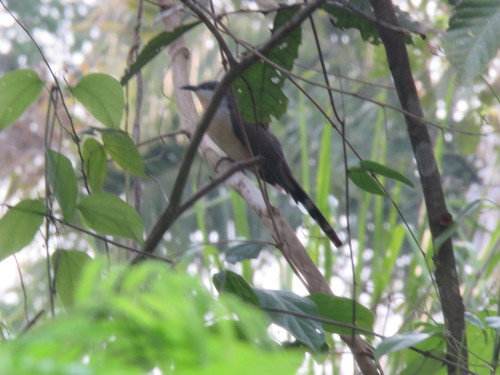
Dark-billed Cuckoo
Mangrove Cuckoo
In short
To distinguish the Dark-billed Cuckoo from the Mangrove Cuckoo, focus on bill color and size. The Dark-billed Cuckoo has a dark bill and is generally smaller, while the Mangrove Cuckoo features a bicolored bill with a black upper mandible and orange-yellow lower mandible base. Both species can be found in overlapping ranges in northern South America.
Identification tips
- Bill Color: Dark-billed Cuckoo has a uniformly dark bill; Mangrove Cuckoo has a bicolored bill.
- Size: Dark-billed Cuckoo is smaller.
- Plumage: Look for the light gray band on the Dark-billed Cuckoo's neck.
- Habitat: Consider the habitat; Mangrove Cuckoo is more likely in mangrove areas.
Size
The Dark-billed Cuckoo is smaller than the Mangrove Cuckoo.
Plumage
The Dark-billed Cuckoo is darker overall with a light neutral gray band from the lower cheeks to the sides of the neck. The Mangrove Cuckoo has a plain grayish-brown head and upperparts with a distinctive black auricular mask and a white 'eyebrow'.
Habitat
The Dark-billed Cuckoo is found in a variety of altitudes, primarily in lowlands, while the Mangrove Cuckoo is typically associated with mangrove habitats.
Voice
Vocalizations can help differentiate these species, but specific call details for the Dark-billed Cuckoo are not provided. The Mangrove Cuckoo's calls are generally lower-pitched and given more slowly than those of the Yellow-billed Cuckoo.