Birdr

Dickcissel vs Yellow-faced Grassquit

Spiza americana versus Tiaris olivaceus

Play a quiz with Dickcissel and Yellow-faced Grassquit
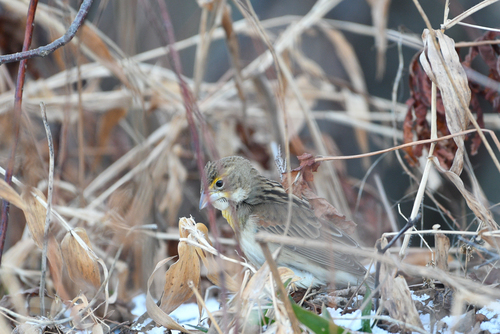
Dickcissel (Spiza americana) Dickcissel
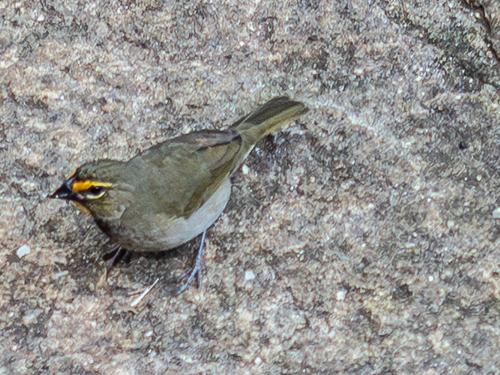
Yellow-faced Grassquit (Tiaris olivaceus) Yellow-faced Grassquit

Media

Loading…

In short

The Dickcissel and Yellow-faced Grassquit are both small, seed-eating birds, but they can be distinguished by their facial markings and habitat preferences. The Dickcissel has a distinctive yellow chest with a black bib, while the Yellow-faced Grassquit features a yellow face with an olive body. Both species are often found in open areas, but their ranges do not typically overlap.

Identification tips

Size

Both species are small, but the Dickcissel is slightly larger and more robust compared to the more delicate Yellow-faced Grassquit.

Plumage

The Dickcissel has a striking yellow chest with a black bib and a grayish head, whereas the Yellow-faced Grassquit has a yellow face and throat with an olive-green body. The Dickcissel's bold chest pattern is a key distinguishing feature.

Behaviour

Both species are seed eaters and can be seen foraging on the ground. The Dickcissel may be more conspicuous due to its singing from elevated perches during the breeding season.

Habitat

Dickcissels are typically found in grasslands and agricultural fields, especially in the central United States during the breeding season. Yellow-faced Grassquits prefer grassy and shrubby areas in the Caribbean and parts of Central and South America.

Voice

The Dickcissel's song is a distinctive, buzzy 'dick-dick-ciss-cissel,' while the Yellow-faced Grassquit has a high-pitched, thin song. These vocal differences are useful in distinguishing the two when they are heard.

Submit a better description

Use the same sections as the comparison. Your text is published immediately.

The Dickcissel and Yellow-faced Grassquit are both small, seed-eating birds, but they can be distinguished by their facial markings and habitat preferences. The Dickcissel has a distinctive yellow chest with a black bib, while the Yellow-faced Grassquit features a yellow face with an olive body. Both species are often found in open areas, but their ranges do not typically overlap.

  • Look for the yellow chest and black bib of the Dickcissel.
  • Note the yellow face and olive body of the Yellow-faced Grassquit.
  • Consider the habitat: Dickcissels in grasslands, Yellow-faced Grassquits in more tropical, shrubby areas.
  • Listen for the distinctive song of the Dickcissel, especially during the breeding season.

Both species are small, but the Dickcissel is slightly larger and more robust compared to the more delicate Yellow-faced Grassquit.

The Dickcissel has a striking yellow chest with a black bib and a grayish head, whereas the Yellow-faced Grassquit has a yellow face and throat with an olive-green body. The Dickcissel's bold chest pattern is a key distinguishing feature.

Both species are seed eaters and can be seen foraging on the ground. The Dickcissel may be more conspicuous due to its singing from elevated perches during the breeding season.

Dickcissels are typically found in grasslands and agricultural fields, especially in the central United States during the breeding season. Yellow-faced Grassquits prefer grassy and shrubby areas in the Caribbean and parts of Central and South America.

The Dickcissel's song is a distinctive, buzzy 'dick-dick-ciss-cissel,' while the Yellow-faced Grassquit has a high-pitched, thin song. These vocal differences are useful in distinguishing the two when they are heard.

Discard your changes?

You have unsaved edits. If you leave now, those changes will be lost.

Dickcissel · Yellow-faced Grassquit · My Tricky Birds