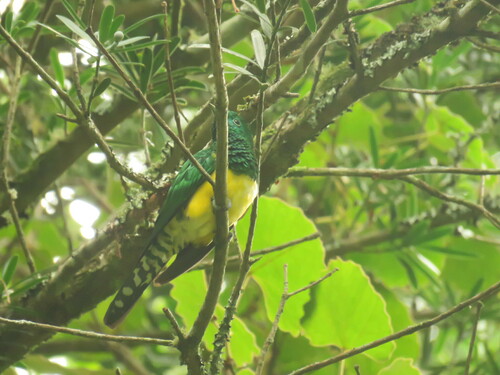
Dideric Cuckoo vs African Emerald Cuckoo
Chrysococcyx caprius versus Chrysococcyx cupreus
Play a quiz with Dideric Cuckoo and African Emerald Cuckoo

Dideric Cuckoo
African Emerald Cuckoo
In short
The Dideric Cuckoo and African Emerald Cuckoo are both small, metallic green cuckoos, but they can be distinguished by their plumage and vocalizations. The Dideric Cuckoo has a more pronounced white underpart with black barring, while the African Emerald Cuckoo is more uniformly green with a bright yellow belly. Listen for the Dideric Cuckoo's repetitive 'dee-dee-dee' call compared to the African Emerald Cuckoo's more melodic and varied song.
Identification tips
1. Plumage: Look for the Dideric Cuckoo's white underparts with black barring versus the African Emerald Cuckoo's bright yellow belly. 2. Vocalization: Listen for the Dideric Cuckoo's repetitive call compared to the African Emerald Cuckoo's melodic whistles. 3. Habitat: Note the habitat; the African Emerald Cuckoo prefers denser forests. 4. Behavior: Both are elusive, so patience is key.
Size
Both species are similar in size, typical of small cuckoos.
Plumage
The Dideric Cuckoo has white underparts with distinctive black barring, whereas the African Emerald Cuckoo has a bright yellow belly and more uniform green upperparts. The African Emerald Cuckoo's green is often more vibrant and shiny.
Behaviour
Both species are often seen perched quietly in trees and can be elusive. They are similar in behavior, often remaining still and making them difficult to spot.
Habitat
Both species inhabit open woodlands and forest edges, but the African Emerald Cuckoo is more frequently found in dense forests compared to the Dideric Cuckoo, which can also be seen in more open areas.
Voice
The Dideric Cuckoo's call is a repetitive 'dee-dee-dee', while the African Emerald Cuckoo has a more melodic and varied song, often described as a series of whistles.