Double-banded Courser vs Chestnut-backed Sparrow-Lark
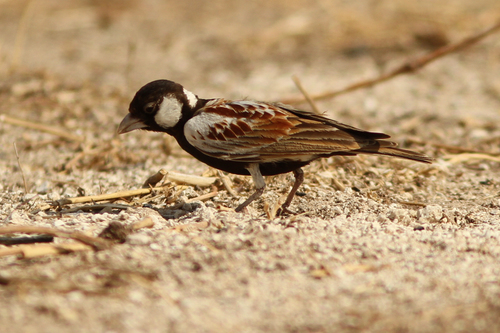
Smutsornis africanus versus Eremopterix leucotis
Play a quiz with Double-banded Courser and Chestnut-backed Sparrow-Lark
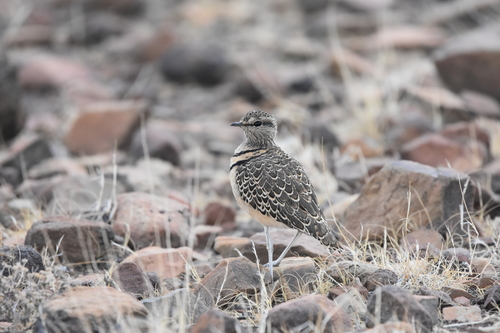
Double-banded Courser
Chestnut-backed Sparrow-Lark
In short
The Double-banded Courser and Chestnut-backed Sparrow-Lark are unlikely to be confused due to their distinct habitats and plumage. The courser is a medium-sized bird with two black breast bands and pale plumage, while the sparrow-lark is smaller with a distinctive chestnut back. Their preferred environments also differ significantly, aiding in identification.
Identification tips
- Look for two black breast bands on the Double-banded Courser. 2. Note the chestnut back of the Chestnut-backed Sparrow-Lark. 3. Observe habitat: coursers in open plains, sparrow-larks in varied open areas. 4. In flight, check for the courser's rich chestnut or rufous inner primaries and secondaries.
Size
The Double-banded Courser is larger, measuring 19–24 cm, while the Chestnut-backed Sparrow-Lark is smaller.
Plumage
The Double-banded Courser features two black breast bands and pale sandy to white underparts, with rich chestnut or rufous inner primaries and secondaries in flight. The Chestnut-backed Sparrow-Lark has a chestnut back and lacks the distinctive breast bands.
Behaviour
Behavioral differences are not well-documented, but the courser's flight displays its distinctive wing pattern.
Habitat
The Double-banded Courser prefers open plains and semi-arid shrublands, while the Chestnut-backed Sparrow-Lark is more adaptable to various open habitats.
Voice
Vocalizations are not detailed for these species, suggesting they are not a primary identification feature.
Double-banded Courser · Chestnut-backed Sparrow-Lark · My Tricky Birds