Double-striped Thick-knee vs Kentish Plover
Hesperoburhinus bistriatus versus Anarhynchus alexandrinus
Play a quiz with Double-striped Thick-knee and Kentish Plover
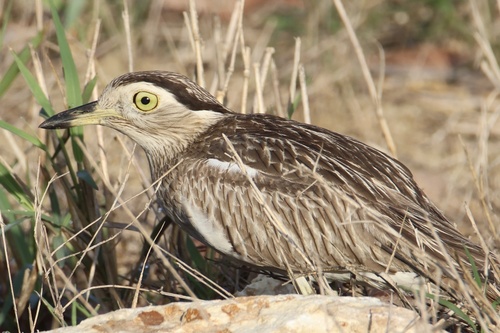
Double-striped Thick-knee
Kentish Plover
In short
The Double-striped Thick-knee and Kentish Plover can be distinguished by size and behavior. The Thick-knee is larger and more nocturnal, often seen crouching in shade, while the Kentish Plover is smaller and active during the day, often found near water.
Identification tips
- Size: Look for the larger size of the Double-striped Thick-knee. 2. Plumage: Note the white collar and black patches on the Kentish Plover. 3. Behavior: Observe the time of activity; Thick-knees are nocturnal, Plovers are diurnal. 4. Habitat: Check the habitat; Thick-knees in dry areas, Plovers near water. 5. Vocalization: Listen for the loud, excited calls of the Thick-knee at night.
Size
The Double-striped Thick-knee is significantly larger than the Kentish Plover, making size a reliable field mark.
Plumage
The Kentish Plover has a distinct white collar on its hindneck and black patches on the sides of its head, which are absent in the Double-striped Thick-knee. The Thick-knee has a more uniform brownish plumage with distinctive double stripes on its wings.
Behaviour
Double-striped Thick-knees are largely nocturnal and often crouch in shady areas during the day. In contrast, Kentish Plovers are diurnal and actively forage along shorelines.
Habitat
Double-striped Thick-knees are typically found in open, dry habitats, while Kentish Plovers prefer coastal areas and wetlands.
Voice
Double-striped Thick-knees are known for their noisy calls at night, which get louder and faster when excited. Kentish Plovers have a softer, less conspicuous call.
Double-striped Thick-knee · Kentish Plover · My Tricky Birds