
Dunlin vs Purple Sandpiper
Calidris alpina versus Calidris maritima
Play a quiz with Dunlin and Purple Sandpiper
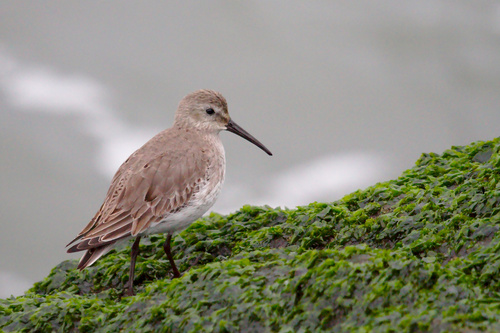 Dunlin
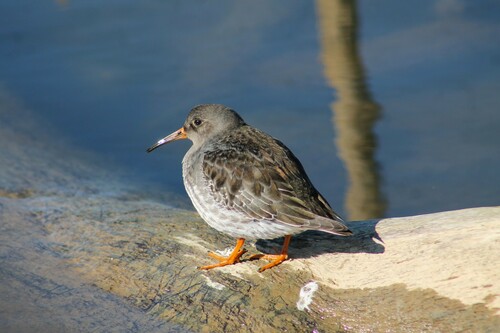 Purple Sandpiper
In short
The most reliable field mark for separating Dunlin from Purple Sandpiper is leg color: Dunlin always shows black legs, while Purple Sandpiper has short yellow legs, easily seen when perched or feeding. In flight, both show a white wingbar, but Dunlin is slimmer, with a longer, slightly decurved black bill, and in breeding plumage has a unique black belly patch. Purple Sandpiper is chunkier, darker above with a subtle purplish gloss, and has a yellow-based bill. Juvenile Dunlin can show faint whitish 'V' marks on the back, but these are less obvious than in some stints. Habitat is also a strong clue: Dunlin favors muddy or sandy flats, while Purple Sandpiper sticks to rocky coasts.
Identification tips
- Leg color: Dunlin always has black legs; Purple Sandpiper has short yellow legs. This is the quickest field check when birds are standing or walking.
- Bill structure: Dunlin’s bill is longer, finer, and distinctly decurved (especially in females); Purple Sandpiper’s bill is shorter, thicker, and only slightly downcurved, with a yellow base. Bill color is best seen at close range.
- Body shape: Purple Sandpiper is chunkier and heavier-set, with a deeper chest and shorter legs, while Dunlin is slimmer and longer-legged.
- Breeding plumage: Only Dunlin shows a solid black belly patch in spring/summer adults. Purple Sandpiper never has a black belly, remaining white below with grey smudges on the breast.
- Non-breeding plumage: Dunlin is paler grey above and white below; Purple Sandpiper is darker, with a faint purple gloss and more uniform upperparts.
- Juvenile marks: Juvenile Dunlin may show faint whitish 'V' marks on the back, but these are subtle and not always visible. Purple Sandpiper juveniles are darker and lack obvious 'V' marks.
- Wingbar in flight: Both show a narrow white wingbar, so this is not a separator. Neither shows a strong contrasting upperwing panel or black 'W' like some other Calidrids.
- Leg length: Purple Sandpiper’s legs are shorter and stubbier, making the bird appear lower to the ground compared to the longer-legged Dunlin.
- Habitat: On rocky coasts, especially in winter, expect Purple Sandpiper; on mudflats or sandy beaches, expect Dunlin.
- Feeding behavior: Dunlin feeds with rapid, methodical 'sewing machine' movements on soft substrates; Purple Sandpiper picks and probes among rocks and crevices.
- Flock size and association: Dunlin often forms large, swirling flocks; Purple Sandpiper is usually in small groups, sometimes with Turnstones.
- Rump and tail: Purple Sandpiper has a black rump, but this is not easily seen in the field. Dunlin’s rump is not distinctive.
- Bill tip: Dunlin’s bill tip is blunt in life (not sharp), with a sensitive pad for probing mud.
- Voice: Dunlin gives a 'chreep' call; Purple Sandpiper’s call is not described here, so do not rely on voice for separation.
- Seasonal context: In late autumn and winter, Purple Sandpiper is present only on rocky coasts, while Dunlin is widespread on mud and sand. Overlap is rare except at migration stopovers.
Size
Purple Sandpiper is distinctly heavier and bulkier than Dunlin. Purple Sandpiper averages about 72 g (range 50–105 g) and measures 20–22 cm in length with a 42–46 cm wingspan. Dunlin is smaller and lighter, at 16–20 cm in length, 38–43 cm wingspan, and 34–77 g in weight. In the field, Purple Sandpiper appears stouter and more robust, while Dunlin is slimmer and more delicate, especially in direct comparison.
Plumage
For juveniles and non-breeding birds, both species are generally dark above and pale below, but Dunlin is paler and greyer, while Purple Sandpiper is darker with a faint purplish gloss. Juvenile Dunlin can show two faint whitish 'V' marks on the back, but these are subtle. Both species show a narrow white wingbar in flight, so this is not a separator. In breeding plumage, Dunlin is unmistakable with a black belly patch (all other similar-sized waders lack this), while Purple Sandpiper remains dark above and white below with grey-smudged breast and black rump. Purple Sandpiper’s bill is dark with a yellow base and legs are yellow, while Dunlin’s bill and legs are always black. Dunlin’s bill is longer and more decurved, especially in females. Purple Sandpiper’s upperparts are darker and more uniform, with a slight purple sheen in good light. Underparts in both are mainly white, but Purple Sandpiper’s breast is more diffusely smudged grey, not clean white.
Behaviour
Dunlin is highly gregarious in winter, often forming large, synchronized flocks on mudflats or sandy beaches, and feeds with a rapid 'sewing machine' motion. Purple Sandpiper is also gregarious but typically in smaller flocks, often with Turnstones, and is notably tame and approachable. Purple Sandpiper is most often seen creeping among rocks at the water’s edge, rarely venturing onto open sand or mud. Dunlin is much more likely to be seen probing in soft mud or sand, rarely on rocks.
Habitat
Habitat is a strong separator: Dunlin is found on coastal mudflats, sandy beaches, and estuaries, rarely on rocky shores. Purple Sandpiper is almost exclusively on rocky, wave-washed Atlantic coasts in winter, rarely if ever on mud or sand. If you see a small Calidrid on a rocky shore in winter, it is far more likely to be Purple Sandpiper; on mud or sand, Dunlin is vastly more likely.
Voice
Dunlin gives a typical sandpiper 'chreep' call and a harsh trilling display song. Purple Sandpiper’s voice is not described in the provided notes, so vocalization is not a reliable separator based on this information.