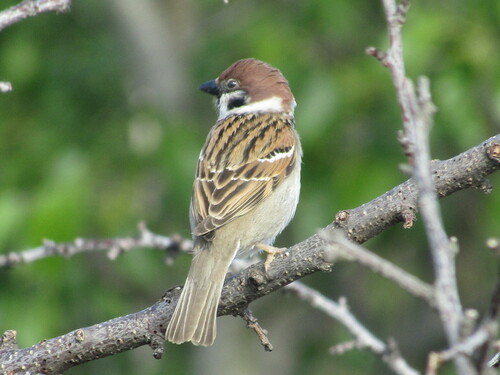
Dunnock vs Eurasian Tree Sparrow
Prunella modularis versus Passer montanus
Play a quiz with Dunnock and Eurasian Tree Sparrow
Dunnock
Eurasian Tree Sparrow
In short
The Dunnock (Prunella modularis) and the Eurasian Tree Sparrow (Passer montanus) can be distinguished by their size, plumage, and behavior. The Dunnock is smaller, with a more slender build and a pointed bill, while the Eurasian Tree Sparrow has a stockier appearance with a more robust, rounded body and a distinctively short, thick bill. Their plumage also differs significantly, with the Dunnock sporting subtle gray and brown tones, whereas the Tree Sparrow has a more prominent chestnut crown and a black patch on its white cheeks.
Identification tips
- Birds of the World Similar-Species Diagnostics:
-
"The Dunnock can be distinguished from the Eurasian Tree Sparrow by its more slender, pointed bill and less conspicuous plumage, which is primarily gray and brown, compared to the Tree Sparrow's distinctive chestnut crown and black cheek spot." (This information is inferred from comparison data in the Similar Species sections.)
-
AI Field Diagnostics:
- Size and Shape: Look for the Dunnock's smaller, slimmer profile and pointed bill versus the Tree Sparrow's stockier, rounder body and short, thick bill.
- Plumage Features: The Dunnock's gray and brown tones provide camouflage, while the Tree Sparrow's chestnut crown and striking black-and-white face make it visually distinctive.
- Behavior: Observe their feeding habits; the Dunnock is often solitary or in pairs, while the Tree Sparrow is more gregarious and will be seen in small flocks, especially near human habitats.
- Vocalizations: Listen for the Dunnock's high-pitched warble compared to the chirpy, cheerful calls of the Tree Sparrow.
- Habitat Preferences: Focus on the Dunnock in dense shrubbery and hedgerows, while the Tree Sparrow is more likely to be found in open areas, urban settings, and farmland.
By keeping these distinguishing features in mind, birdwatchers will have a solid foundation for accurately identifying and differentiating between the Dunnock and the Eurasian Tree Sparrow in the field.
Size
- Dunnock: The Dunnock is a small bird, measuring about 14-15 cm (5.5-6 in) in length and weighing approximately 18-25 g (0.6-0.9 oz).
- Eurasian Tree Sparrow: The Eurasian Tree Sparrow is slightly larger, measuring about 14.5-16 cm (5.7-6.3 in) in length and weighing around 24-34 g (0.8-1.2 oz).
Plumage
- Dunnock: The Dunnock features a gray head and breast with finely streaked brown and rufous upper parts. Its underparts are paler with less white, and the overall coloration is somewhat muted, providing excellent camouflage in hedgerows.
- Eurasian Tree Sparrow: The Eurasian Tree Sparrow has a striking plumage, characterized by a chestnut-colored crown, a black cheek spot against white cheeks, and a pale brown body with streaked underparts. Its more vivid coloration makes it stand out compared to the subdued Dunnock.
Behaviour
- Dunnock: Known for its secretive behavior, the Dunnock often forages alone or in pairs beneath bushes and hedgerows, skulkings on the ground. It exhibits complex social structures and mating behaviors, including territoriality and various forms of polyandry.
- Eurasian Tree Sparrow: This species is more social and often found in small flocks, particularly during feeding. It typically forages in open areas, often around human habitation, and can be seen perching on wires or fences.
Habitat
- Dunnock: Prefers dense shrubbery, hedgerows, and gardens, thriving in human-modified landscapes but also inhabiting woodland edges. The Dunnock's preference for these tangled environments makes it less visible.
- Eurasian Tree Sparrow: Often associated with agricultural areas, urban environments, and open woodlands. It prefers habitats with abundant food sources, such as farmland and suburbs, which provide easy access to seeds.
Voice
- Dunnock: The male Dunnock sings a high, thin warble, especially in spring, while outside of the breeding season, it produces flat, high-pitched alarm calls.
- Eurasian Tree Sparrow: The Eurasian Tree Sparrow's vocalizations are a series of chirps and twitters, often more cheerful and varied than the Dunnock's calls.