Birdr

Dusky-capped Flycatcher vs Nutting's Flycatcher

Myiarchus tuberculifer versus Myiarchus nuttingi

Play a quiz with Dusky-capped Flycatcher and Nutting's Flycatcher
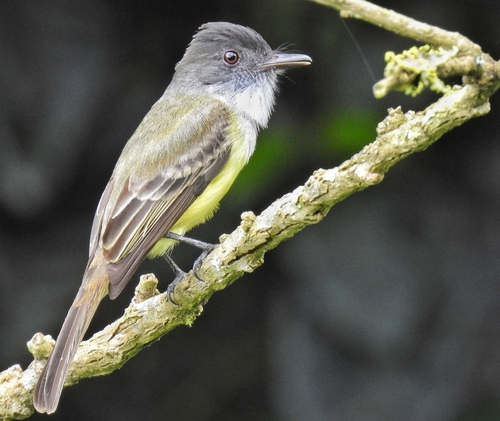
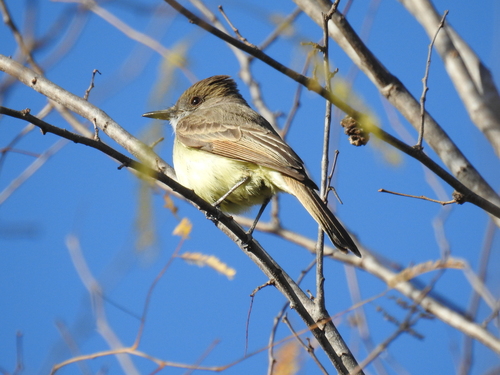
Dusky-capped Flycatcher (Myiarchus tuberculifer) Dusky-capped Flycatcher
Nutting's Flycatcher (Myiarchus nuttingi) Nutting's Flycatcher

Media

Loading…

In short

Dusky-capped Flycatcher and Nutting's Flycatcher are similar in appearance, but can be distinguished by their vocalizations and subtle plumage differences. The Dusky-capped Flycatcher has a more subdued coloration and distinct vocal patterns, while Nutting's Flycatcher often shows brighter plumage and different calls.

Identification tips

1. Listen for vocalizations: Dusky-capped has a mournful call, while Nutting's differs. 2. Look for plumage tone: Dusky-capped is generally duller. 3. Consider habitat: Nutting's prefers thorn forests. 4. Note behavior: Both are territorial and solitary.

Size

Both species are similar in size, typical of Myiarchus flycatchers, with no significant size difference to aid in field identification.

Plumage

Dusky-capped Flycatcher generally has a duller, more olive-brown coloration on the back and a less contrasting head pattern compared to Nutting's Flycatcher, which may appear slightly brighter with a more pronounced contrast between the crown and back.

Behaviour

Both species exhibit typical Myiarchus flycatcher behavior, such as perching quietly and sallying for insects. They are not particularly social and maintain territories year-round.

Habitat

Dusky-capped Flycatcher is often found in more varied forest habitats, while Nutting's Flycatcher prefers dense, closed canopy thorn forests, often at higher elevations when sympatric with similar species.

Voice

Vocalizations are a key differentiator: Dusky-capped Flycatcher has a distinctive, mournful call, while Nutting's Flycatcher produces a different set of calls. Observers should focus on these vocal differences for reliable identification.

Submit a better description

Use the same sections as the comparison. Your text is published immediately.

Dusky-capped Flycatcher and Nutting's Flycatcher are similar in appearance, but can be distinguished by their vocalizations and subtle plumage differences. The Dusky-capped Flycatcher has a more subdued coloration and distinct vocal patterns, while Nutting's Flycatcher often shows brighter plumage and different calls.

1. Listen for vocalizations: Dusky-capped has a mournful call, while Nutting's differs. 2. Look for plumage tone: Dusky-capped is generally duller. 3. Consider habitat: Nutting's prefers thorn forests. 4. Note behavior: Both are territorial and solitary.

Both species are similar in size, typical of Myiarchus flycatchers, with no significant size difference to aid in field identification.

Dusky-capped Flycatcher generally has a duller, more olive-brown coloration on the back and a less contrasting head pattern compared to Nutting's Flycatcher, which may appear slightly brighter with a more pronounced contrast between the crown and back.

Both species exhibit typical Myiarchus flycatcher behavior, such as perching quietly and sallying for insects. They are not particularly social and maintain territories year-round.

Dusky-capped Flycatcher is often found in more varied forest habitats, while Nutting's Flycatcher prefers dense, closed canopy thorn forests, often at higher elevations when sympatric with similar species.

Vocalizations are a key differentiator: Dusky-capped Flycatcher has a distinctive, mournful call, while Nutting's Flycatcher produces a different set of calls. Observers should focus on these vocal differences for reliable identification.

Discard your changes?

You have unsaved edits. If you leave now, those changes will be lost.

Dusky-capped Flycatcher · Nutting's Flycatcher · My Tricky Birds