Birdr

Dusky Sunbird vs Red-cheeked Cordonbleu

Cinnyris fuscus versus Uraeginthus bengalus

Play a quiz with Dusky Sunbird and Red-cheeked Cordonbleu
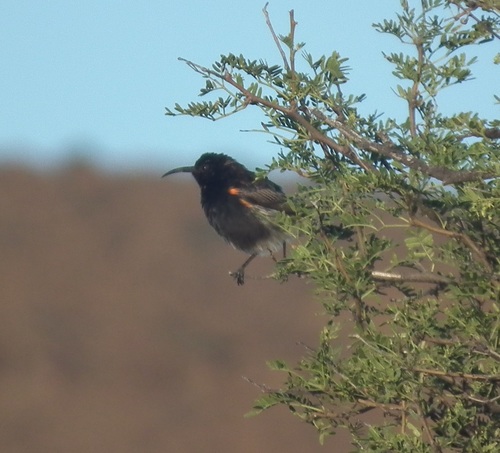
Dusky Sunbird (Cinnyris fuscus) Dusky Sunbird
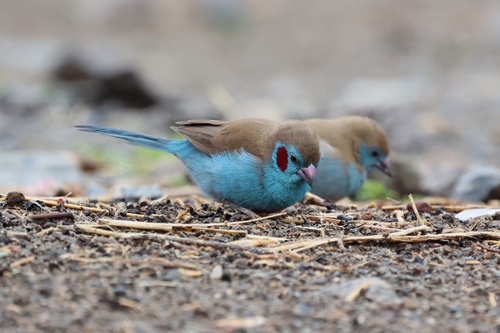
Red-cheeked Cordonbleu (Uraeginthus bengalus) Red-cheeked Cordonbleu

Media

Loading…

In short

The Dusky Sunbird and Red-cheeked Cordonbleu are distinct in both appearance and behavior. The Dusky Sunbird is a nectar-feeding bird with a slender, curved bill, while the Red-cheeked Cordonbleu is a small finch with a stout bill and striking red cheek patch. Observing bill shape and plumage differences will help distinguish these species in the field.

Identification tips

  1. Bill shape: Look for the slender, curved bill of the Dusky Sunbird versus the stout bill of the Red-cheeked Cordonbleu. 2. Plumage: Note the metallic sheen in male Dusky Sunbirds and the red cheek patch in male Red-cheeked Cordonbleus. 3. Behavior: Observe feeding habits, with sunbirds at flowers and cordonbleus on the ground. 4. Habitat: Consider the environment; sunbirds in arid areas, cordonbleus in savannas.

Size

The Dusky Sunbird is slightly larger and more slender than the compact Red-cheeked Cordonbleu.

Plumage

The Dusky Sunbird has a more uniform, dusky brown plumage with a metallic sheen in males, while the Red-cheeked Cordonbleu features a distinctive red cheek patch and blue underparts in males, with females being duller.

Behaviour

Dusky Sunbirds are often seen hovering at flowers to feed on nectar, whereas Red-cheeked Cordonbleus are more likely to be found foraging on the ground for seeds.

Habitat

Dusky Sunbirds are typically found in arid and semi-arid regions, often near flowering shrubs, while Red-cheeked Cordonbleus prefer savannas and open woodlands.

Voice

The Dusky Sunbird has a varied song with melodious notes, while the Red-cheeked Cordonbleu produces a soft, high-pitched call. Vocalizations are distinct but may require experience to differentiate.

Submit a better description

Use the same sections as the comparison. Your text is published immediately.

The Dusky Sunbird and Red-cheeked Cordonbleu are distinct in both appearance and behavior. The Dusky Sunbird is a nectar-feeding bird with a slender, curved bill, while the Red-cheeked Cordonbleu is a small finch with a stout bill and striking red cheek patch. Observing bill shape and plumage differences will help distinguish these species in the field.

  1. Bill shape: Look for the slender, curved bill of the Dusky Sunbird versus the stout bill of the Red-cheeked Cordonbleu. 2. Plumage: Note the metallic sheen in male Dusky Sunbirds and the red cheek patch in male Red-cheeked Cordonbleus. 3. Behavior: Observe feeding habits, with sunbirds at flowers and cordonbleus on the ground. 4. Habitat: Consider the environment; sunbirds in arid areas, cordonbleus in savannas.

The Dusky Sunbird is slightly larger and more slender than the compact Red-cheeked Cordonbleu.

The Dusky Sunbird has a more uniform, dusky brown plumage with a metallic sheen in males, while the Red-cheeked Cordonbleu features a distinctive red cheek patch and blue underparts in males, with females being duller.

Dusky Sunbirds are often seen hovering at flowers to feed on nectar, whereas Red-cheeked Cordonbleus are more likely to be found foraging on the ground for seeds.

Dusky Sunbirds are typically found in arid and semi-arid regions, often near flowering shrubs, while Red-cheeked Cordonbleus prefer savannas and open woodlands.

The Dusky Sunbird has a varied song with melodious notes, while the Red-cheeked Cordonbleu produces a soft, high-pitched call. Vocalizations are distinct but may require experience to differentiate.

Discard your changes?

You have unsaved edits. If you leave now, those changes will be lost.

Dusky Sunbird · Red-cheeked Cordonbleu · My Tricky Birds