
Dusky Warbler vs Willow Warbler
Phylloscopus fuscatus versus Phylloscopus trochilus
Play a quiz with Dusky Warbler and Willow Warbler
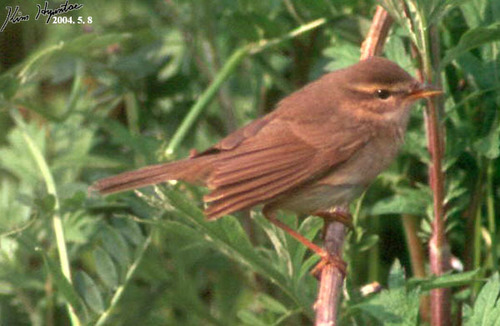 Dusky Warbler
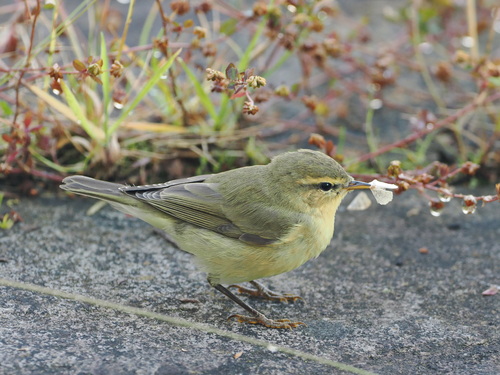 Willow Warbler
In short
The most reliable field mark between Dusky Warbler and Willow Warbler is overall color tone: Dusky Warbler is a plain, rather dark brown bird with buff underparts and a strong whitish supercilium, while Willow Warbler is paler, more greenish or yellowish above and below, especially in juveniles. Willow Warbler also has a longer, paler bill and a more elegant, slender shape with longer primary projection. Both species lack wingbars, but Willow Warbler often appears brighter and more yellowish, especially in fresh plumage. In the field, Dusky Warbler looks dingier and more compact, while Willow Warbler is more graceful and often shows yellow tones on the underparts.
Identification tips
- Overall color tone: Dusky Warbler is plain brown above and buff below, while Willow Warbler is greenish-brown above and off-white to yellowish below. This is the most consistent field mark in all ages and seasons.
- Supercilium: Dusky Warbler shows a strong, prominent whitish supercilium (eyebrow), often more obvious than in Willow Warbler, which has a less striking supercilium.
- Yellow tones: Willow Warbler, especially juveniles, show yellowish or greenish tones on the underparts and sometimes on the face, which Dusky Warbler never shows. If you see clear yellow, it's Willow Warbler.
- Bill: Willow Warbler has a longer, paler bill, while Dusky Warbler's bill is fine, pointed, and generally darker. Bill color and length are best judged in good light and close views.
- Primary projection: Willow Warbler has a noticeably longer primary projection (the wingtips extend further beyond the tertials when perched), giving it a more elegant, elongated look compared to the compact Dusky Warbler. This is most useful on perched birds.
- Leg color: While not detailed for Dusky Warbler here, Willow Warbler's legs are paler pinkish-yellow (not blackish as in chiffchaff), but this is not a strong separator from Dusky Warbler.
- Wingbars: Both species lack wingbars; do not use this as a separator.
- Juvenile plumage: Willow Warbler juveniles are distinctly yellower below than adults or any Dusky Warbler. Dusky Warbler juveniles may be slightly more olive above, but never yellow below.
- Behavior: Willow Warbler is more likely to be seen actively foraging in open woodland or scrub, while Dusky Warbler is more skulking and prefers dense cover.
- Habitat: In Western Europe, Willow Warbler is common in open woodlands and scrub, while Dusky Warbler is a rare migrant or vagrant, usually in dense, damp thickets.
- Voice: Willow Warbler's song is a simple, descending whistle, and its call is a disyllabic 'hoo-eet'. Dusky Warbler's call (not described here) is a sharp 'tack', very different from Willow Warbler's vocalizations. If you hear the song, identification is straightforward.
- Season: Willow Warbler is present in Europe mainly in spring and summer (breeding), while Dusky Warbler is only likely in autumn or winter as a rare migrant or vagrant.
- Structure: Willow Warbler appears more slender and elongated, especially in flight or when perched with wings closed, due to its longer primary projection. Dusky Warbler is more compact and less elegant.
- Sex differences: Both species are sexually monomorphic; sex is not a useful field mark.
- Pitfalls: Do not confuse Willow Warbler's yellowish tones with Dusky Warbler; if the bird is plain brown and buff with a strong supercilium and no yellow, it's Dusky Warbler.
Size
Both species are similar in size and shape to chiffchaffs and to each other, with Willow Warbler typically 11–12.5 cm long and weighing 7–15 g [wikipedia]. Dusky Warbler is described as similar in size and shape to a chiffchaff, so any size difference is negligible in the field. Structure is more useful than size: Willow Warbler has a longer primary projection (wingtip) and a slightly more elongated, elegant look, while Dusky Warbler is more compact.
Plumage
- Juvenile/First-year birds: Willow Warbler juveniles are noticeably yellower below than adults, often with a greenish-brown upper side and off-white to yellowish underparts. Dusky Warbler juveniles are more olive-tinged above than adults, but still lack any strong yellow tones and remain overall brown and buff.
- Adults: Dusky Warbler adults are plain brown above and buff below, with a prominent whitish supercilium and no streaking or wingbars. Willow Warbler adults are greenish-brown above and off-white to yellowish below, with no wingbars but a generally brighter, fresher look. Both species lack wingbars and have plain wings, but Willow Warbler is usually brighter and more colorful, especially in spring and summer.
- Aging in the field: The yellowish or greenish tones of Willow Warbler (especially in juveniles) are a key contrast to the duller, browner Dusky Warbler of any age.
Behaviour
Willow Warbler is typically more active and agile, often seen flitting through open woodland foliage and sometimes hovering or sallying after insects. Dusky Warbler tends to be more skulking, keeping low in dense undergrowth or shrubs, and is less likely to be seen in open situations. In flight, Willow Warbler may appear more elongated due to its longer wings, while Dusky Warbler looks more compact.
Habitat
Willow Warbler is a widespread breeder in open woodlands, especially with birch, alder, and willow, and is common throughout northern and temperate Europe and the Palearctic. Dusky Warbler breeds in the east Palearctic and is typically found in dense, shrubby habitats, often near water or in thick undergrowth. In Western Europe, Dusky Warbler is a rare migrant or vagrant, usually found in dense cover during migration or winter, while Willow Warbler is common and widespread in suitable woodland and scrub.
Voice
Willow Warbler has a distinctive, simple, repetitive descending whistle for its song, and a disyllabic 'hoo-eet' contact call. Dusky Warbler's vocalizations are not described in the provided notes, but are not likely to be confused with Willow Warbler's song. Voice is a strong separator if heard: Willow Warbler's song is unique among leaf warblers, while Dusky Warbler's call is a sharp 'tack' (not described here), very different from Willow Warbler's calls.