
Eastern Cattle-Egret vs Great White Egret
Ardea coromanda versus Ardea alba
Play a quiz with Eastern Cattle-Egret and Great White Egret
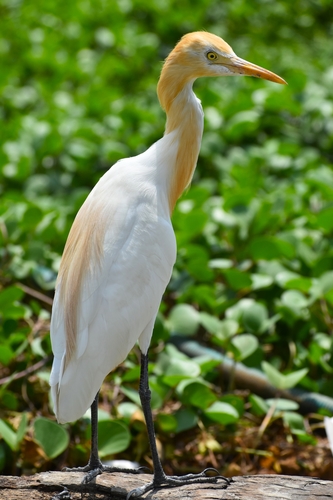 Eastern Cattle-Egret
 Great White Egret
In short
The most reliable way to separate Eastern Cattle-Egret from Great White Egret in the field is by size and structure: Great White Egret is much larger, with a long neck and legs, while Eastern Cattle-Egret is compact, short-necked, and often appears hunched. In breeding season, Eastern Cattle-Egret shows golden-orange plumes on the head, throat, and back, while Great White Egret remains all white with delicate lacy plumes only on the back. Bill and leg color also help: Great White Egret has a yellow bill and black legs, while Eastern Cattle-Egret has a yellow bill and greyish-yellow legs. Habitat and behavior can reinforce the ID, as Eastern Cattle-Egret is usually found foraging on land near cattle, while Great White Egret prefers wetlands and is rarely seen associating with livestock.
Identification tips
- Size and Structure: Great White Egret is much larger and taller, with a long neck and legs; Eastern Cattle-Egret is compact, short-necked, and stocky. This is the most reliable field mark at any age or season.
- Neck Length and Posture: Great White Egret typically stands and walks with its neck fully extended, looking elegant and elongated. Eastern Cattle-Egret often appears hunched with a short, thick neck, especially when perched or foraging.
- Leg Color: Great White Egret has black legs and feet (sometimes legs may appear slightly lighter in breeding season), while Eastern Cattle-Egret has greyish-yellow legs. This is visible in both perched and walking birds.
- Bill Color and Shape: Both species have yellow bills in nonbreeding season, but Great White Egret's bill is longer and more slender, matching its overall proportions. Eastern Cattle-Egret's bill is shorter and stouter.
- Breeding Plumage: In breeding season, Eastern Cattle-Egret shows golden-orange plumes on the head, throat, and back, with the buff color extending to the cheeks and throat. Great White Egret remains all white but grows long, lacy plumes on the back only.
- Flight Silhouette: In flight, Great White Egret shows a long neck (retracted), long legs trailing well beyond the tail, and a large, broad wingspan. Eastern Cattle-Egret is much smaller, with shorter neck and legs, and a more compact, rounded appearance.
- Association with Livestock: Eastern Cattle-Egret is almost always found near cattle or other large mammals, often in dry fields. Great White Egret is rarely, if ever, seen following livestock.
- Habitat: Great White Egret is tied to wetlands and is typically seen wading in water. Eastern Cattle-Egret prefers open fields, grasslands, and agricultural areas, often far from water.
- Behavior: Eastern Cattle-Egret forages by walking among grazing animals, picking insects from the ground. Great White Egret stalks prey in shallow water, moving slowly and deliberately.
- Perched Posture: When perched, Great White Egret is upright and elongated; Eastern Cattle-Egret is more hunched and squat.
- Juvenile/Nonbreeding Plumage: Both species are all white in these plumages; rely on size, structure, and habitat for separation.
- Voice: Not usually helpful, as both are quiet away from colonies, but Great White Egret's croaks are louder and deeper than the cattle egret's soft 'rick-rack.'
- Seasonal Context: Breeding plumage differences are only visible during the nesting season; outside this period, rely on structure and behavior.
- Pitfalls: Do not rely on bill color alone, as both can show yellow bills. Leg color and overall size are more reliable.
- When in Doubt: If you see a white egret in a field with cattle, it's almost certainly Eastern Cattle-Egret; if it's in a wetland, especially if large and elegant, it's likely Great White Egret.
Size
Great White Egret is substantially larger: it stands up to 1 meter tall, with a length of 80–104 cm and a wingspan of 131–170 cm, and weighs 700–1,500 g [wikipedia]. Eastern Cattle-Egret is much smaller and stockier, measuring 46–56 cm in length, with a wingspan of 88–96 cm, and weighs 270–512 g [wikipedia]. In direct comparison, Great White Egret is nearly twice as heavy and much taller, with a proportionally longer neck and legs.
Plumage
Juvenile and nonbreeding plumages are all-white in both species, so size and structure are critical for separation at these ages. There are no distinctive juvenile upperwing patterns described for either species, so flight views rely on overall shape and size. In breeding season, Eastern Cattle-Egret develops golden-orange plumes on the head, throat, and lower back, with the buff color extending to the cheeks and throat—this is diagnostic and not shown by Great White Egret. Great White Egret in breeding plumage remains all white but grows long, delicate ornamental plumes (aigrettes) on the back. Bill and leg color are also useful: Great White Egret has a yellow bill and black legs/feet (though the bill may darken and the legs lighten slightly in breeding season), while Eastern Cattle-Egret has a yellow bill and greyish-yellow legs. Juveniles of both species resemble nonbreeding adults.
Behaviour
Eastern Cattle-Egret is most often seen foraging on land, closely following cattle or other large mammals to catch insects disturbed by their movement. It tends to walk with a hunched posture and short neck. Great White Egret is more aquatic, typically seen wading in wetlands, lakes, or rivers, and rarely associates with livestock. It walks with its neck extended and appears much more graceful and elongated both when perched and in flight. In flight, Great White Egret retracts its neck, but its large size and long legs trailing behind are distinctive.
Habitat
Eastern Cattle-Egret is found in open country, grasslands, farmland, and near grazing animals, often far from water. It is adapted to terrestrial foraging. Great White Egret is a wetland specialist, found in marshes, lakes, rivers, and coastal habitats. While their ranges can overlap, their preferred microhabitats are usually quite different: Cattle-Egret is rarely seen in deep water, and Great White Egret is rarely seen in dry fields with livestock.
Voice
Both species are generally quiet away from breeding colonies. Eastern Cattle-Egret gives a quiet, throaty 'rick-rack' call at colonies, but is otherwise silent. Great White Egret is also not very vocal, but at breeding sites can give a low, hoarse croak or a loud 'cuk cuk cuk' and higher-pitched squawks. In the field, vocalizations are rarely helpful for separation.