Birdr

Eastern Rosella vs Budgerigar

Platycercus eximius versus Melopsittacus undulatus

Play a quiz with Eastern Rosella and Budgerigar
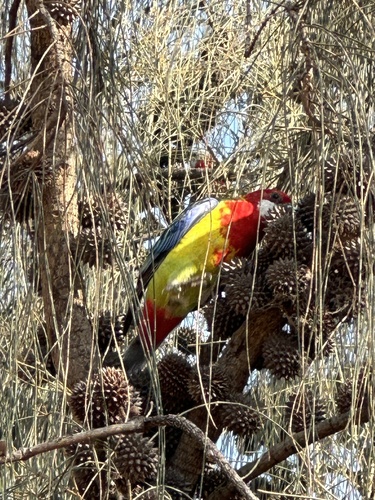
Eastern Rosella (Platycercus eximius) Eastern Rosella
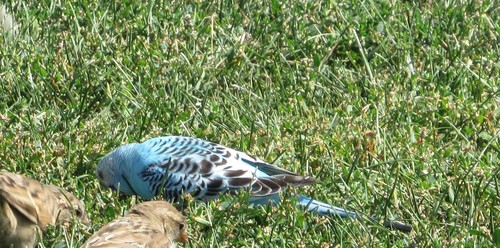
Budgerigar (Melopsittacus undulatus) Budgerigar

Media

Loading…

In short

The Eastern Rosella and Budgerigar are both colorful parrots, but they differ significantly in size and plumage patterns. Eastern Rosellas are larger with a distinctive red head and multi-colored body, while Budgerigars are smaller with a primarily green body and characteristic black barring on the back.

Identification tips

1. Size: Eastern Rosellas are larger than Budgerigars. 2. Head Color: Look for the red head of the Eastern Rosella versus the green and yellow face of the Budgerigar. 3. Plumage Patterns: Note the multi-colored body of the Eastern Rosella compared to the green body with black barring of the Budgerigar. 4. Habitat: Consider the habitat; Eastern Rosellas prefer woodlands, Budgerigars are found in drier areas.

Size

Eastern Rosellas are noticeably larger than Budgerigars, with a length of about 30 cm compared to the Budgerigar's 18 cm.

Plumage

Eastern Rosellas have a striking red head, white cheeks, and a vibrant mix of yellow, blue, and green on their body. Budgerigars are primarily green with black barring on the back and wings, and a yellow face in the wild form.

Behaviour

Both species are social, but Eastern Rosellas are often seen in pairs or small groups, while Budgerigars can form large flocks, especially in the wild.

Habitat

Eastern Rosellas are typically found in open woodlands, gardens, and parks, whereas Budgerigars inhabit arid and semi-arid regions, often near water sources.

Voice

Eastern Rosellas have a varied repertoire of whistles and chattering calls, while Budgerigars produce a softer, more continuous chattering sound.

Submit a better description

Use the same sections as the comparison. Your text is published immediately.

The Eastern Rosella and Budgerigar are both colorful parrots, but they differ significantly in size and plumage patterns. Eastern Rosellas are larger with a distinctive red head and multi-colored body, while Budgerigars are smaller with a primarily green body and characteristic black barring on the back.

1. Size: Eastern Rosellas are larger than Budgerigars. 2. Head Color: Look for the red head of the Eastern Rosella versus the green and yellow face of the Budgerigar. 3. Plumage Patterns: Note the multi-colored body of the Eastern Rosella compared to the green body with black barring of the Budgerigar. 4. Habitat: Consider the habitat; Eastern Rosellas prefer woodlands, Budgerigars are found in drier areas.

Eastern Rosellas are noticeably larger than Budgerigars, with a length of about 30 cm compared to the Budgerigar's 18 cm.

Eastern Rosellas have a striking red head, white cheeks, and a vibrant mix of yellow, blue, and green on their body. Budgerigars are primarily green with black barring on the back and wings, and a yellow face in the wild form.

Both species are social, but Eastern Rosellas are often seen in pairs or small groups, while Budgerigars can form large flocks, especially in the wild.

Eastern Rosellas are typically found in open woodlands, gardens, and parks, whereas Budgerigars inhabit arid and semi-arid regions, often near water sources.

Eastern Rosellas have a varied repertoire of whistles and chattering calls, while Budgerigars produce a softer, more continuous chattering sound.

Discard your changes?

You have unsaved edits. If you leave now, those changes will be lost.

Eastern Rosella · Budgerigar · My Tricky Birds