Birdr

Eastern Wood-Pewee vs Acadian Flycatcher

Contopus virens versus Empidonax virescens

Play a quiz with Eastern Wood-Pewee and Acadian Flycatcher
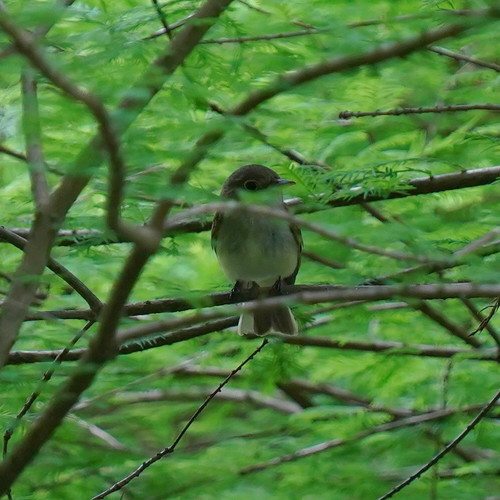
Eastern Wood-Pewee (Contopus virens) Eastern Wood-Pewee
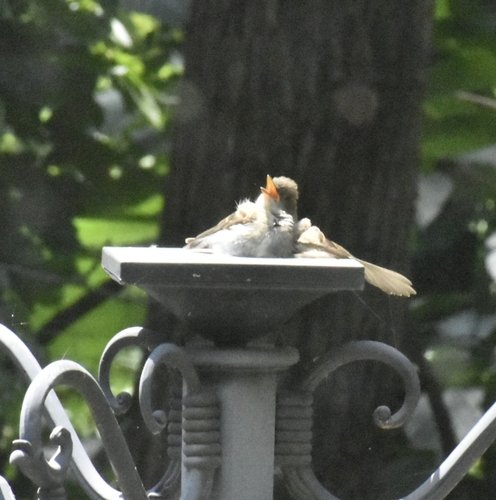
Acadian Flycatcher (Empidonax virescens) Acadian Flycatcher

Media

Loading…

In short

The Eastern Wood-Pewee and Acadian Flycatcher can be challenging to distinguish, but key differences in structure and vocalizations aid identification. The Eastern Wood-Pewee has a longer primary projection and lacks the distinctive eye-ring of the Acadian Flycatcher. Their songs are also notably different, with the Eastern Wood-Pewee having a more plaintive, slurred whistle compared to the explosive song of the Acadian Flycatcher.

Identification tips

Size

Both species are similar in size, but the Acadian Flycatcher has a slightly larger bill and longer primaries.

Plumage

The Eastern Wood-Pewee is generally more uniform in color with a less distinct eye-ring, while the Acadian Flycatcher often shows a more pronounced eye-ring and slightly greener upperparts.

Behaviour

Both species are active flycatchers, often seen sallying from perches to catch insects. The Acadian Flycatcher might be more associated with dense, shady areas.

Habitat

The Eastern Wood-Pewee is found in a variety of wooded habitats, including urban forests and open woodlands. In contrast, the Acadian Flycatcher prefers mature deciduous forests and is often found near water.

Voice

The Eastern Wood-Pewee's song is a plaintive, slurred whistle, often described as "pee-a-wee," while the Acadian Flycatcher's song is more explosive and abrupt, often rendered as "peet-sa."

Submit a better description

Use the same sections as the comparison. Your text is published immediately.

The Eastern Wood-Pewee and Acadian Flycatcher can be challenging to distinguish, but key differences in structure and vocalizations aid identification. The Eastern Wood-Pewee has a longer primary projection and lacks the distinctive eye-ring of the Acadian Flycatcher. Their songs are also notably different, with the Eastern Wood-Pewee having a more plaintive, slurred whistle compared to the explosive song of the Acadian Flycatcher.

  • Check for eye-ring: Acadian Flycatcher has a more distinct eye-ring.
  • Primary projection: Eastern Wood-Pewee has longer primary projection.
  • Vocalizations: Listen for the plaintive whistle of the Eastern Wood-Pewee versus the explosive call of the Acadian Flycatcher.
  • Habitat preference: Note if the bird is near water or in dense forest (Acadian) versus more open wooded areas (Eastern Wood-Pewee).

Both species are similar in size, but the Acadian Flycatcher has a slightly larger bill and longer primaries.

The Eastern Wood-Pewee is generally more uniform in color with a less distinct eye-ring, while the Acadian Flycatcher often shows a more pronounced eye-ring and slightly greener upperparts.

Both species are active flycatchers, often seen sallying from perches to catch insects. The Acadian Flycatcher might be more associated with dense, shady areas.

The Eastern Wood-Pewee is found in a variety of wooded habitats, including urban forests and open woodlands. In contrast, the Acadian Flycatcher prefers mature deciduous forests and is often found near water.

The Eastern Wood-Pewee's song is a plaintive, slurred whistle, often described as "pee-a-wee," while the Acadian Flycatcher's song is more explosive and abrupt, often rendered as "peet-sa."

Discard your changes?

You have unsaved edits. If you leave now, those changes will be lost.

Eastern Wood-Pewee · Acadian Flycatcher · My Tricky Birds