
Birdr

Ecuadorian Tyrannulet vs Bronze-olive Pygmy-Tyrant

Phylloscartes gualaquizae versus Pseudotriccus pelzelni

Play a quiz with Ecuadorian Tyrannulet and Bronze-olive Pygmy-Tyrant
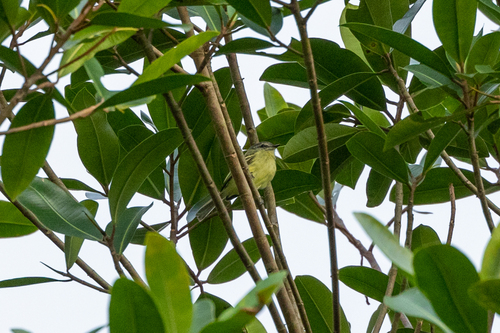
Ecuadorian Tyrannulet (Phylloscartes gualaquizae) Ecuadorian Tyrannulet
Bronze-olive Pygmy-Tyrant (Pseudotriccus pelzelni) Bronze-olive Pygmy-Tyrant

Media

Loading…

In short

The Ecuadorian Tyrannulet and the Bronze-olive Pygmy-Tyrant can be distinguished by their structure and behavior. The Ecuadorian Tyrannulet has a more slender build with a longer tail, while the Bronze-olive Pygmy-Tyrant is more compact with a shorter tail. The latter is often detected by the whirring sound of its wings during foraging.

Identification tips

  1. Look for the slender build and longer tail of the Ecuadorian Tyrannulet. 2. Note the hovering behavior and wing whirring sound of the Bronze-olive Pygmy-Tyrant. 3. Pay attention to habitat preference: dense undergrowth suggests the Pygmy-Tyrant. 4. Observe plumage contrast: rufous lore in the Tyrannulet versus uniform bronze-olive in the Pygmy-Tyrant.

Size

The Ecuadorian Tyrannulet is generally more slender with a longer tail compared to the more compact Bronze-olive Pygmy-Tyrant.

Plumage

Both species have olive tones, but the Ecuadorian Tyrannulet may show more contrast with its rufous lore. The Bronze-olive Pygmy-Tyrant has a more uniform bronze-olive coloration.

Behaviour

The Bronze-olive Pygmy-Tyrant often hovers while foraging, producing a distinctive wing whirring sound. The Ecuadorian Tyrannulet is less likely to hover and more often seen actively moving through foliage.

Habitat

Both species inhabit forested areas, but the Bronze-olive Pygmy-Tyrant is more often found in dense undergrowth, while the Ecuadorian Tyrannulet may be seen at various forest levels.

Voice

Specific vocal differences are not detailed, but the Bronze-olive Pygmy-Tyrant's wing whirring sound is a notable auditory cue.

Submit a better description

Use the same sections as the comparison. Your text is published immediately.

The Ecuadorian Tyrannulet and the Bronze-olive Pygmy-Tyrant can be distinguished by their structure and behavior. The Ecuadorian Tyrannulet has a more slender build with a longer tail, while the Bronze-olive Pygmy-Tyrant is more compact with a shorter tail. The latter is often detected by the whirring sound of its wings during foraging.

  1. Look for the slender build and longer tail of the Ecuadorian Tyrannulet. 2. Note the hovering behavior and wing whirring sound of the Bronze-olive Pygmy-Tyrant. 3. Pay attention to habitat preference: dense undergrowth suggests the Pygmy-Tyrant. 4. Observe plumage contrast: rufous lore in the Tyrannulet versus uniform bronze-olive in the Pygmy-Tyrant.

The Ecuadorian Tyrannulet is generally more slender with a longer tail compared to the more compact Bronze-olive Pygmy-Tyrant.

Both species have olive tones, but the Ecuadorian Tyrannulet may show more contrast with its rufous lore. The Bronze-olive Pygmy-Tyrant has a more uniform bronze-olive coloration.

The Bronze-olive Pygmy-Tyrant often hovers while foraging, producing a distinctive wing whirring sound. The Ecuadorian Tyrannulet is less likely to hover and more often seen actively moving through foliage.

Both species inhabit forested areas, but the Bronze-olive Pygmy-Tyrant is more often found in dense undergrowth, while the Ecuadorian Tyrannulet may be seen at various forest levels.

Specific vocal differences are not detailed, but the Bronze-olive Pygmy-Tyrant's wing whirring sound is a notable auditory cue.

Discard your changes?

You have unsaved edits. If you leave now, those changes will be lost.

Ecuadorian Tyrannulet · Bronze-olive Pygmy-Tyrant · My Tricky Birds