Egyptian Vulture vs Griffon Vulture
Neophron percnopterus versus Gyps fulvus
Play a quiz with Egyptian Vulture and Griffon Vulture
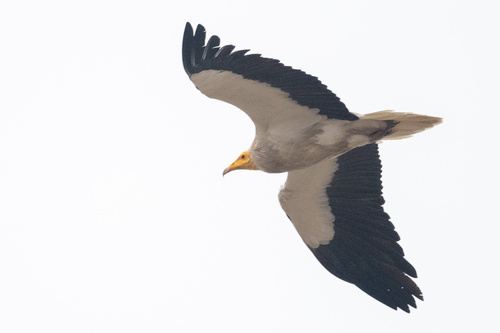
Egyptian Vulture
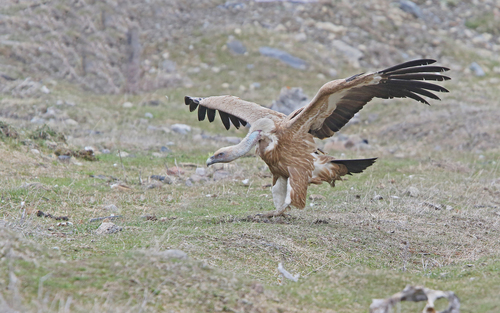
Griffon Vulture
In short
The Egyptian Vulture is smaller and more slender than the Griffon Vulture, with a distinctive yellow face and contrasting black and white plumage. The Griffon Vulture is much larger, with a pale head and neck, and uniform brownish plumage with dark flight feathers.
Identification tips
1. Size and Shape: The Egyptian Vulture is smaller and more slender, with a wedge-shaped tail. The Griffon Vulture is bulkier with a short tail. 2. Face and Head: Look for the Egyptian Vulture's yellow face and contrasting black and white plumage. The Griffon Vulture has a pale head and neck with a brown body. 3. Behavior: If observed using tools, it's likely an Egyptian Vulture. 4. Habitat: Consider the habitat; Egyptian Vultures are more common in arid regions and near human settlements.
Size
The Egyptian Vulture is significantly smaller, with a wingspan of about 180 cm, compared to the Griffon Vulture's 232.6–275.6 cm wingspan.
Plumage
The Egyptian Vulture has a striking yellow face and mostly white body with black flight feathers. In contrast, the Griffon Vulture has a pale head and neck, brown body and wing coverts, and blackish flight feathers.
Behaviour
Both species are scavengers, but the Egyptian Vulture is known for using tools to break open eggs, a behavior not observed in the Griffon Vulture.
Habitat
Both species inhabit open areas, but the Egyptian Vulture is more often found in arid regions and can be seen near human settlements, while the Griffon Vulture prefers mountainous and hilly areas.
Voice
Vocalizations are not a reliable field mark as both species are generally silent, but the Egyptian Vulture may emit a high-pitched whistle.