Birdr

Emerald-spotted Wood-Dove vs Tambourine Dove

Turtur chalcospilos versus Turtur tympanistria

Play a quiz with Emerald-spotted Wood-Dove and Tambourine Dove
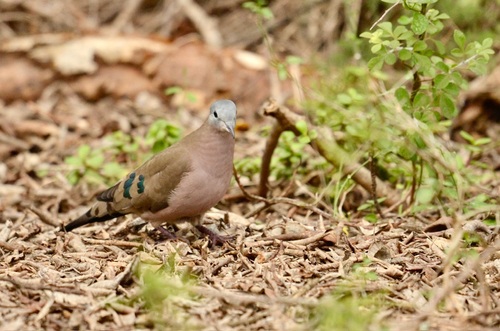
Emerald-spotted Wood-Dove (Turtur chalcospilos) Emerald-spotted Wood-Dove
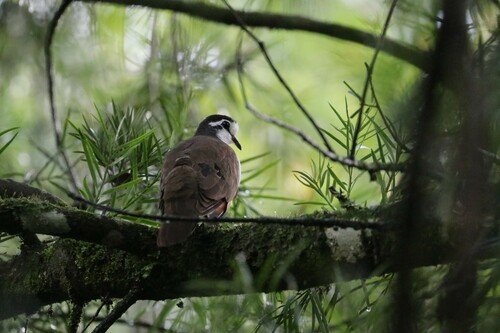
Tambourine Dove (Turtur tympanistria) Tambourine Dove

Media

Loading…

In short

The Emerald-spotted Wood-Dove and Tambourine Dove can be distinguished by their wing spots and underpart coloration. The Emerald-spotted Wood-Dove has iridescent green spots on its wings, while the Tambourine Dove lacks these and has whiter underparts, especially in males. Both species are often found alone or in pairs, but their preferred habitats differ slightly.

Identification tips

  1. Look for iridescent green wing spots to identify the Emerald-spotted Wood-Dove. 2. Note the whiter underparts and forehead of male Tambourine Doves. 3. Observe habitat: drier areas suggest Emerald-spotted, while more humid, forested areas suggest Tambourine. 4. Both species are often found alone or in pairs, but Tambourine Doves may be in small groups.

Size

Both species are similar in size, typical of small doves.

Plumage

The Emerald-spotted Wood-Dove features iridescent green spots on its wings and has pale gray underparts with a pinkish hue on the breast. In contrast, the Tambourine Dove does not have wing spots and males have much whiter underparts, forehead, and a postocular supercilium.

Behaviour

Both species are usually seen alone or in pairs. The Tambourine Dove may sometimes be observed in small groups, especially when walking on forest trails.

Habitat

The Emerald-spotted Wood-Dove inhabits moderately wooded, dry-country habitats like bush, scrub, and farmland. The Tambourine Dove is more adaptable, found in farmbush, gardens, and forest trails, often in more humid environments.

Voice

Vocalizations are not well-documented for both species, but the Tambourine Dove is noted to be more frequently heard than seen.

Submit a better description

Use the same sections as the comparison. Your text is published immediately.

The Emerald-spotted Wood-Dove and Tambourine Dove can be distinguished by their wing spots and underpart coloration. The Emerald-spotted Wood-Dove has iridescent green spots on its wings, while the Tambourine Dove lacks these and has whiter underparts, especially in males. Both species are often found alone or in pairs, but their preferred habitats differ slightly.

  1. Look for iridescent green wing spots to identify the Emerald-spotted Wood-Dove. 2. Note the whiter underparts and forehead of male Tambourine Doves. 3. Observe habitat: drier areas suggest Emerald-spotted, while more humid, forested areas suggest Tambourine. 4. Both species are often found alone or in pairs, but Tambourine Doves may be in small groups.

Both species are similar in size, typical of small doves.

The Emerald-spotted Wood-Dove features iridescent green spots on its wings and has pale gray underparts with a pinkish hue on the breast. In contrast, the Tambourine Dove does not have wing spots and males have much whiter underparts, forehead, and a postocular supercilium.

Both species are usually seen alone or in pairs. The Tambourine Dove may sometimes be observed in small groups, especially when walking on forest trails.

The Emerald-spotted Wood-Dove inhabits moderately wooded, dry-country habitats like bush, scrub, and farmland. The Tambourine Dove is more adaptable, found in farmbush, gardens, and forest trails, often in more humid environments.

Vocalizations are not well-documented for both species, but the Tambourine Dove is noted to be more frequently heard than seen.

Discard your changes?

You have unsaved edits. If you leave now, those changes will be lost.

Emerald-spotted Wood-Dove · Tambourine Dove · My Tricky Birds